The Trojan Horse at the Pump: Costco’s Invisible Moat
The Alchemy of Membership
In the grand theater of global commerce, most retailers are engaged in a desperate, daily battle for relevance. They fight for 'share of wallet' through transient discounts and expensive marketing. Costco ($COST), however, plays a different game entirely. As we look at the landscape in June 2026, it is clear that Costco is not a retailer in the traditional sense; it is a membership-based financial utility that happens to sell rotisserie chickens and tires. Its true product is access—a subscription to a price umbrella that competitors simply cannot replicate.
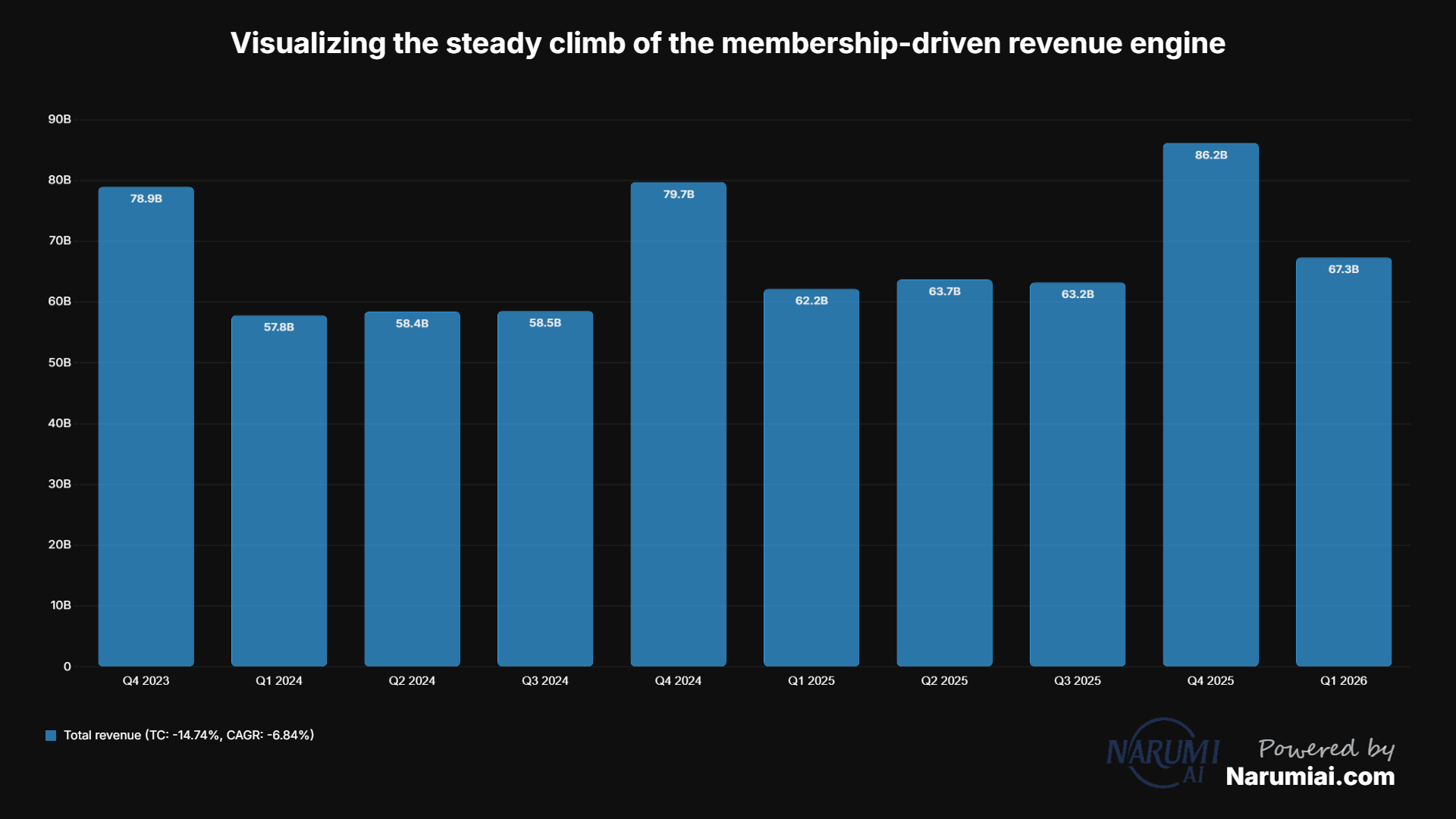
The recent earnings report, showing a surge in Q4 2025 revenue to $86.16 billion, is merely a symptom of a deeper structural advantage. While the broader market remains obsessed with the 'neutral rate' of interest and the debut of SpaceX on the public stage at a $1.8 trillion valuation, Costco has quietly mastered the art of the 'loss leader' at a macro scale. It uses the volatility of the energy market as a customer acquisition funnel, turning its gas stations into high-frequency touchpoints that justify the annual fee before a member even steps foot in the warehouse.
The High-Octane Acquisition Funnel
Fuel has become the ultimate Trojan horse. As energy prices fluctuate and the Treasury market signals that interest rates may need to remain restrictive, consumers are flocking to Costco’s pumps for immediate, tangible relief. This isn't just about selling gas; it's about the 'Executive Membership Flywheel.' Currently, Executive members represent roughly half of the total base but account for a staggering 75% of worldwide sales. By drawing price-sensitive households in through the gas station, Costco incentivizes them to upgrade to the $130 tier to maximize their 2% rewards.
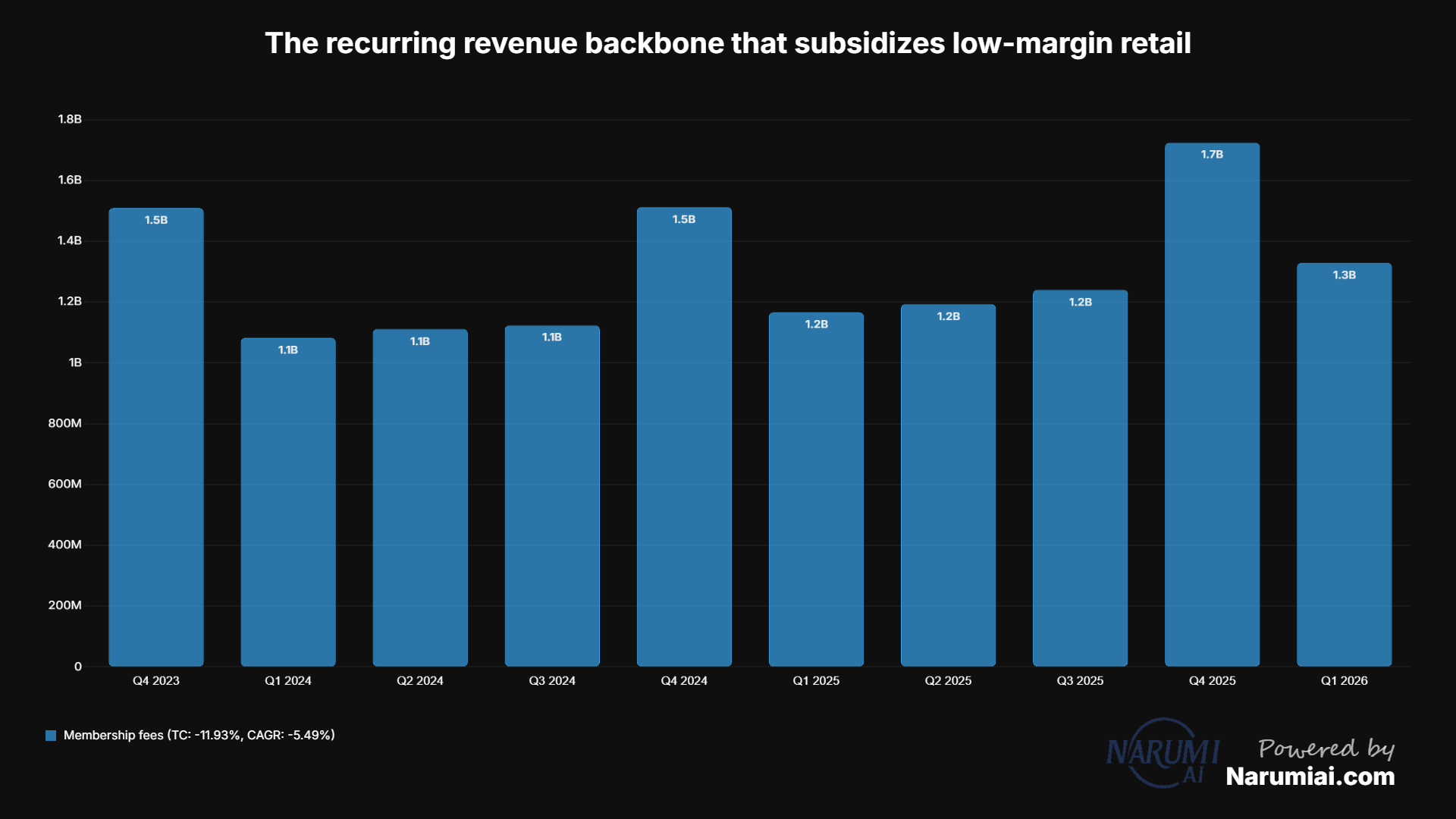
The financial data confirms this resilience. Membership fees climbed to $1.33 billion in Q1 2026, up from $1.08 billion just two years prior. This is pure, high-margin oxygen for the business. It allows Costco to operate with merchandise costs that often exceed 90% of net sales, a ratio that would bankrupt a traditional retailer. By subsidizing its low margins with recurring membership income, Costco creates a moat that is reinforced by every inflationary spike.
Silicon Warehouse: The Digital Pivot
For years, critics labeled Costco a digital laggard. In 2026, that narrative has been dismantled. Digitally enabled sales rose 21.5% in the latest quarter, driven by a mobile app that has moved from a basic inventory checker to an AI-powered discovery platform. Unlike Amazon ($AMZN) or Meta ($META), which are aggressively expanding enterprise AI infrastructure to capture subscription revenue, Costco is using AI to shrink the distance between a member’s intent and their purchase.
This digital evolution is particularly critical as it attracts a younger demographic. Online registration is now the primary entry point for Gen Z and Millennial members. While their renewal rates are slightly lower than the North American average of 92.2%, they represent the 'Next Decade' of the Costco ecosystem. The company is now leveraging this first-party data through retail media partnerships, allowing brands to target a high-income demographic with surgical precision—a high-margin revenue stream that drops directly to the bottom line.
The Neutral Rate and the Resilience of Cash
As Federal Reserve Chairman Kevin Warsh navigates his first meeting amid concerns of an overheating AI-induced economy, Costco’s balance sheet stands as a fortress. With cash and cash equivalents reaching $16.22 billion in Q1 2026, the company is insulated from the credit tightening that plagues its smaller peers. Its operating margin has shown a subtle but significant expansion, moving from ~3.52% in late 2023 to ~3.88% in the most recent blowout quarter.
This capital allocation strategy—reinvesting in price leadership while maintaining a massive cash buffer—ensures that Costco remains the 'Price Umbrella' for the American middle class. Even as SpaceX forces investors to bet on 'entangled AI empires,' the long-term strategic case for Costco remains its grounded, physical monopoly on value. It is a business model that thrives on the very volatility that threatens to disrupt the rest of the retail sector.
The Verdict: A Sovereign Consumer Ecosystem
The next decade will not be won by those who simply sell goods, but by those who own the relationship with the consumer. Costco has effectively created a sovereign ecosystem where loyalty is not requested, but mathematically incentivized. As it expands its retail media footprint and deepens its digital engagement, the warehouse giant is transitioning from a physical destination to a lifestyle utility. For the strategist, the message is clear: the gas pump is the hook, the data is the fuel, and the membership is the moat.
Check out our Interactive Charting Tool.