The Silicon Tax: Google’s High-Stakes Bet on the AI Plumbing
The Hum of the Hyper-Scale Factory
Walk into any of Alphabet's newest data centers and the sound is no longer just the whir of fans; it is the sound of a multi-billion dollar gamble. For years, Google operated as a software company that happened to own servers. Today, it has evolved into a vertically integrated industrial titan, fighting a war of attrition where the primary weapons are not just algorithms, but the raw silicon and power grids required to sustain them. While the market celebrates the soaring revenue, a veteran eye sees a company in the midst of a frantic, expensive pivot to avoid the very disruption it once pioneered.
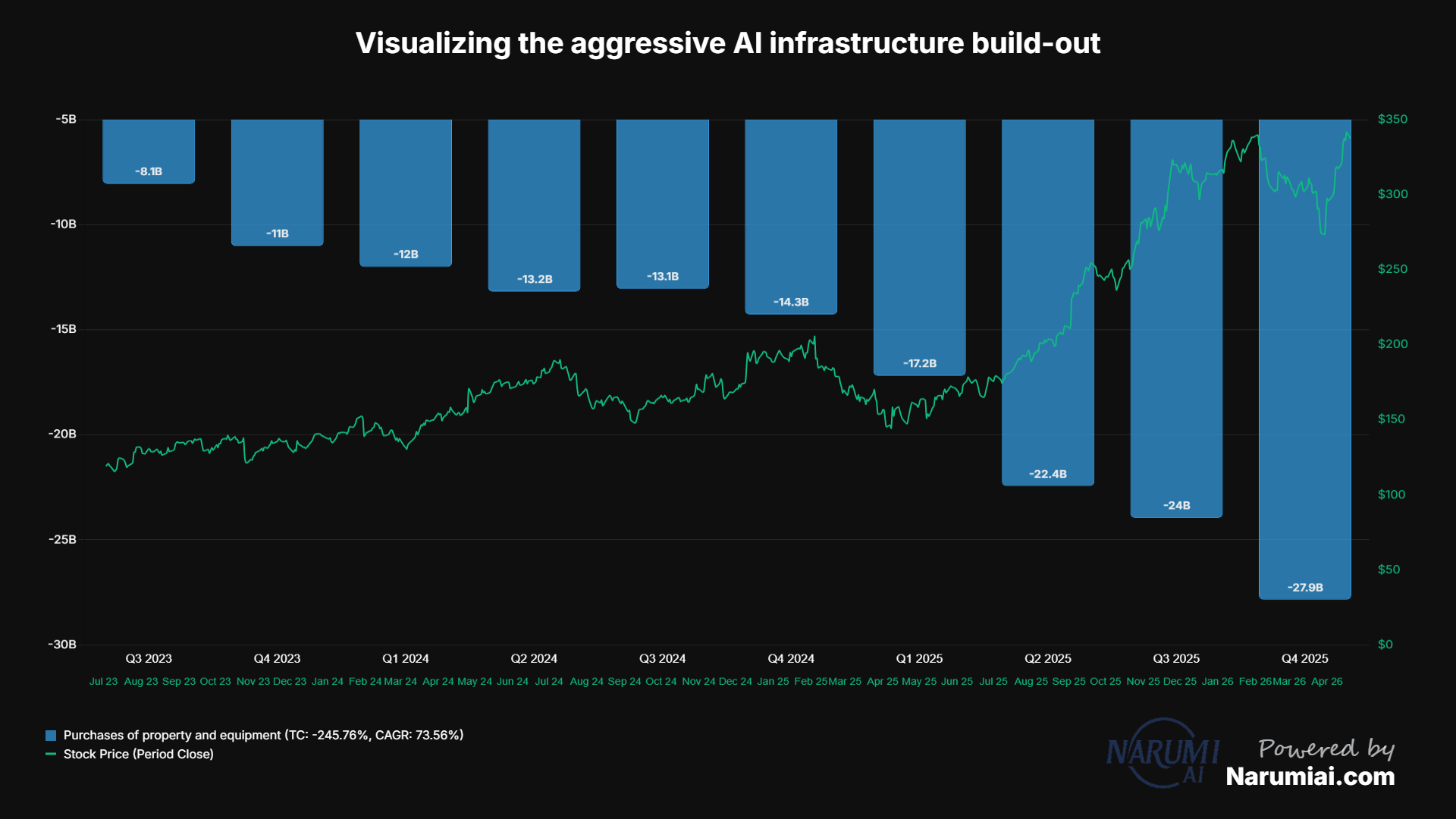
The financial data tells a story of aggressive, almost desperate, expansion. Google's capital expenditures—the money spent on the physical 'bricks and mortar' of the digital age—have exploded. In Q3 2023, the company was spending roughly $8.05 billion per quarter on property and equipment; by Q4 2025, that figure surged to a staggering $27.85 billion. This isn't just growth; it's a hyper-investment phase designed to ensure that Google's Gemini doesn't just think faster, but has the physical capacity to exist at scale.
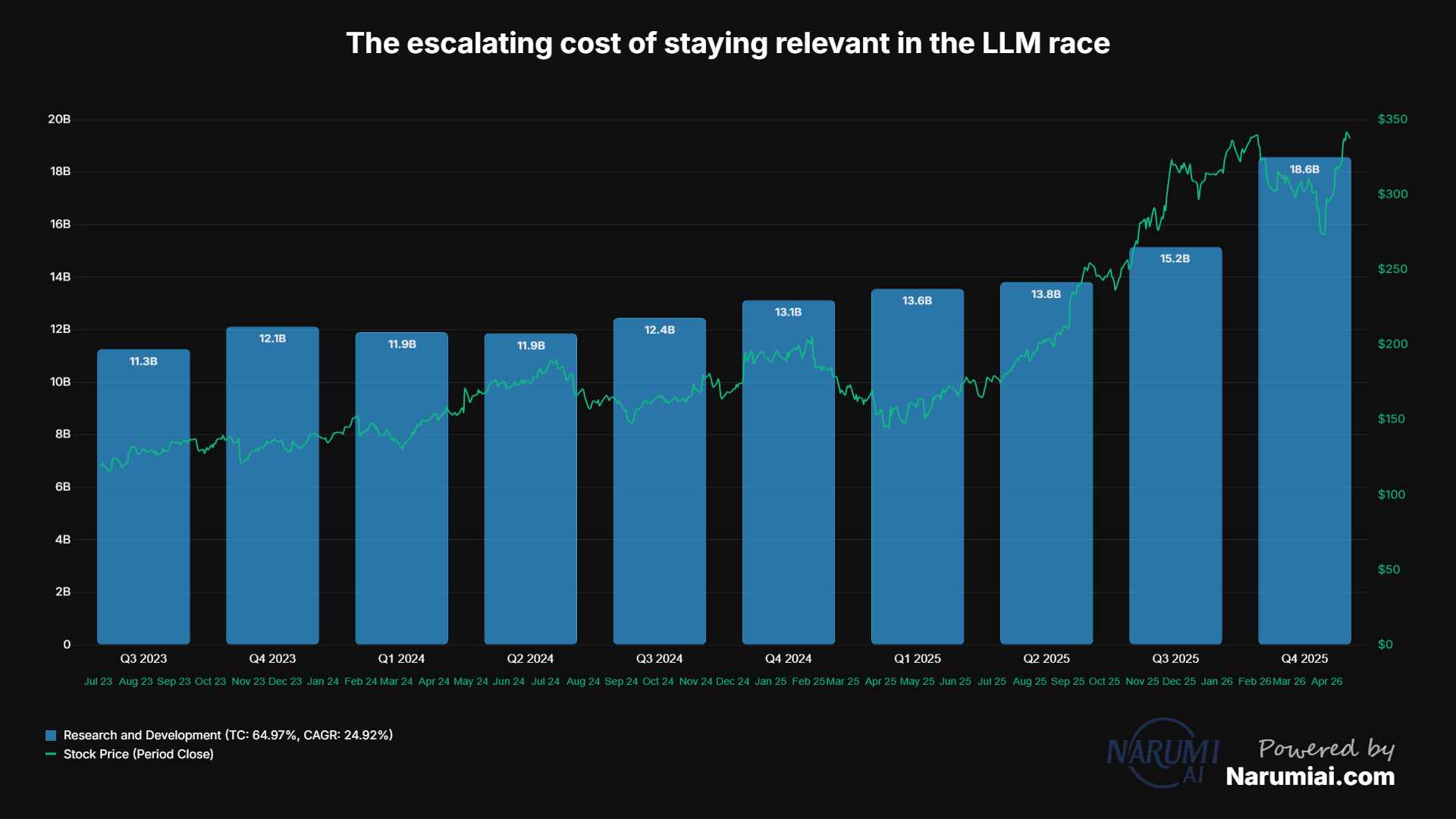
This spending spree is mirrored in the R&D budget, which climbed from $11.26 billion in Q3 2023 to $18.57 billion by the end of 2025. Alphabet is essentially paying a 'silicon tax' to maintain its dominance, pouring capital into a void of specialized chips and energy-hungry clusters.
The Invisible Toll Booth
While Google and Amazon fight for the crown of the 'AI-First' cloud, a quieter player is collecting the tolls on every single transaction. Broadcom ($AVGO) has positioned itself as the indispensable architect of the AI supercycle. As hyperscalers like Google seek to reduce their dependence on NVIDIA's expensive H100s, they turn to Broadcom to co-design custom ASICs (Application-Specific Integrated Circuits). Broadcom doesn't care which LLM wins the popularity contest; they simply own the plumbing that connects the chips.
This strategic positioning is reflected in Broadcom's staggering EBITDA margins, which hover around 68%. While Google's operating margins remain healthy at roughly 31.57%, they are fighting a constant battle against the rising costs of power and cooling—a 'Power Wall' that threatens to cap the growth of even the largest cloud providers.
The AWS Shadow and the Agility Gap
The conflict isn't just between Google and the hardware providers, but between Google and Amazon. AWS remains the volume leader, a profit engine that accounts for over 55% of Amazon's operating profit. However, Google Cloud (GCP) is the aggressor. By leveraging its Tensor Processing Units (TPUs), Google has achieved a growth rate of nearly 50% in early 2026, significantly narrowing the gap in enterprise relevance.
Amazon’s strategy is one of breadth and scale, offering a model-agnostic approach via Bedrock. Google, conversely, is betting on vertical integration. By owning the chip (TPU), the model (Gemini), and the interface (Search/Workspace), Google is attempting to create a closed-loop ecosystem that is impossible to replicate. But this integration comes with a valuation risk. Google's P/E ratio has expanded from 19.19 in late 2022 to 28.93 by Q4 2025, suggesting that investors are pricing in a future of AI-driven monopolies that may never fully materialize due to regulatory headwinds.
The tension here is clear: Amazon is winning on reliability and choice, while Google is winning on raw performance and specialized tooling. Most enterprises are now hedging their bets with a multi-cloud strategy, effectively paying both giants to ensure they aren't locked into a failing architecture.
The Regulatory Ceiling
Just as Google's AI empire reaches critical mass, it is colliding with a global wall of scrutiny. The EU AI Act, becoming fully applicable in August 2026, transforms AI from a wild-west frontier into a highly regulated utility. The risk is no longer just a fine; it is structural. With the DOJ and FTC circling the vertical integration of the AI stack, the possibility of a mandatory divestiture of units like Chrome or Android looms over the stock.
Ultimately, Alphabet is operating in a state of high-functioning anxiety. The revenue is there, and the net income has climbed to $34.46 billion in Q4 2025, but the cost of maintaining that lead is escalating. Google is no longer just fighting for search queries; it is fighting for the very electricity and silicon that power the modern world. In the AI arms race, the winner isn't necessarily the one with the smartest model, but the one who can afford to keep the lights on.
Check out our Interactive Charting Tool.