The Peace Tax: ExxonMobil’s Margin War in a $70 World

The Geneva Squeeze and the End of the Scarcity Premium
For two years, the global energy complex has operated under the comfortable, if grim, umbrella of geopolitical risk. But as rumors of a diplomatic settlement between Washington and Tehran turn into concrete negotiations, that umbrella is folding. The prospect of 1.5 million barrels per day of Iranian crude hitting a market already teetering on oversupply has sent Brent and WTI into a tailspin, with benchmarks sliding toward the $70 mark. For ExxonMobil ($XOM), this isn't just a pricing correction; it is a fundamental stress test of the 'Permian-Guyana' miracle that has defined the Darren Woods era.
The market’s reaction is cold. While broader indices might welcome a lower-inflation framework, the energy sector is feeling the 'Peace Tax.' The conflict is no longer about finding oil; it is about who can survive the margin compression when the scarcity premium evaporates. Exxon, long the gold standard of the supermajors, is suddenly finding its internal efficiency metrics under the microscope as the top-line revenue begins to erode.
The Silent Bleed in the Permian
A deep dive into Exxon’s latest filings reveals a troubling divergence. While the company touts its 'advantaged barrels' in Guyana and the Permian, the actual costs of bringing that oil to market are creeping upward. Between Q3 2023 and Q4 2025, Exxon’s total revenues and other income fell from $90.76 billion to $82.31 billion. This 9.3% decline in the top line is expected in a cooling price environment, but it’s the 'silent bleed' in operating expenses that should keep investors awake.
Production and manufacturing expenses, which stood at $8.69 billion in the third quarter of 2023, have ballooned to $12.15 billion by the end of 2025. This represents a staggering 40% increase in the cost of simply keeping the lights on and the pumps moving. When we calculate the Operating Margin—a key measure of how much profit a company makes on each dollar of sales after paying for variable costs of production—the erosion is stark. In Q3 2023, Exxon boasted an operating margin of approximately 15.1%. By Q4 2025, that margin has compressed to roughly 9.7%.
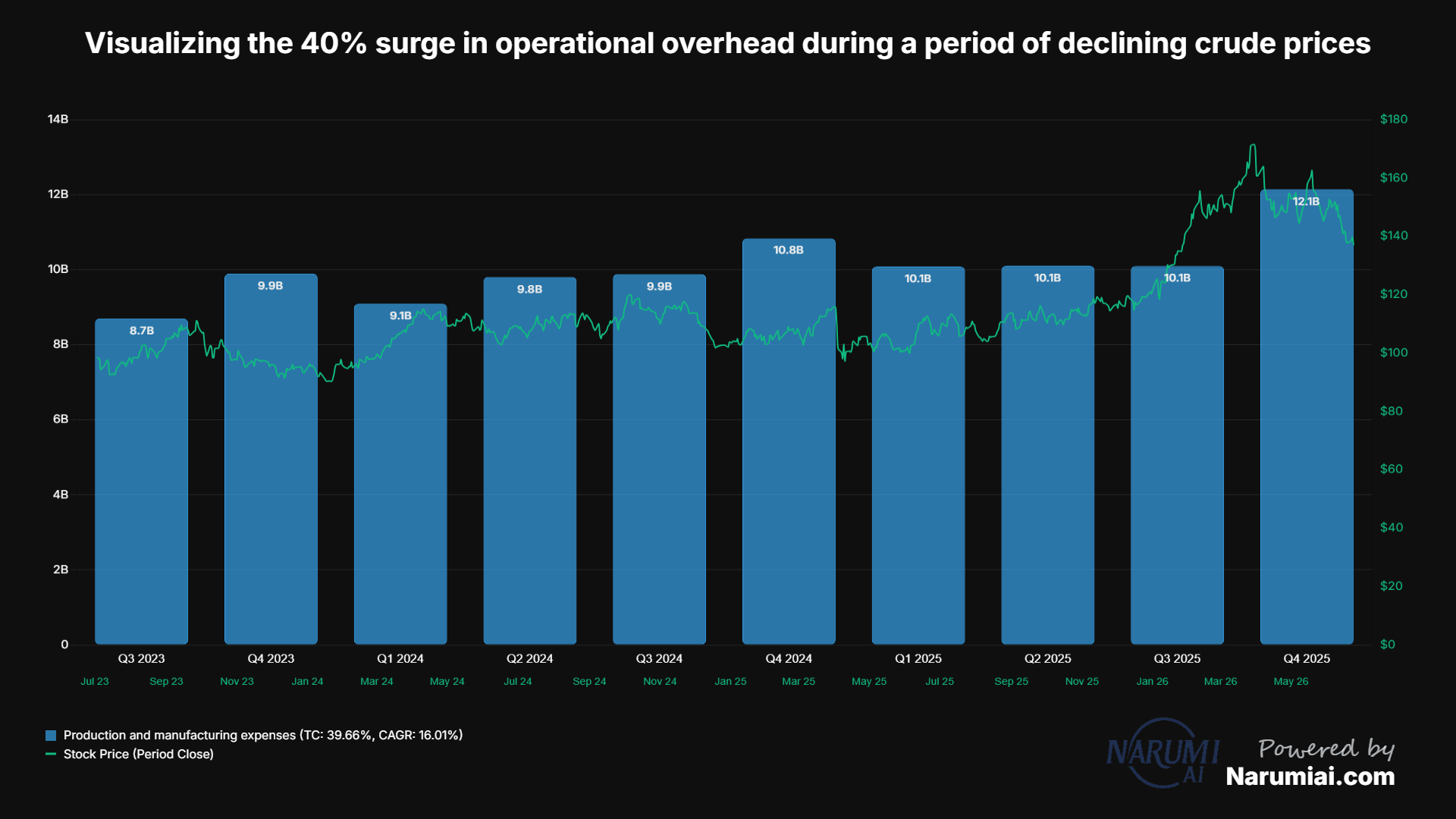
This margin compression suggests that despite the high-grading of assets, the complexity of the global supply chain and inflationary pressures on labor and materials are eating the 'shale buffer.' In contrast, Chevron ($CVX) has used its acquisition of Hess to consolidate its footprint, attempting to shield its margins through sheer proximity and logistical dominance in the Permian, though it too faces a tightening vice as Iranian supply threatens to displace domestic grades.
The Incredible Shrinking Cash Fortress
Perhaps the most cinematic shift in Exxon’s story is the rapid evaporation of its liquidity. For decades, Exxon’s balance sheet was an impregnable fortress. However, the latest data shows a liquidity profile in retreat. Cash and cash equivalents have plummeted from a robust $32.94 billion in Q3 2023 to a mere $10.68 billion in Q4 2025. This 67% reduction in dry powder limits the company’s ability to act as a consolidator if the current sell-off drives smaller, high-cost producers into bankruptcy.
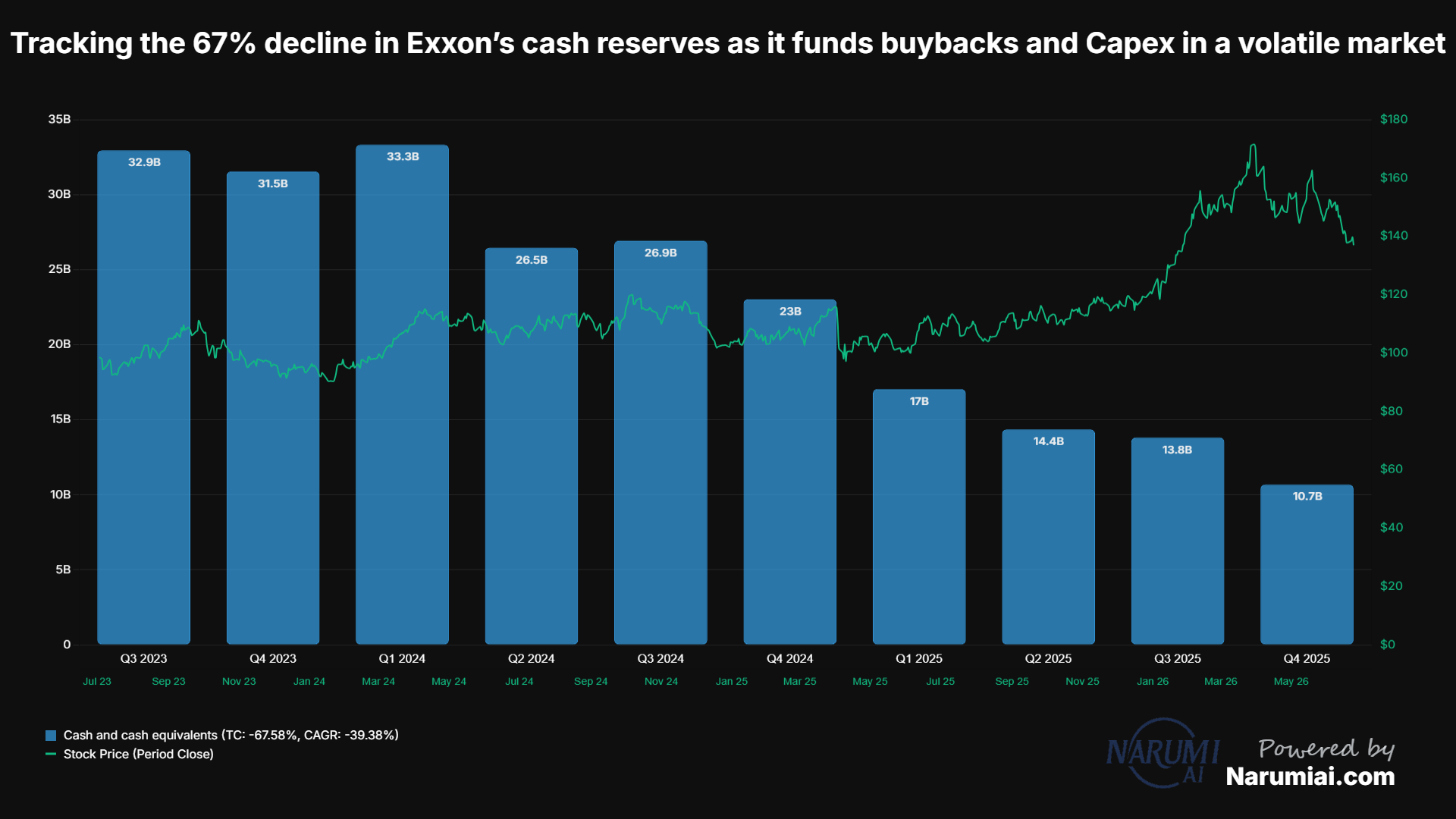
This cash burn is particularly sensitive because Exxon has committed to a disciplined $20 billion annual share buyback program. While this signals confidence to the street, it leaves very little room for error if Brent crude stays below $75 for a prolonged period. Meanwhile, BP ($BP) has taken a different route, slashing its green energy transition budgets by $5 billion to pivot back to 'resilient hydrocarbons.' BP is betting that its sophisticated global trading desk can route around Iranian barrels more effectively than a pure-play producer, but its higher structural overhead remains a liability compared to the American giants.
The Downstream Redoubt
If there is a silver lining for Exxon, it lies in its massive refining complex. Integrated oil companies often view their downstream segment as a natural hedge: when crude prices fall, refinery feedstock costs drop, potentially widening refining margins. However, an influx of Iranian medium-sour crude creates a specific risk. Exxon and Chevron have spent billions optimizing their Gulf Coast refineries to process heavy, sour barrels at a discount. If the market is flooded with Iranian sour crude, that historic discount may narrow, neutralizing the very advantage these specialized refineries were built to exploit.
Furthermore, the 'Transition Capital Whiplash' is real. As Exxon doubles down on fossil fuels—evidenced by its $7.7 billion in depreciation and depletion charges in Q4 2025—it is increasingly tethered to the volatility of the molecule. Its diversification into lithium extraction and performance chemicals is a long-term play, but for the next 24 months, the stock is a hostage to the diplomatic table in Geneva.
The Verdict: Survival of the Lowest Breakeven
The coming influx of Iranian supply will separate the 'advantaged' from the 'average.' Exxon’s Guyana assets, with breakevens near $35 per barrel, are safe. But the rest of the portfolio is starting to look expensive. With a Cash Ratio that has deteriorated from 0.46 to 0.18 over the last two years, Exxon no longer has the luxury of ignoring the cost curve. The era of easy margins is over; the era of the 'Efficiency War' has begun.
As the market adjusts to a lower-inflation framework, the question for Exxon is no longer about how much oil they can find, but how much profit they can squeeze out of a $70 barrel when their own production costs have climbed 40%. For now, the dividend remains a sacred cow, but the fortress is looking considerably less impregnable than it did two years ago.
Check out our Interactive Charting Tool.