The Invisible Tax in Your Grocery Cart: Exxon’s Plastic Fortress
The $118 Barrel Hiding in Your Pantry
On a humid morning in May 2026, the global economy is relearning a painful lesson in geography. With the Strait of Hormuz effectively shuttered, Brent crude has punched through the $118 ceiling, sending shockwaves far beyond the local gas station. But for the investigative desk at Narumi AI, the real story isn't the price of premium unleaded; it’s the silent, petroleum-derived tax currently inflating the price of every gallon of milk and box of detergent on the planet. This is the 'Petro-Plastic' crisis, a fundamental shift where the cost of the container is beginning to rival the value of the contents.
At the center of this storm sits ExxonMobil ($XOM), a titan that has spent the last three years fortifying its operations into what insiders call an 'Integrated Fortress.' While the public sees a gas company, the board sees a high-performance polymer play. By leveraging its massive 2024 Pioneer acquisition, Exxon has effectively cornered the market on low-cost ethane, the primary feedstock for the plastics that Walmart ($WMT) and Costco ($COST) desperately need to wrap their goods.
A Tale of Two Balance Sheets: The Integration Shield
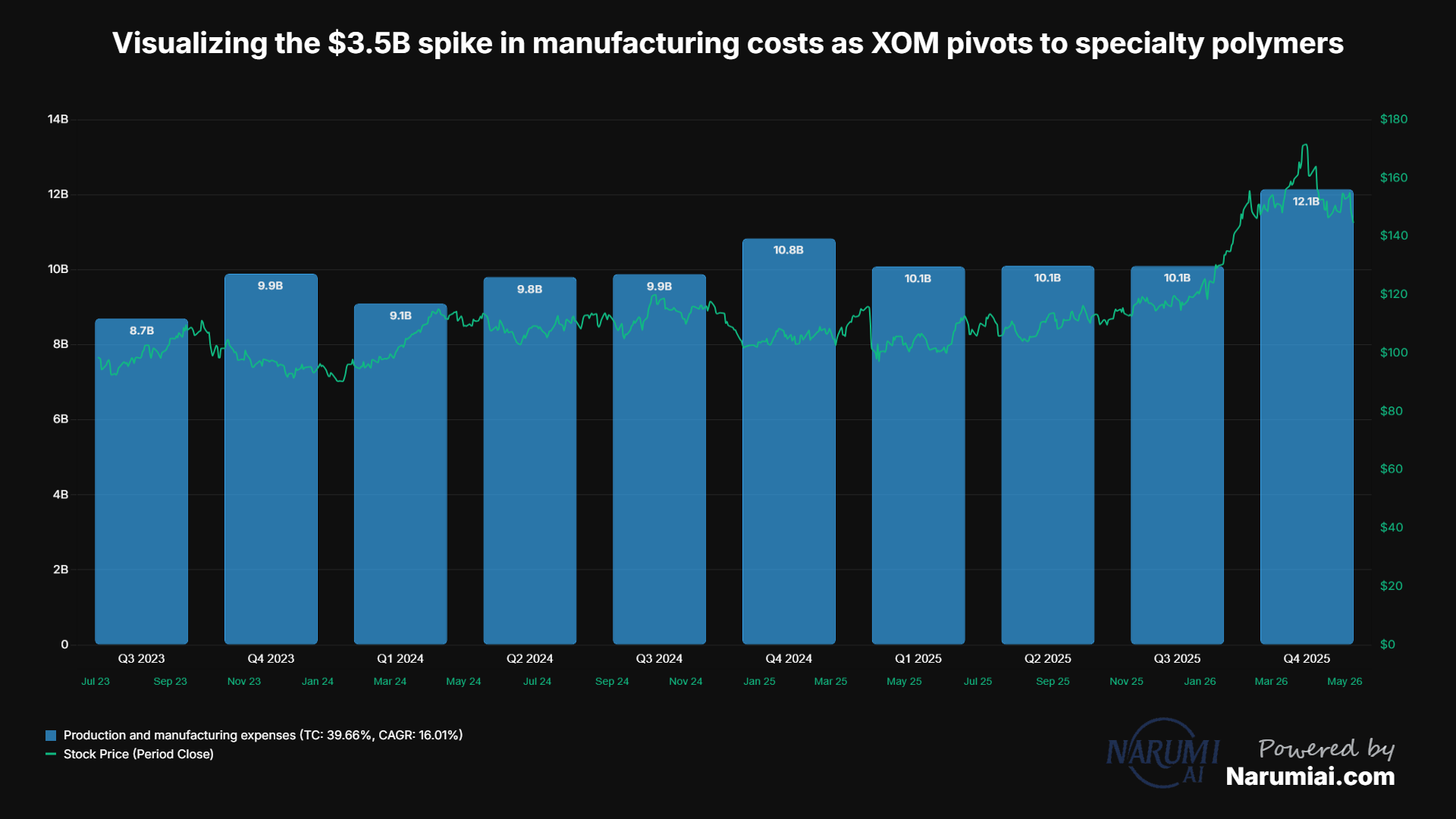
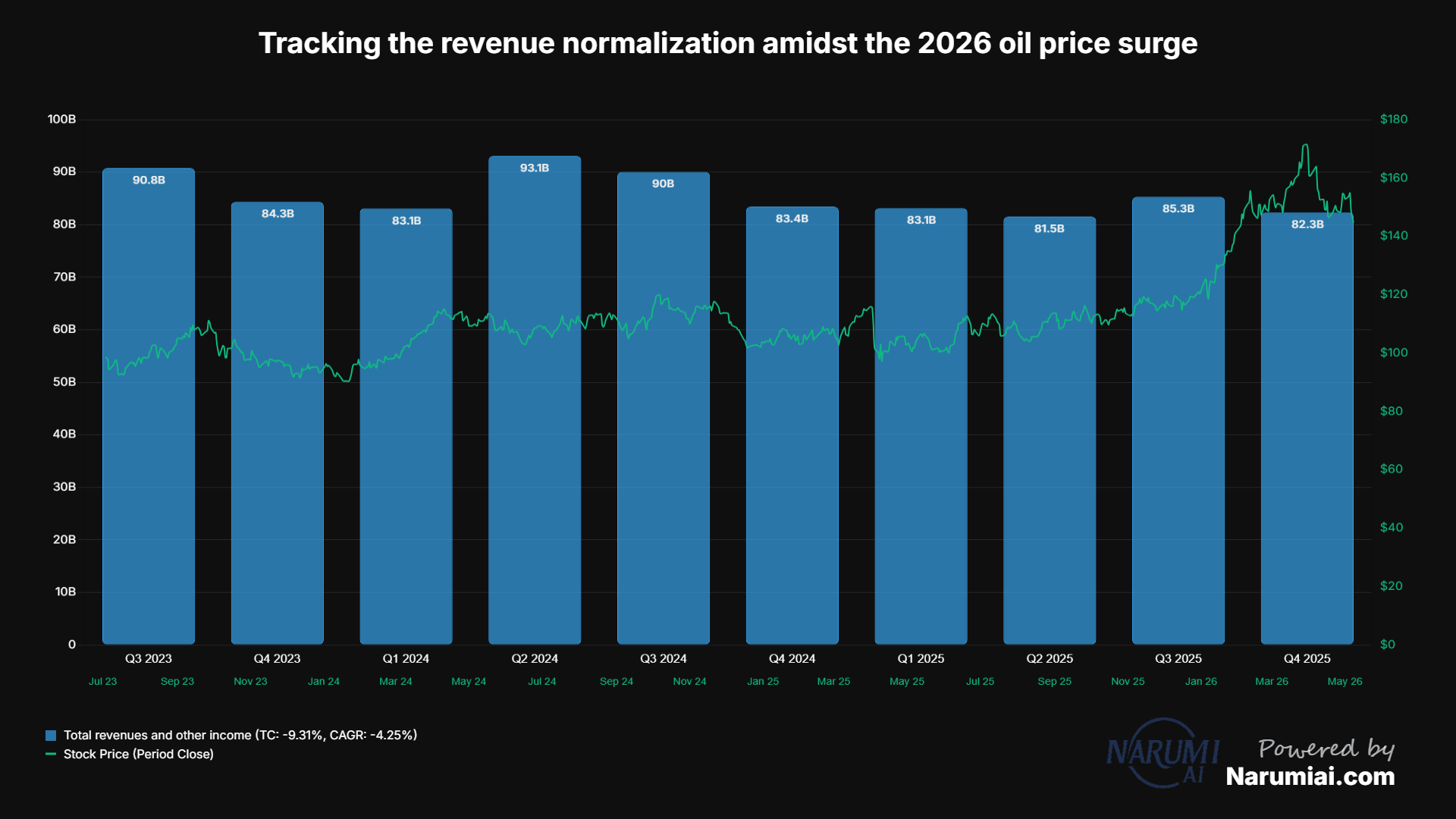
The financial data reveals a company in the midst of a high-stakes transformation. While Exxon’s total revenues have seen a gradual cooling—falling from $90.7 billion in Q3 2023 to $82.3 billion in Q4 2025—the real story is buried in the 'Costs and Other Deductions' line. Production and manufacturing expenses have surged to $12.1 billion in the latest quarter, up significantly from the $8.6 billion seen just two years prior.
Contrast this with LyondellBasell ($LYB). As a pure-play petrochemical producer, LYB is a 'price taker.' When the cost of raw materials spikes due to geopolitical friction, LYB has no upstream oil profits to buffer the blow. They are forced into a game of 'operational agility,' frantically switching feedstocks and pruning European assets to survive. Exxon, meanwhile, simply sells itself the feedstock at cost, effectively exporting U.S. shale advantages to a plastic-starved global market.
The Silent Bleed: Erosion of the Cash Pile
Despite the 'fortress' branding, a skeptical look at Exxon’s liquidity reveals a silent bleed. The company’s cash and cash equivalents have dwindled from a robust $32.9 billion in late 2023 to just $10.6 billion by the end of 2025. This 67% reduction in liquidity suggests that maintaining the 'Integrated Fortress' isn't cheap. The company is pouring billions into CAPEX—specifically 'certified-circular' recycling facilities—to stay ahead of looming 2026 European packaging regulations.
This drop in cash has directly impacted the company’s Cash Ratio, which has plummeted from 0.46 to a lean 0.18. For an investigative journalist, this raises the question: Is Exxon overextending itself to win the plastics war? The operating margin (calculated as Income before Taxes / Total Revenue) has eroded from roughly 15% in Q3 2023 to under 10% in Q4 2025. The fortress is standing, but the walls are getting thinner.
Retailers at the Breaking Point: Walmart vs. Costco
As Exxon and LYB battle for feedstock supremacy, the retail giants are fighting a different war: the war for the consumer’s wallet. Walmart ($WMT) has turned to AI-driven automation to minimize secondary plastic waste, essentially trying to 'out-math' the rising cost of resin. Their 'Ship in Own Container' initiative is a direct strike at the petro-plastic tax, penalizing suppliers who use excess petroleum-based wrap.
Costco ($COST), however, uses its unique membership model as a shield. With inventory turning over 12 times a year, Costco can maintain 'old' prices longer than traditional supermarkets. Furthermore, their Kirkland Signature private label has been aggressively 'lightweighted'—using 15-20% less plastic in water bottles and milk jugs.
The Verdict: Material Independence as the New Moat
The long-term outlook for 2026 and beyond suggests that 'Material Independence' will be the defining competitive moat. ExxonMobil is betting its balance sheet on the idea that it can control the entire lifecycle of plastic, from the Permian Basin to the recycling plant. While its shrinking cash pile is a cause for concern, its ability to maintain a 31.9% gross margin in the face of massive manufacturing spikes proves the power of vertical integration.
The real risk lies in the 'Great Decoupling.' If retailers like Walmart successfully shift their private labels to fiber-based, non-petroleum packaging, the 'Petro-Plastic' empire could find itself with a surplus of high-performance resins and no one to buy them. For now, however, as long as the Strait of Hormuz remains a flashpoint, Exxon holds the keys to the grocery aisle.
Check out our Interactive Charting Tool.