The Hormuz Paradox: ExxonMobil and the End of Geographic Destiny
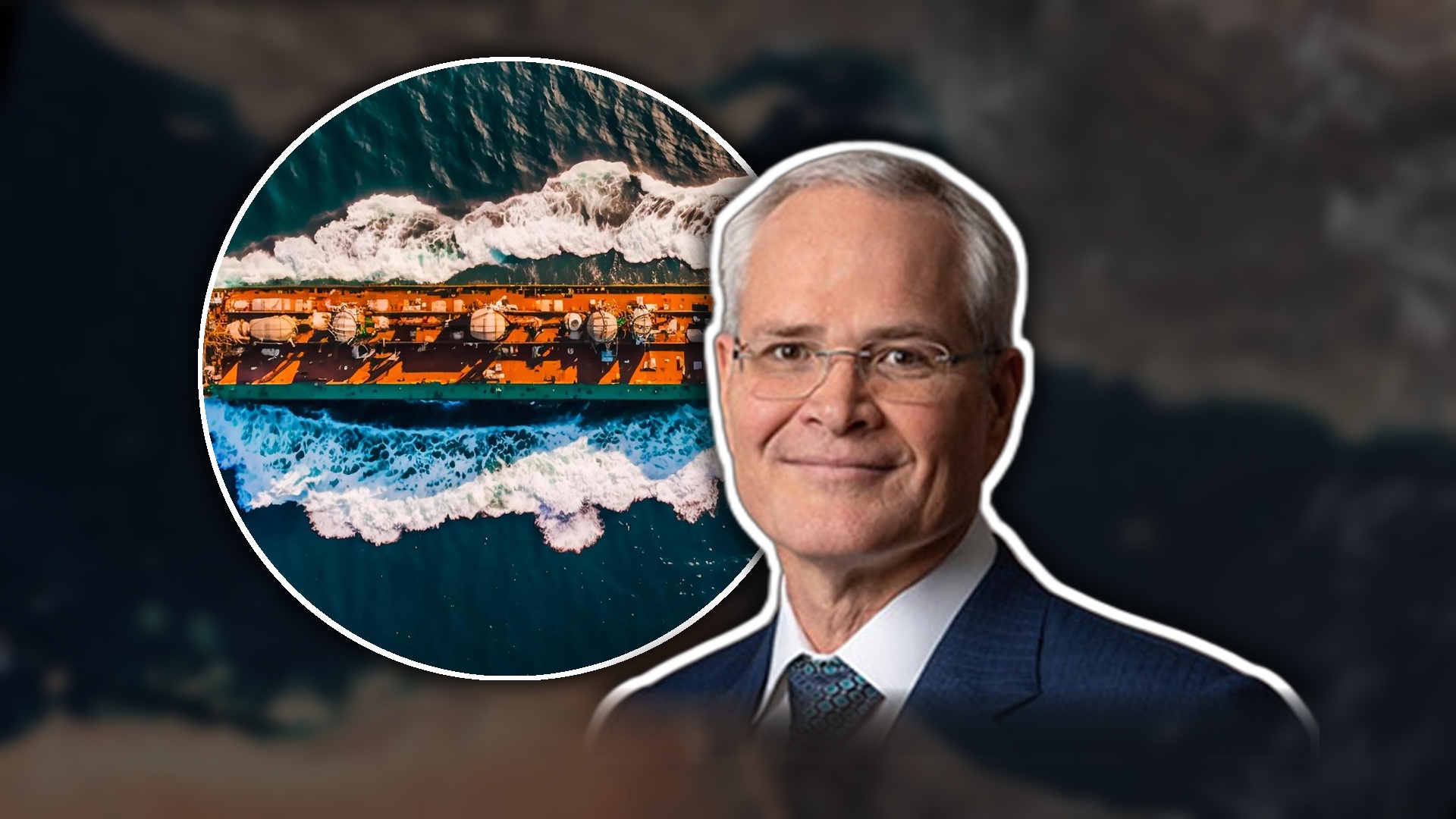
In the spring of 2026, the sight of U.S. naval escorts through the Strait of Hormuz is no longer a temporary escalation; it is a permanent feature of a fractured global order. For the visionary strategist, this isn't just a military operation—it is the final death knell for the era of 'cheap' Middle Eastern oil. We are witnessing the birth of the Geopolitical Navigator, a business model where the primary economic moat is no longer the cost of extraction, but the security of the supply chain. ExxonMobil ($XOM), once the quintessential player of the old map, is now the architect of the new one.
The Great Atlantic Decoupling
The structural shift is visible not in the daily volatility of Brent futures, but in the cold, hard deployment of capital. While the Strait of Hormuz remains a 'symptom' of global instability, ExxonMobil’s internal response has been an aggressive 'Atlantic Pivot.' By doubling down on the Permian Basin and Guyana, XOM is effectively bypassing the world’s most volatile chokepoints. This isn't just a diversification strategy; it is a fundamental decoupling from the geographic liabilities of the 20th century.
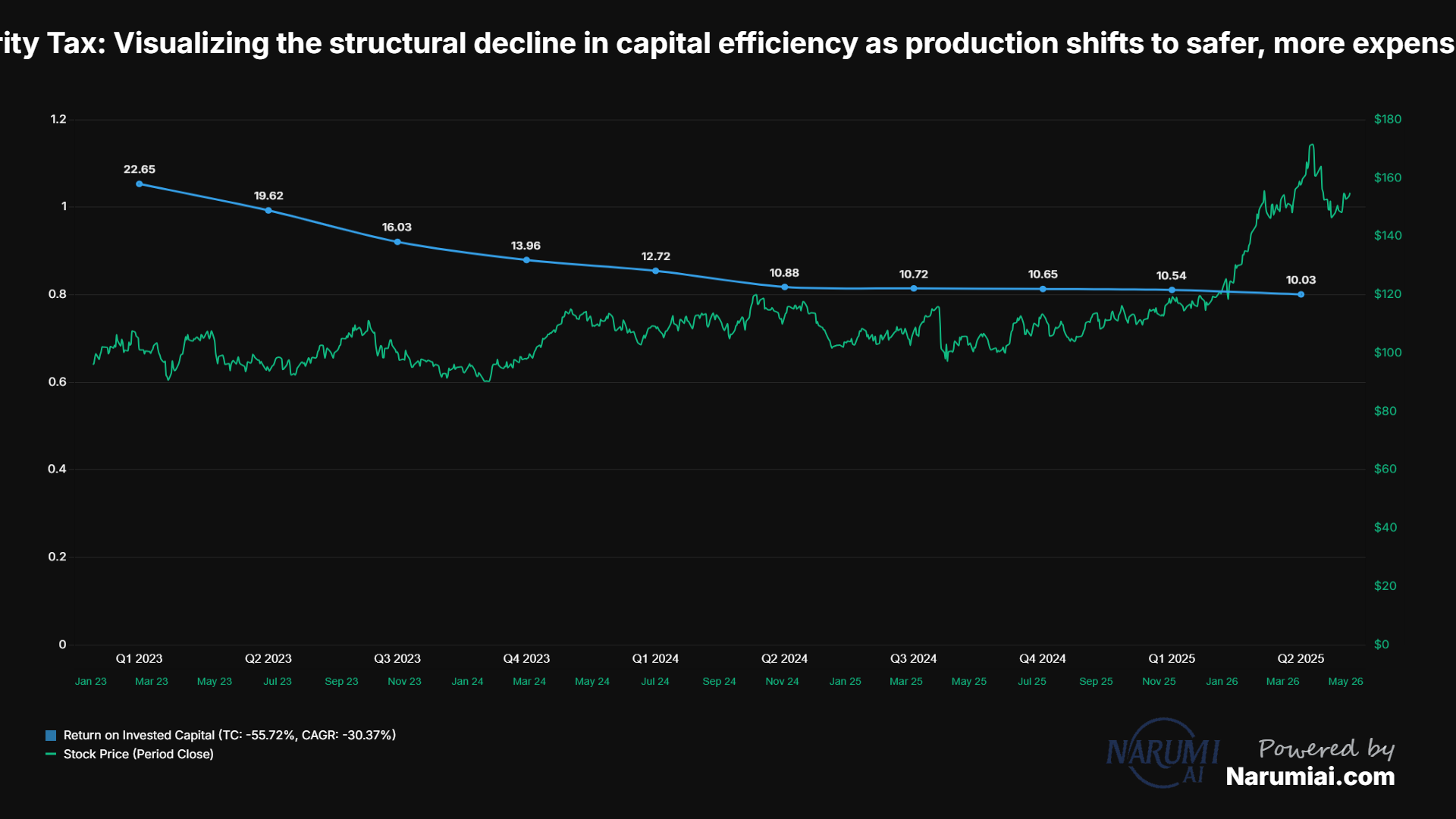
However, this security comes at a steep price. The financial data reveals a sobering reality: de-risking is expensive. Exxon’s Return on Invested Capital (ROIC) has seen a steady erosion, falling from a peak of 22.65% in early 2023 to a more modest 10.03% by mid-2025. This 1,200 basis point decline represents the 'Security Tax'—the massive capital expenditure required to build out infrastructure in 'safe harbor' basins while maintaining a global footprint under siege.
The Liquidity Drain and the Stability Premium
The market, paradoxically, seems to love this lower efficiency. As of May 5, 2026, XOM’s stock price sits at $154.88, a significant climb from the $120 range seen at the end of 2025. Investors are no longer valuing XOM on its ability to generate hyper-growth; they are paying a 'Stability Premium.' The P/E ratio has expanded from 7.81 in mid-2023 to over 16.14 by late 2025, suggesting that in a world of 50% food inflation in Southeast Asia and blockaded straits, a 9% net margin is the new gold standard.
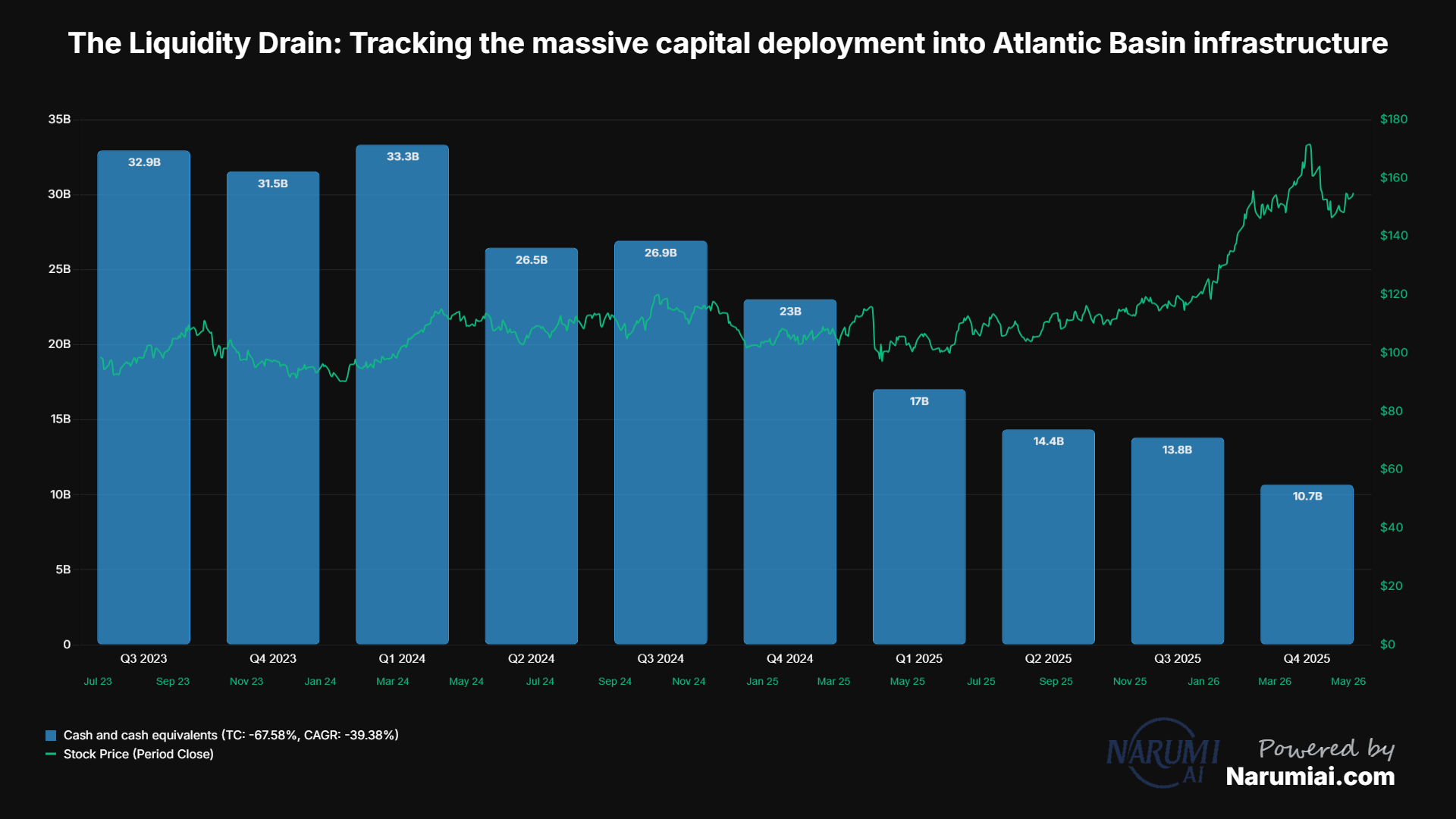
To fund this pivot, Exxon has aggressively tapped its liquidity. Cash and cash equivalents have plummeted from $32.9 billion in Q3 2023 to just $10.6 billion by the end of 2025. This $22 billion drawdown is the fuel for the Atlantic Fortress—a massive bet that the next decade will be defined by physical supply chain resilience rather than paper trading.
The ASEAN Pivot: Technology as the New Diplomacy
Perhaps the most profound shift is happening in Southeast Asia. As ASEAN nations begin to view China as a 'stable' alternative to U.S. maritime security, the Western supermajors are pivoting their value proposition. They are no longer just selling crude; they are selling technological insulation. Exxon and Chevron ($CVX) are increasingly using proprietary subsea robotics and AI-driven seismic imaging as a competitive moat to secure deep-water licenses that Chinese state-owned enterprises cannot yet master.
By May 2026, the 'Hormuz Standoff' has forced a move toward 'Island-Mode' production—modular, decentralized LNG units that can reroute at a moment’s notice. This logistical agility is the only way to counter the 'Dual-Sourcing' headache, where companies must navigate a technology minefield between U.S. export controls and the need for Chinese-protected maritime lanes.
The Strategist’s Verdict
ExxonMobil is no longer an oil company in the traditional sense; it is a geopolitical insurance policy. The rising SG&A to Revenue ratio (climbing to 3.55% in Q3 2025) and the declining Net Income per Employee are the scars of this transition. But for the institutional investor looking at 'The Next Decade,' these metrics are secondary to the fact that XOM has successfully insulated its core production from the single greatest chokepoint in human history. The Atlantic Pivot is complete; the fortress is built. Now, we wait to see if the world can afford the rent.
Check out our Interactive Charting Tool.