The Gigawatt Hegemony: Broadcom’s $35 Billion Bid to Unseat the Cloud Kings

The Great Decoupling of AI Capital
For the better part of a decade, the narrative of the digital economy was written on the balance sheets of the 'Big Four' hyperscalers. If you wanted to build a data center, you needed a fortress balance sheet and a trillion-dollar market cap. But the announcement that Broadcom ($AVGO) is launching a $35 billion AI infrastructure platform in partnership with Apollo Global Management and Blackstone marks the end of that monopoly. This is not merely a capital expenditure; it is a structural decoupling. By leveraging private equity to fund 20 gigawatts of compute capacity, Broadcom is essentially architecting a parallel track for the AI revolution—one that bypasses traditional cloud providers to serve frontier labs like Anthropic and OpenAI directly.
We are witnessing the birth of 'Alternative Hyper-Scale.' While Amazon ($AMZN) is forced to tap the Canadian bond market for $10 billion to fuel its staggering $200 billion data center spree, Broadcom is orchestrating a consortium. This model allows Broadcom to secure a massive, guaranteed pipeline for its proprietary custom silicon (XPUs) without bearing the full weight of real estate and energy acquisition risks. It is a masterclass in capital allocation: Broadcom provides the high-margin intellectual property, while the asset managers provide the low-cost, long-horizon infrastructure capital.
The ASIC Insurgency and the End of GPU Monoculture
While Nvidia ($NVDA) has enjoyed a near-total hegemony over the training phase of large language models, the Broadcom-Apollo-Blackstone alliance is a direct assault on that crown. The AI XPV platform is built specifically around Broadcom’s custom ASICs—Application-Specific Integrated Circuits designed to do one thing with extreme efficiency. As the industry moves from the 'frantic scramble' for any available GPU to a structured focus on inference and per-token delivery costs, Broadcom’s specialized silicon becomes the more attractive long-term bet for labs seeking to lower their power consumption.
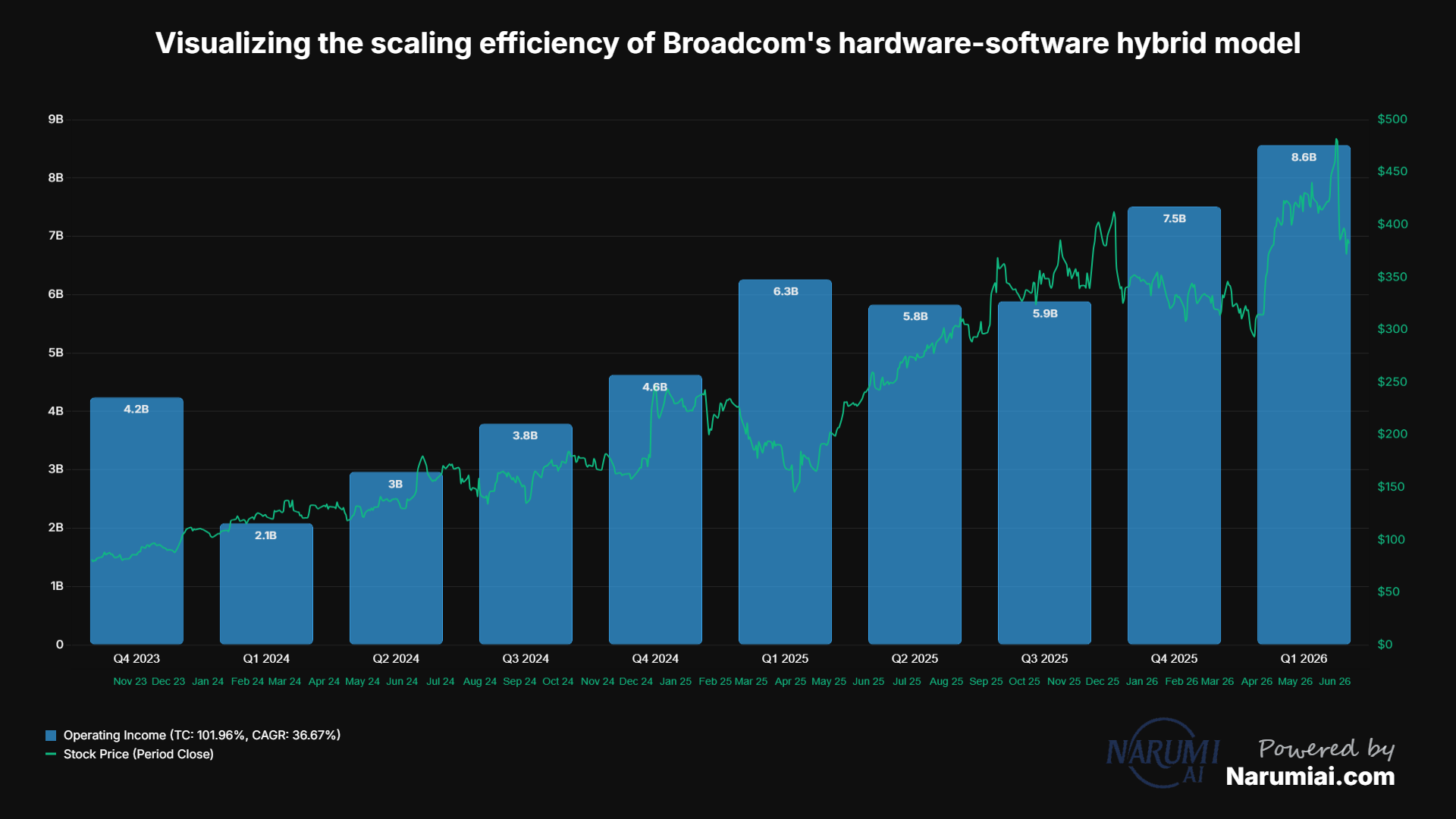
Looking at the financial internals, Broadcom’s pivot is already bearing fruit. In Q1 2026, the company reported an operating income of $8.56 billion on total net revenue of $19.31 billion, representing a formidable 44.3% operating margin. This efficiency is a far cry from the capital-intensive erosion often seen in hardware cycles. However, the market’s appetite for this growth has pushed valuations into the stratosphere; with a P/E ratio reaching 77.34 in late 2025, the margin for error has vanished. Broadcom is no longer being priced as a semiconductor firm; it is being priced as the toll-booth for the entire AI ecosystem.
The Power Wall: 20 Gigawatts or Bust
The strategic bottleneck of the next decade is not silicon; it is electricity. Broadcom’s commitment to adding 20 gigawatts of compute capacity by 2028 is an acknowledgment of the 'Power Wall.' To put this in perspective, 20 gigawatts is enough to power roughly 15 million homes. By securing this capacity through private equity, Broadcom is essentially pre-buying the most valuable commodity in the AI age: grid priority.
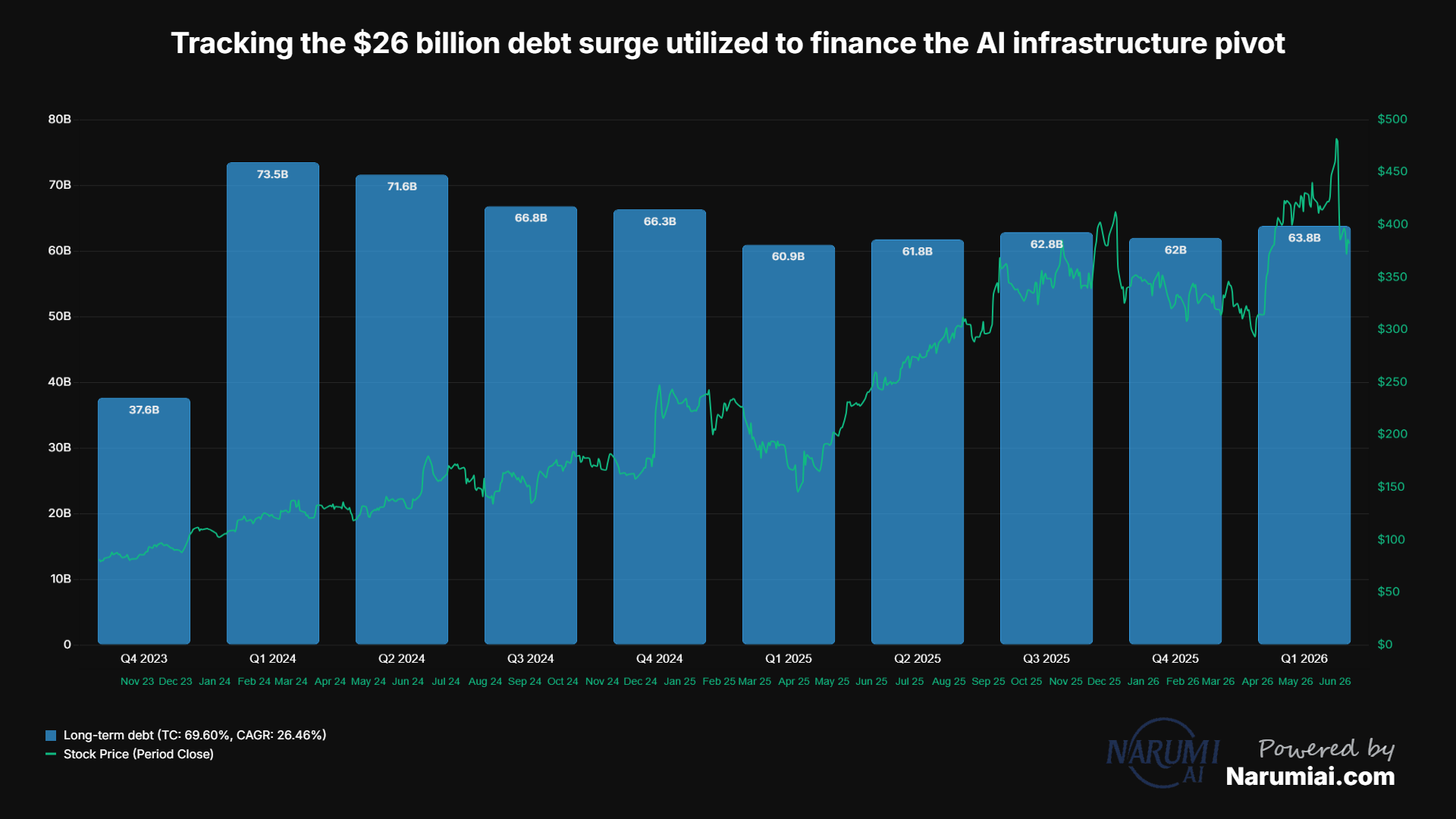
This aggressive expansion is reflected in Broadcom’s balance sheet. Long-term debt has surged from $37.6 billion in Q4 2023 to $63.8 billion by Q1 2026. While this leverage would be concerning for a legacy firm, for Broadcom, it represents the cost of building a moat. The risk, however, is credit exposure. Broadcom is backstopping interest payments on this $35 billion package. If the frontier labs it serves—many of which are still pre-profit—fail to scale their monetization, Broadcom could find itself holding the bag for specialized data centers that have no other viable tenants.
A Multi-Polar AI Landscape
As we look toward the next five years, the competitive landscape is fragmenting. Nvidia is playing a defensive game, launching 'Physical AI' labs in Europe with Nebius to lock in the robotics and simulation markets before they even exist. Amazon is leveraging sovereign debt to diversify its funding. But Broadcom is the only player building a consortium that bridges the gap between the digital and the physical.
The structural shift is clear: The 'Hyperscale' era of 2010-2024 was defined by centralized cloud dominance. The 'Inference' era of 2025-2035 will be defined by decentralized, private-equity-funded, ASIC-driven infrastructure. Broadcom has positioned itself as the architect of this new world. For investors, the question is no longer about quarterly earnings beats, but about whether the world can actually generate the 20 gigawatts of power Broadcom has already promised to sell.
Check out our Interactive Charting Tool.