The Boise Tollbooth: Micron’s $100 Billion AI Fortress

The Death of the Commodity
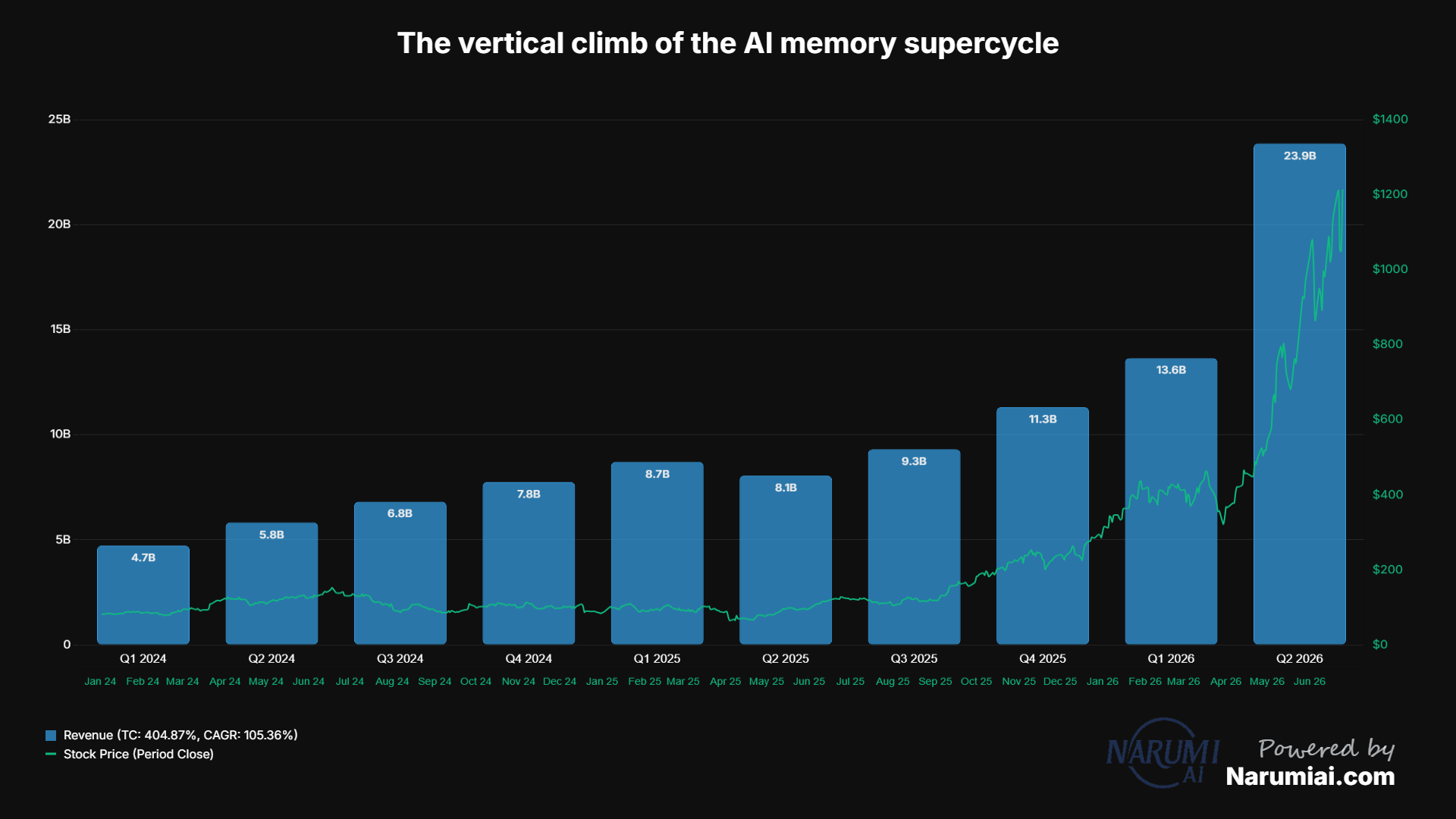
For decades, Micron Technology ($MU) was the scrappy, often-overlooked third wheel in the global DRAM triumvirate—a company whose fate was tethered to the brutal, boom-and-bust cycles of the PC and smartphone markets. But walk through the glass-walled corridors of their Boise headquarters today, and you won’t find a commodity supplier. You’ll find a landlord. By reporting a staggering fiscal Q3 revenue surge to $41.5 billion—a 346% year-over-year explosion—Micron has effectively declared that the memory cycle is no longer a cycle. It is a vertical climb.
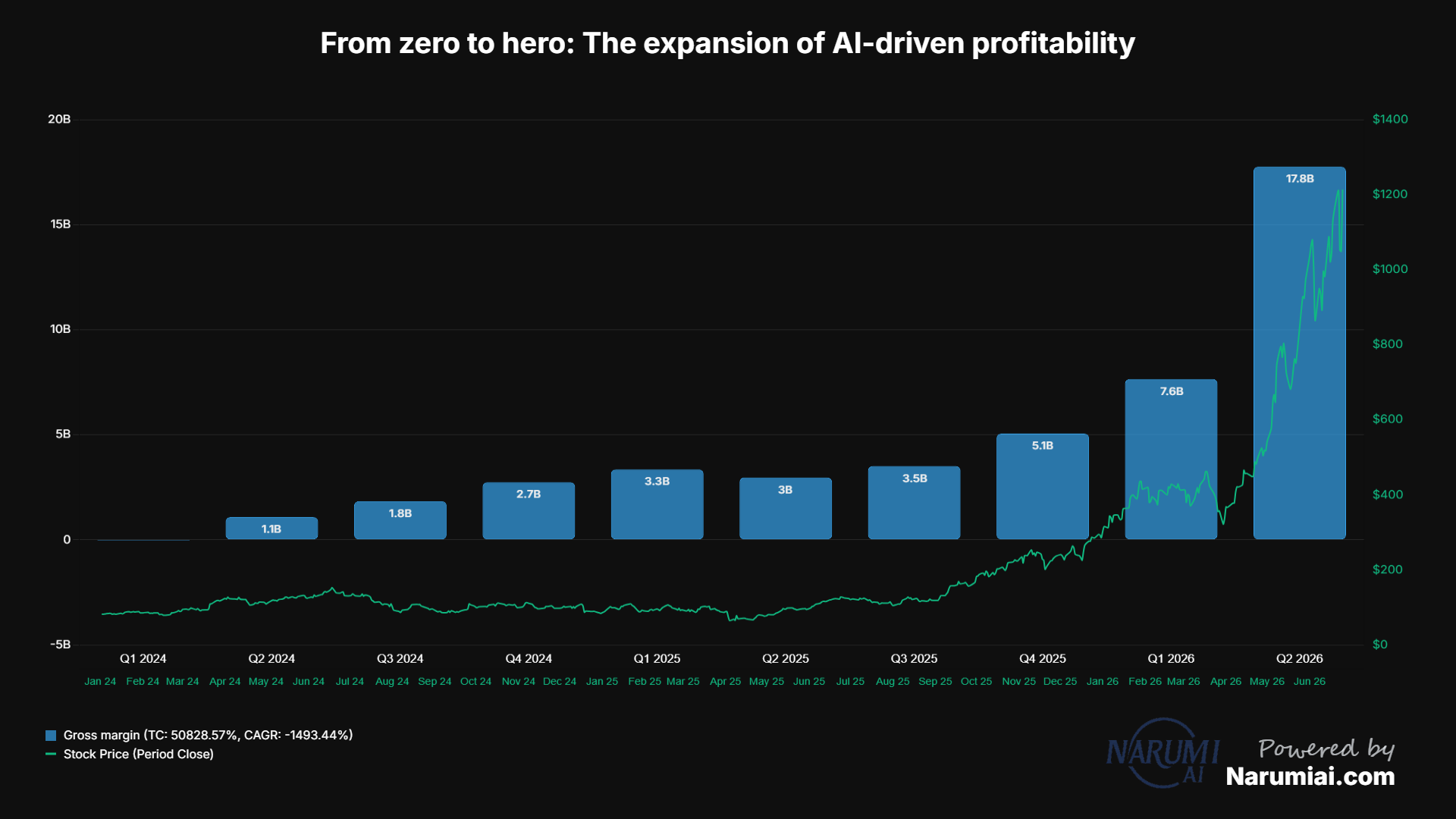
The financial data reveals a company that has successfully hijacked the AI revolution. In Q1 2024, Micron was generating a modest $4.7 billion in revenue with a gross margin that sat precariously at -0.74%. Fast forward to the latest data, and the transformation is total. Revenue for Q2 2026 hit $23.8 billion, and the breaking news of a $41.5 billion Q3 suggests that the ceiling hasn't just been raised; it’s been removed.
The $22 Billion Security Deposit
The most provocative shift isn't just the top-line growth; it’s how that growth is being secured. Skeptics have long waited for the 'CapEx cliff'—the moment when oversupply crashes the party. However, Micron is front-running this risk with a masterful commercial pivot: Strategic Customer Agreements (SCAs). These aren't your father’s purchase orders. We are talking about 'take-or-pay' contracts stretching through 2030, covering a cumulative $100 billion in revenue.
Perhaps most telling is the $22 billion in customer deposits. In essence, the world’s hyperscalers—Meta, Google, and Microsoft—are so desperate for High-Bandwidth Memory (HBM) that they are effectively providing Micron with interest-free loans to build the very factories that will supply them. This has fundamentally altered the company's financial health. The Operating Margin, which was a bleeding -23.87% in Q1 2024, has swung to a massive 67.6% by Q2 2026 (calculated as $16.1 billion in operating income on $23.8 billion in revenue).
Leapfrogging the Giants
While SK Hynix remains the volume leader in HBM, Micron has executed a surgical strike on the high end of the market. By skipping early, low-margin iterations of HBM, Micron focused its R&D—which hit $1.25 billion in Q2 2026—on HBM3E and the upcoming HBM4. This 'leapfrog' strategy has allowed them to capture key allocations for Nvidia’s next-generation Vera Rubin platform.
Meanwhile, Samsung, the traditional 800-pound gorilla, has been caught flat-footed. Yield issues and qualification delays with advanced HBM suites have left a vacuum that Micron is filling with aggressive pricing power. When you possess the only qualified 'onshore' U.S. supply of the most critical bottleneck in AI, you don't ask for a price; you dictate it. This is reflected in the 'Net Income per Employee,' which skyrocketed from a loss of $129,660 in Q1 2024 to a staggering profit of $224,698 per head in Q1 2026.
The $25 Billion Question
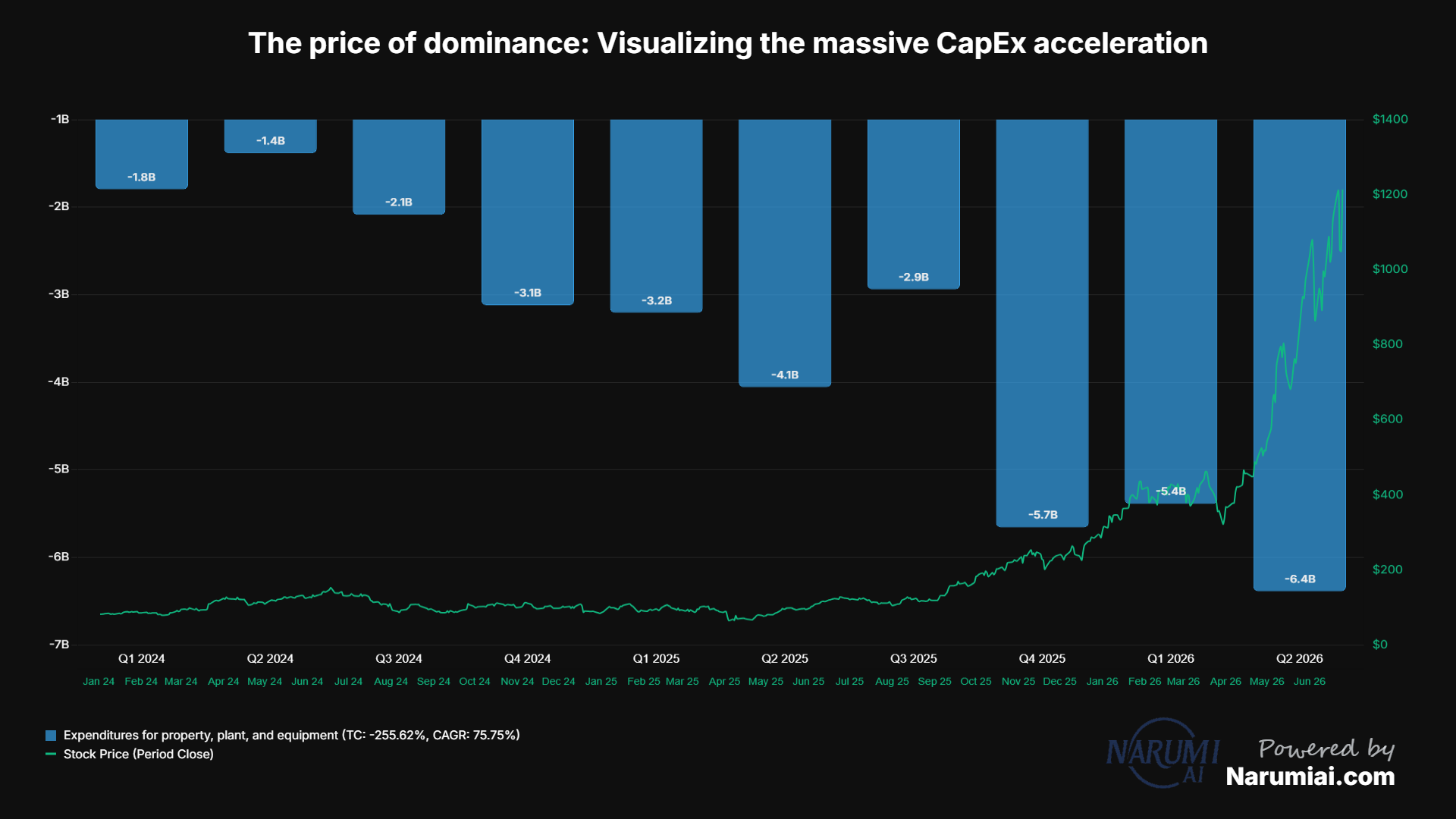
But dominance has a price tag, and it is written in silicon and steel. Micron is currently locked in a brutal arms race, with annual Capital Expenditures (CapEx) tracking over $25 billion. In Q2 2026 alone, expenditures for property, plant, and equipment reached $6.38 billion, a nearly four-fold increase from the $1.79 billion spent in Q1 2024.
The risk is no longer just market demand; it is execution. Building greenfield fabs in Idaho and New York involves navigating labor shortages and permitting delays that could create a $100 million to $200 million quarterly headwind. If the 'agentic AI' software ecosystem doesn't mature by 2028 to absorb the massive capacity currently being built, the industry could face a deflationary price inversion that would make previous cycles look like a mild breeze.
The Verdict: A Hardware Tax
Institutional investors are no longer trading Micron as a chip stock; they are trading it as a 'hardware tax' on the entire AI industry. While companies like Dell and Apple may see margins squeezed by component costs, Micron is the one doing the squeezing. With a forward P/E that compresses toward 8.5x based on $50 billion quarterly guidance, the valuation remains surprisingly grounded for a company at the center of a technological tectonic shift.
As long as the context windows for LLMs keep expanding and the world’s data centers continue their insatiable hunger for HBM4, Micron’s Boise tollbooth will keep collecting its due. The cyclical bear has been put into a deep, expensive hibernation.
Check out our Interactive Charting Tool.