The $8.5 Billion Quarry King: CRH’s Massive Bet on the U.S. Grid
The Great American Land Grab
For years, the Dublin-based construction titan CRH ($CRH) has been quietly shedding its European skin. The move of its primary listing to the New York Stock Exchange was the first shot across the bow; its latest maneuver is a full-scale invasion. By announcing an $8.5 billion all-cash acquisition of Arcosa ($ACA), CRH isn't just buying gravel and asphalt—it is buying a seat at the head of the table for the most lucrative infrastructure boom in a generation. The deal, which includes 109 quarries and a stranglehold on the Texas and Florida markets, signals a fundamental shift from a materials supplier to an integrated infrastructure powerhouse.
The AI Moat and the Connected Portfolio
While the headlines focus on the quarries, the real prize in the Arcosa deal lies in the 'Engineered Structures' segment. As the U.S. attempts to modernize a crumbling power grid to support the voracious energy demands of AI data centers, Arcosa’s position as a top-three manufacturer of utility structures becomes a strategic goldmine. CRH is moving toward what management calls a 'connected portfolio'—a model where they don't just sell the aggregate for the foundation; they sell the asphalt for the access road and the engineered steel poles for the data connectivity.
Under the Hood: Margin Expansion vs. Debt Loading
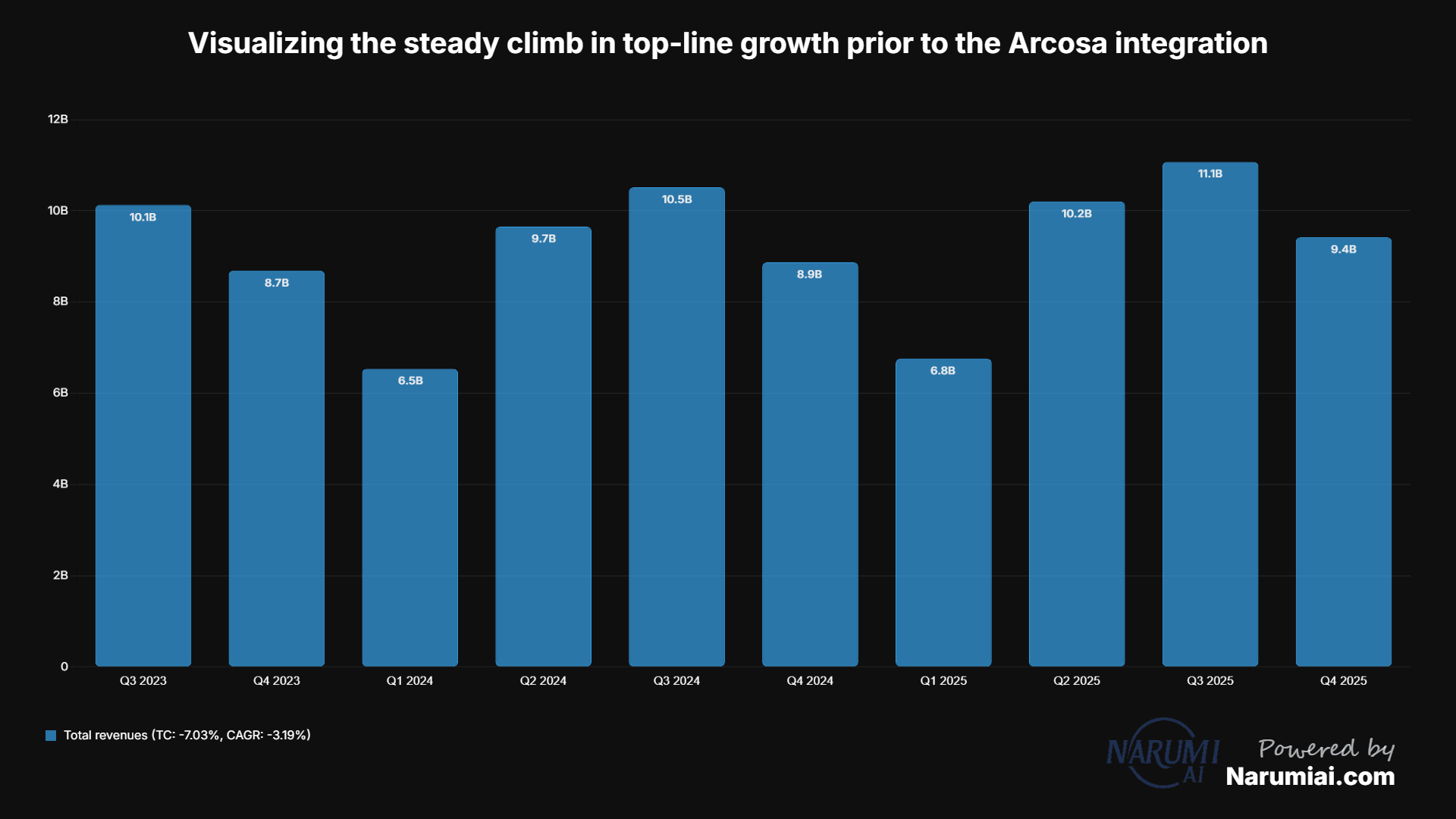
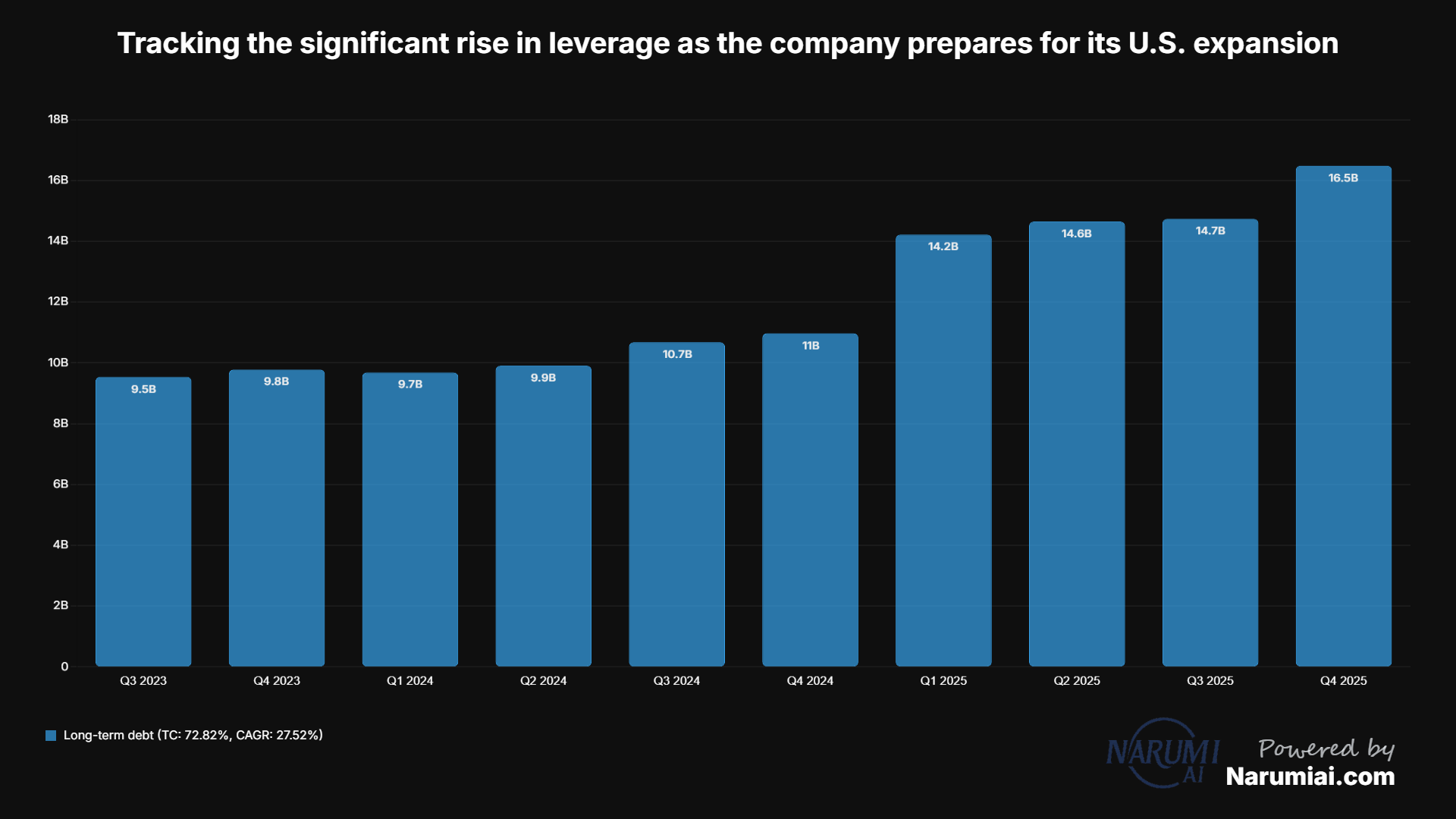
A deep dive into the SEC filings reveals why CRH feels emboldened to write such a massive check. Between Q3 2023 and Q3 2025, CRH saw its quarterly revenue climb from $10.13 billion to $11.07 billion. More impressively, its operating margin—the core measure of how efficiently it turns stone into profit—expanded from 17.6% to 18.8% over that same period. However, this growth has come at a cost. Long-term debt has already swelled from $9.5 billion in late 2023 to $16.5 billion by the end of 2025, even before the $8.5 billion Arcosa price tag is factored in.
The Pure-Play Foil: Vulcan and Summit
CRH’s strategy stands in stark contrast to its primary U.S. rivals. Vulcan Materials ($VMC) has long championed the 'pure-play' aggregates model, arguing that upstream extraction offers the highest returns and the cleanest margins. By diversifying into utility structures, CRH is taking a riskier, more complex path. While Vulcan and Summit Materials ($SUM) focus on defending their local quarry monopolies with elite pricing power, CRH is betting that vertical integration will make them indispensable to federal projects. The conflict is clear: Vulcan wants to be the best at one thing; CRH wants to own the entire construction ecosystem.
The 'Radius Rule' and the Regulatory Trap
The path to a 2027 closing is littered with regulatory landmines. In the world of aggregates, competition is local. Because stone is heavy and expensive to transport, a quarry’s influence rarely extends beyond a 30-mile radius. In high-growth hubs like Dallas and Miami, CRH and Arcosa’s footprints overlap significantly. The Federal Trade Commission (FTC) is expected to apply the 'Radius Rule' with surgical precision. If the combined entity reduces local bidding options from three to two, CRH will likely be forced into mandatory divestitures. The stakes are high: if the deal collapses under regulatory weight, CRH is on the hook for a $372 million reverse break-up fee.
The Verdict: A High-Stakes Pivot
CRH is no longer an Irish company that does business in America; it is an American infrastructure giant that happens to have Irish roots. By paying 11.5x 2026E Adjusted EBITDA for Arcosa—a disciplined entry point compared to Vulcan’s 30x multiple—management is making a calculated bet on the U.S. reindustrialization. If they can successfully integrate Arcosa’s utility structures and realize the promised $175 million in synergies, they will have built a moat that no pure-play rival can cross. For now, investors are watching the debt levels, but the siren song of the Texas and Florida Sunbelt is proving too loud to ignore.
Check out our Interactive Charting Tool.