The $750 Billion Brain: Inside the AI Infrastructure Arms Race

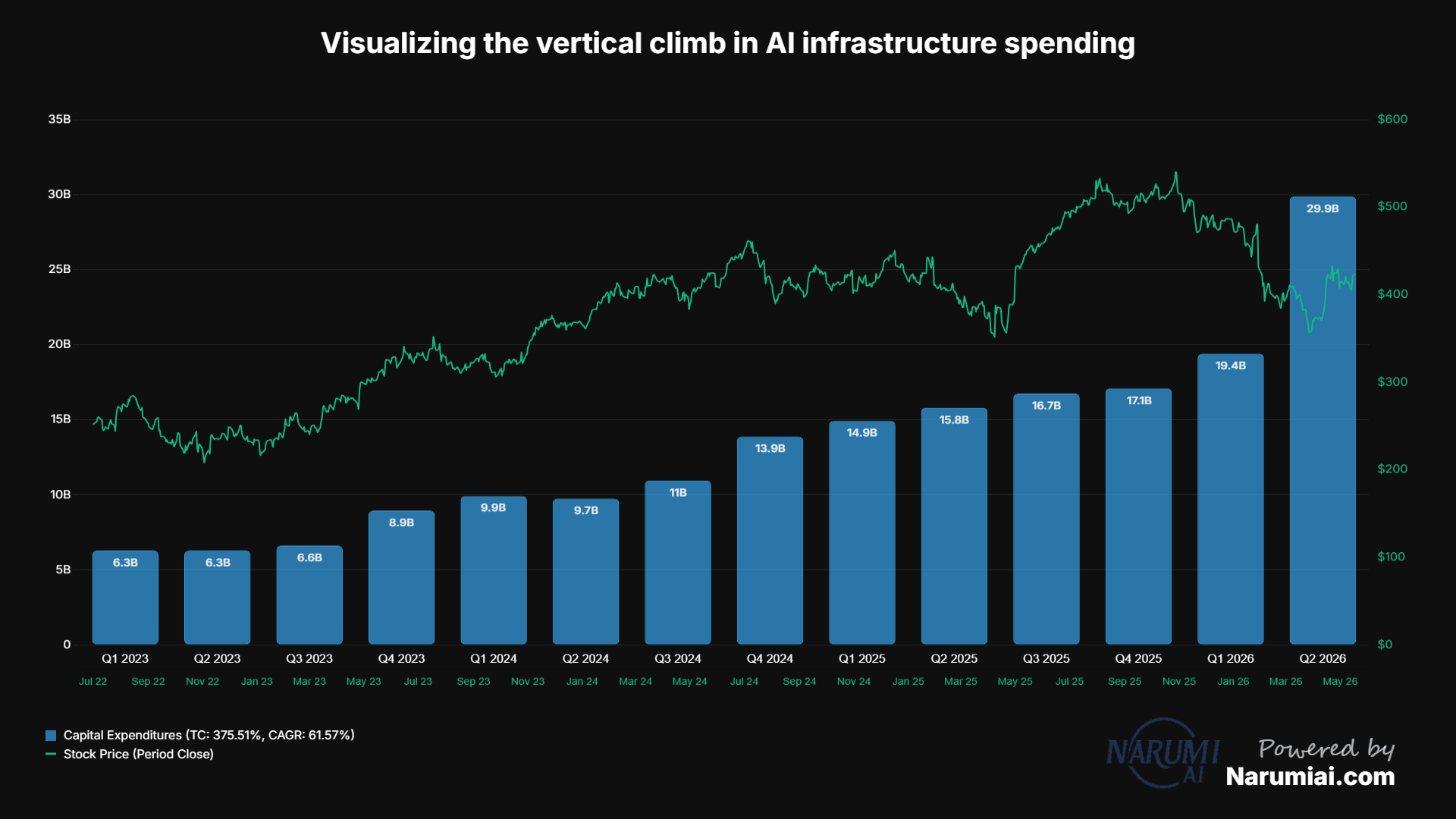
Imagine spending $190 billion in a single year just to stay in the game. That’s not the budget of a small nation; it’s Microsoft’s planned capital expenditure for 2026. We are currently witnessing the most expensive arms race in human history, as the world’s tech titans—Microsoft, Alphabet, Meta, and Amazon—pour a collective $750 billion into the physical guts of Artificial Intelligence.
The Blackwell Inflection and the Rise of the Agents
For the past two years, the narrative has been simple: buy every Nvidia chip you can get your hands on. But the game is changing. We’ve moved past the "chatbot" era into what insiders call Agentic AI. This isn't just about a computer writing a poem; it's about AI systems that can autonomously execute complex workflows, from booking travel to managing supply chains. This shift is driving a voracious appetite for Nvidia’s new Blackwell systems.
Institutional investors are no longer just looking at Nvidia’s top-line revenue. They are scrutinizing the Networking-to-GPU ratio. In an agentic world, how fast chips talk to each other is just as important as how fast they think. Nvidia’s networking segment, including InfiniBand and Spectrum-X, is becoming the secret sauce that prevents massive AI clusters from becoming expensive paperweights.
The GPU-to-CPU Marriage Counseling
In the early days of the AI boom, it was all about the GPU. The CPU (the traditional brain of the computer) was an afterthought. But agentic AI requires heavy "orchestration"—the logic that tells the AI which tool to use and when. This is where CPUs excel. We are seeing a structural shift in data center architecture, moving from an 8-to-1 GPU-to-CPU ratio toward a much tighter 1-to-1 ratio. Nvidia is capitalizing on this by cross-selling its Grace CPUs alongside Blackwell GPUs, effectively doubling its "content per rack."
Microsoft’s $190 Billion Bet vs. Google’s TPU Shield
While Microsoft is writing massive checks to Nvidia, Alphabet (Google) is playing a different game. Google has a 10-year head start in custom silicon with its TPUs (Tensor Processing Units). By building its own chips, Google can bypass the "Nvidia tax," allowing them to run AI models at a significantly lower cost than rivals who are 100% reliant on third-party hardware.
Google’s new "Trillium" TPU v6 is designed specifically for high-volume inference. For investors, this is a Total Cost of Ownership (TCO) play. If Google can deliver the same AI performance for 30% less power and cost, they have a massive pricing advantage in the cloud wars. Meanwhile, Microsoft is effectively building a massive "compute moat," betting that sheer scale and its partnership with OpenAI will outweigh the cost of the hardware.
The Trillion-Dollar Plumbing Problem
The ultimate limit on AI growth isn't money or chips—it's electricity. A single Blackwell NVL72 rack can pull 120kW of power, which is enough to juice a small neighborhood. Hyperscalers are running into a "delivery gap." They can build a data center in two years, but it can take five to ten years to get a connection to the power grid.
This has led to "Game-Theory CapEx." Companies are announcing massive projects just to lock down their spot in the power queue. Investors are now tracking Data Center Megawatt (MW) Pipeline Availability as a lead indicator for future revenue. If you can't plug the chips in, you can't make money from them. This is also why we're seeing a surge in liquid cooling—traditional fans simply can't move enough air to keep these new Blackwell racks from melting.
The "Stranded Asset" Nightmare
There is a dark side to this spending spree. Hardware is evolving so fast that today’s $40,000 chip might be obsolete in 24 months. Institutional investors are worried about Asset-Duration Mismatch. If Microsoft amortizes a data center over five years, but the chips inside are technologically "dead" in three, they face massive write-downs. This is the "stranded asset" risk that keeps CFOs awake at night.
To hedge this, companies like AWS are moving toward a "supermarket" approach, offering a mix of Nvidia chips, their own Trainium silicon, and even AMD alternatives. This optionality protects them from being held hostage by a single supplier or a sudden shift in AI architecture.
The Verdict: Watch the Monetization Velocity
The honeymoon phase of "just buy the chips" is over. Wall Street is now demanding to see the AI-to-CapEx Return Ratio. If capital spending continues to grow at 50% while AI software revenue only grows at 20%, the valuation multiples for these tech giants will face a painful reckoning. The winners of the next phase won't be the ones who spend the most, but the ones who solve the "plumbing problem" of energy, optics, and cost-per-token efficiency.
Check out our Interactive Charting Tool.