The $200 Billion Power Trip: Why Your AI Future Depends on Copper and Nukes

The Great AI Pivot: From Software Dreams to Heavy Metal
For the last two years, the AI conversation has been dominated by chatbots and digital assistants. But as of May 14, 2026, the narrative has shifted from 'what can AI do?' to 'how do we keep the lights on?' We are officially in the era of the AI Industrial Revolution, and the world’s biggest companies are trading their software-first mentalities for massive investments in physical infrastructure. If Nvidia provided the engine, the rest of the tech world is now frantically building the roads, the gas stations, and the power plants to keep it running.
Cisco’s 'Leaner and Meaner' Resurrection
Think of Cisco as the veteran athlete who just spent the off-season getting ripped. Long dismissed as a 'legacy' networking giant, Cisco has silenced the skeptics by pivoting hard toward AI-native infrastructure. The company recently announced a strategic workforce reduction of 4,000 jobs—not because they’re failing, but because they’re reallocating every spare penny into silicon, optics, and security. It’s a surgical strike to capture the 'AI fabric' market, where the goal is to move data between GPU clusters at speeds that would make a traditional router melt.
Cisco’s gamble is already paying off. The company hiked its FY2026 AI infrastructure order target from $5 billion to a staggering $9 billion. This isn’t just incremental growth; it’s a total reimagining of their business model. By focusing on custom silicon, Cisco is now going head-to-head with specialists like Arista Networks, proving that the old guard still has some teeth.
Amazon’s $200 Billion War of Attrition
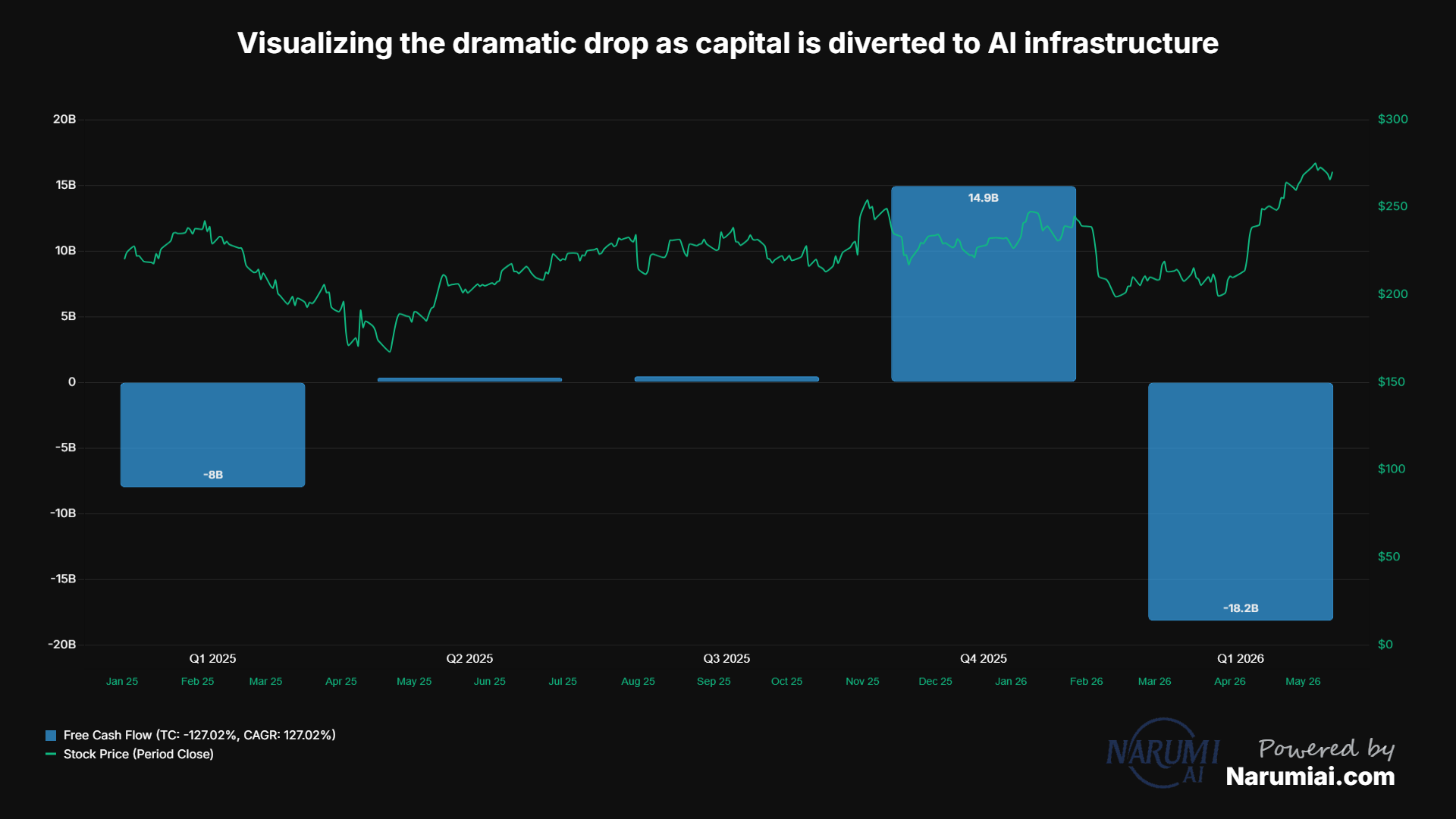
If you think your monthly rent is high, consider Amazon’s 2026 budget. The retail and cloud titan is projecting a mind-melting $200 billion in capital expenditures (CapEx) for the year. To put that in perspective, that’s more than the GDP of many small nations. Amazon is essentially betting the farm on the idea that the winner of the AI race will be the one with the most physical capacity.
However, this spending spree comes with a catch. Amazon’s free cash flow—the 'fun money' a company has left over after paying its bills—has taken a massive hit, plummeting from $26 billion to just $1.2 billion year-over-year. Amazon is operating in a 'War of Attrition' mode, sacrificing short-term profits to ensure that every AI startup on the planet has no choice but to run on AWS hardware. Investors are watching closely: if these massive data centers don't start generating high-margin returns soon, the market's patience might wear thin.
The Nuclear Renaissance and the Power Bottleneck
You can’t run a $200 billion data center on a few solar panels and a dream. AI workloads are energy hogs, requiring 24/7 'baseload' power that intermittent renewables like wind and solar simply can't provide yet. This has led to an unlikely comeback for nuclear and gas energy. Power providers like Vistra and NRG are rapidly expanding their capacity to meet the demands of hyperscalers like Meta and Google.
We’re seeing a 'Bring Your Own Power' trend where tech giants are funding Small Modular Reactors (SMRs) and signing 20-year agreements with nuclear plants. The bottleneck for AI is no longer just the chips; it’s the grid. In some tech hubs, the wait time for a new grid connection now exceeds four years. For companies like Vistra, this means they are no longer just 'boring utilities'—they are the gatekeepers of the AI future.
The Invisible Giants: Copper, Fiber, and Connectivity
While everyone watches the big names, companies like Amphenol are the secret winners of the AI buildout. Think of Amphenol as the plumber of the AI world. Every time Nvidia sells a H100 or a Blackwell chip, it needs high-speed copper and fiber optic cables to connect to the rest of the server. Amphenol’s IT Datacom segment reported a staggering 81% organic revenue growth in Q1 2026. As data speeds move toward 1.6 Terabits, the physical connectors become just as technologically complex as the chips themselves.
The D-Day for Markets: Nvidia’s May 20 Earnings
All eyes are now fixed on May 20, 2026. Nvidia is expected to report nearly $79 billion in sales—a number that would have seemed like science fiction just three years ago. This report isn't just about one company; it’s a litmus test for the entire global economy. If Nvidia beats expectations, it validates the $700 billion collectively being spent by the 'Big Three' (Amazon, Microsoft, Google). If they miss, or even if their guidance is slightly soft, the 'infrastructure bubble' talk will go from a whisper to a roar.
The Verdict: A High-Stakes Game of Musical Chairs
We are currently in the 'build' phase of the AI cycle. The money is flowing into the ground, into the cables, and into the power lines. For retail investors, the takeaway is clear: the AI trade has matured. It’s no longer just about finding the next software app; it’s about identifying the companies that own the physical world. Whether it’s Cisco’s pivot, Amazon’s $200B gamble, or Amphenol’s copper cables, the infrastructure is the story. Just make sure you’re watching the operating margins—because building the future is an expensive business.
Check out our Interactive Charting Tool.