The $200 Billion Poker Game
The Infrastructure Arms Race Hits Geopolitical Proportions
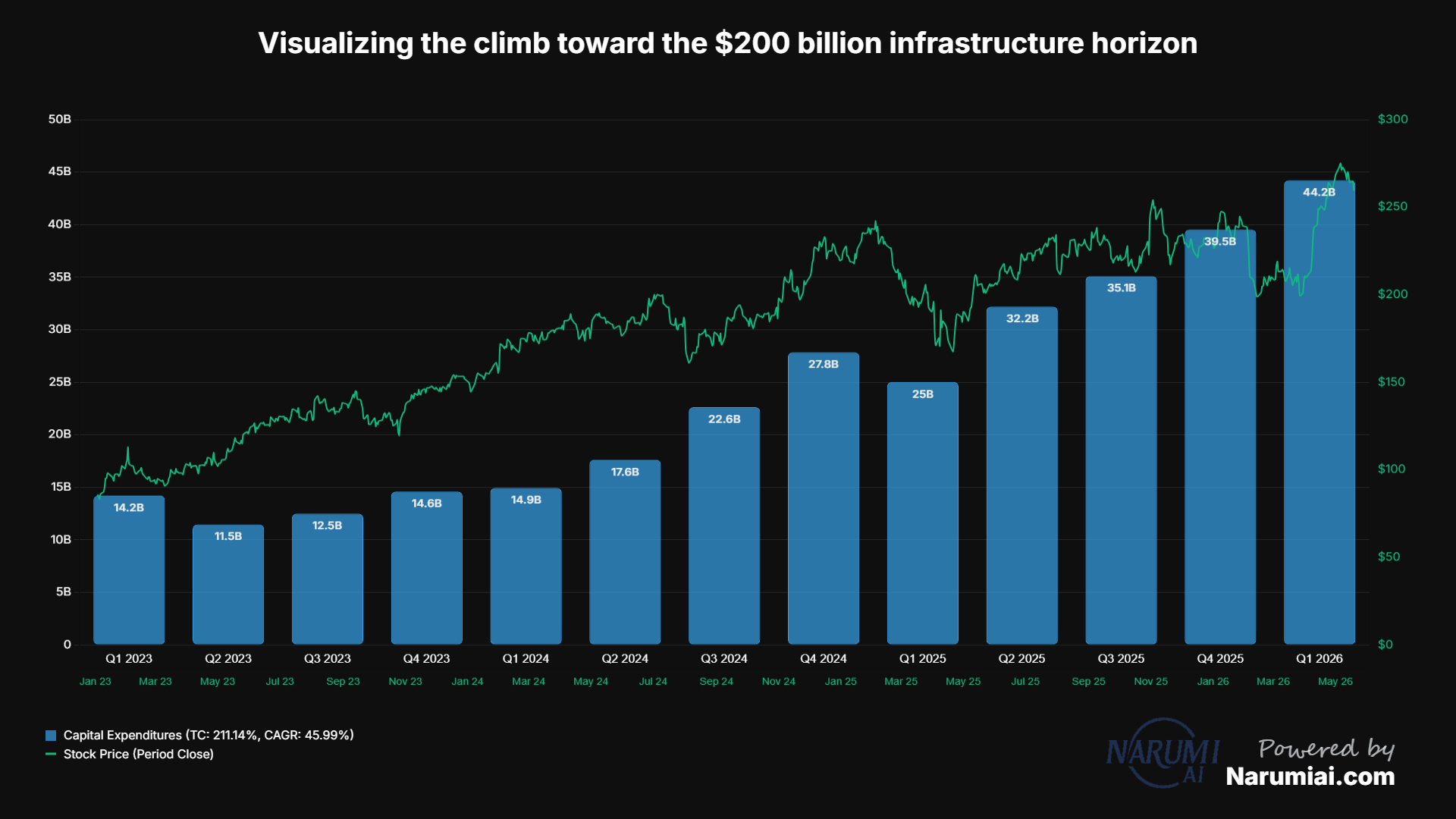
In the wood-paneled conference rooms of Lower Manhattan and the glass-walled offices of Menlo Park, the conversation has shifted. It is no longer about which chatbot can write a better haiku; it is about who can command the most electricity and silicon. As of May 20, 2026, the 'Big Tech AI Race' has evolved into a $200 billion poker game where the ante is nothing less than a company's long-term survival. Amazon is the current protagonist of this drama, hovering at the doorstep of a $3 trillion market cap as its cloud division, AWS, experiences a second wind that has blindsided skeptics.
For years, the narrative was that AWS had grown too large to pivot, a legacy giant tethered to old-school cloud storage while Microsoft Azure and Google Cloud sprinted ahead with generative AI. That narrative just died. AWS revenue growth has surged back into the high 20s, fueled by an annualized generative AI run rate exceeding $15 billion. But the real story isn't just growth; it’s the sheer, brute force of their balance sheet.
The Oracle’s Pivot and the 'SaaSpocalypse'
While Jeff Bezos’s empire builds data centers, the rest of the 'Magnificent Seven' are facing a fundamental reassessment by the world’s most disciplined capital allocators. In a move that sent shockwaves through the valley, Berkshire Hathaway—now steered by Greg Abel—tripled its stake in Alphabet to $23 billion. This isn’t a bet on search; it’s a bet on vertical integration. Unlike its peers, Google’s deployment of its own Tensor Processing Units (TPUs) insulates it from the margin-crushing pricing power of Nvidia. It is a 'low-cost producer' play in a high-cost era.
On the flip side of the ledger, Bill Ackman has ditched Alphabet to 'buy the dip' on Microsoft. The conflict here is what insiders are calling the 'SaaSpocalypse.' There is a growing, silent fear that autonomous AI agents will render traditional productivity software—the very core of Microsoft’s M365 empire—obsolete. If an AI agent can analyze a spreadsheet and generate a report independently, does the enterprise still need to pay for 450 million individual seats? Ackman is betting that Microsoft’s $315 billion 'Remaining Performance Obligation' (RPO)—a metric representing contracted future revenue—is a moat deep enough to survive the transition.
The Switzerland of Silicon
Perhaps the most delicious irony in this boardroom drama is Amazon’s $38 billion cloud capacity deal with OpenAI. Despite Microsoft’s massive equity stake in OpenAI, the world’s leading AI startup is increasingly turning to AWS for its infrastructure needs. By positioning itself as the 'model-agnostic' fabric of the internet—the Switzerland of AI—AWS is ensuring that regardless of which LLM wins the 'intelligence' war, they will likely be paying rent to Amazon to run it.
This 'Switzerland strategy' is bolstered by Amazon’s custom silicon: Trainium and Inferentia. While Azure remains heavily reliant on the 'Nvidia Tax,' AWS is scaling its own chips to offer cheaper, model-agnostic computing. This isn't just a technical flex; it's a structural margin advantage. In an industry where gross margins are the ultimate indicator of pricing power, Nvidia’s upcoming Q1 results—expected to hover around 71% to 72%—will serve as the bellwether. If Nvidia’s margins slip, it suggests that the cost of building the AI future is becoming too expensive even for the giants.
The Verdict: A War of Attrition
We are entering a phase where the 'AI narrative' is being replaced by 'hardcore operational indicators.' Wall Street is no longer listening to AI mentions on earnings calls; they are looking at ROIC (Return on Invested Capital) for data centers that cost more than small-nation GDPs. The winners won't be the ones with the smartest models, but the ones who can manage the 'geopolitical-scale' barrier to entry that infrastructure has become. Amazon, Alphabet, and Microsoft are no longer just software companies; they are the utilities of the 21st century, and the bill is finally coming due.
Check out our Interactive Charting Tool.