The $100 Million Handcuffs: Jamie Dimon’s High-Stakes Succession Gambit

The 50th Floor’s Final Act
At 270 Park Avenue, the air is thick with the scent of a controlled explosion. For twenty years, Jamie Dimon has been the undisputed sun around which the American banking system orbits. But on June 26, 2026, the gravitational pull shifted. The announcement that Doug Petno and Troy Rohrbaugh have been elevated to co-presidents—backed by a staggering $30 million in restricted stock each—is more than a promotion; it is an insurance policy against the chaos that usually follows the departure of a titan. Dimon, now 70, has finally stopped joking that his retirement is 'five years away.' The clock is now at three years, and the bank is spending nine figures to make sure the transition doesn't trigger a bank run of executive talent.
However, the smooth surface of the press release hides a jagged reality. Marianne Lake, the long-tenured executive often whispered to be the first woman to lead a G-SIB of this magnitude, is walking out the door. Her exit creates an immediate vacuum in the consumer division and serves as a warning to the board: even a $4 trillion fortress can’t keep everyone happy when the throne is finally within reach.
A Fortress with Rising Maintenance Costs
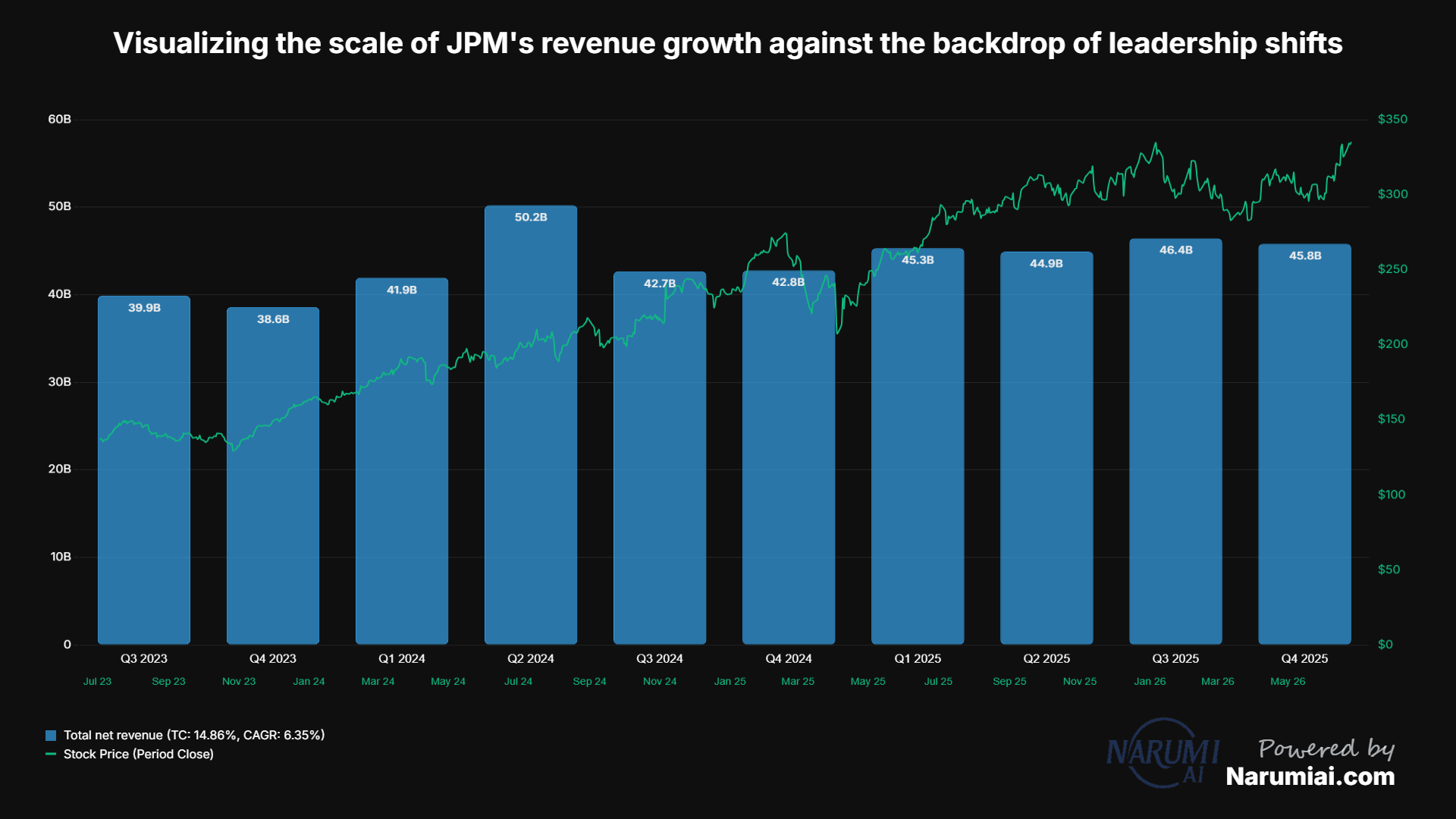
While the market cheered the leadership clarity, a skeptical eye on the bank’s latest regulatory filings reveals a business that is becoming more expensive to run even as it grows larger. JPMorgan’s 'Total Net Revenue' has climbed from $39.87 billion in Q3 2023 to $45.79 billion in Q4 2025, a testament to its scale. But the efficiency that Dimon once boasted of is under siege. We calculated the operating margin—the pure heat of the bank's engine—and the results show a cooling trend. In Q3 2023, the bank turned 41.9% of its revenue into pre-tax income. By Q4 2025, that margin had eroded to 37.4%.
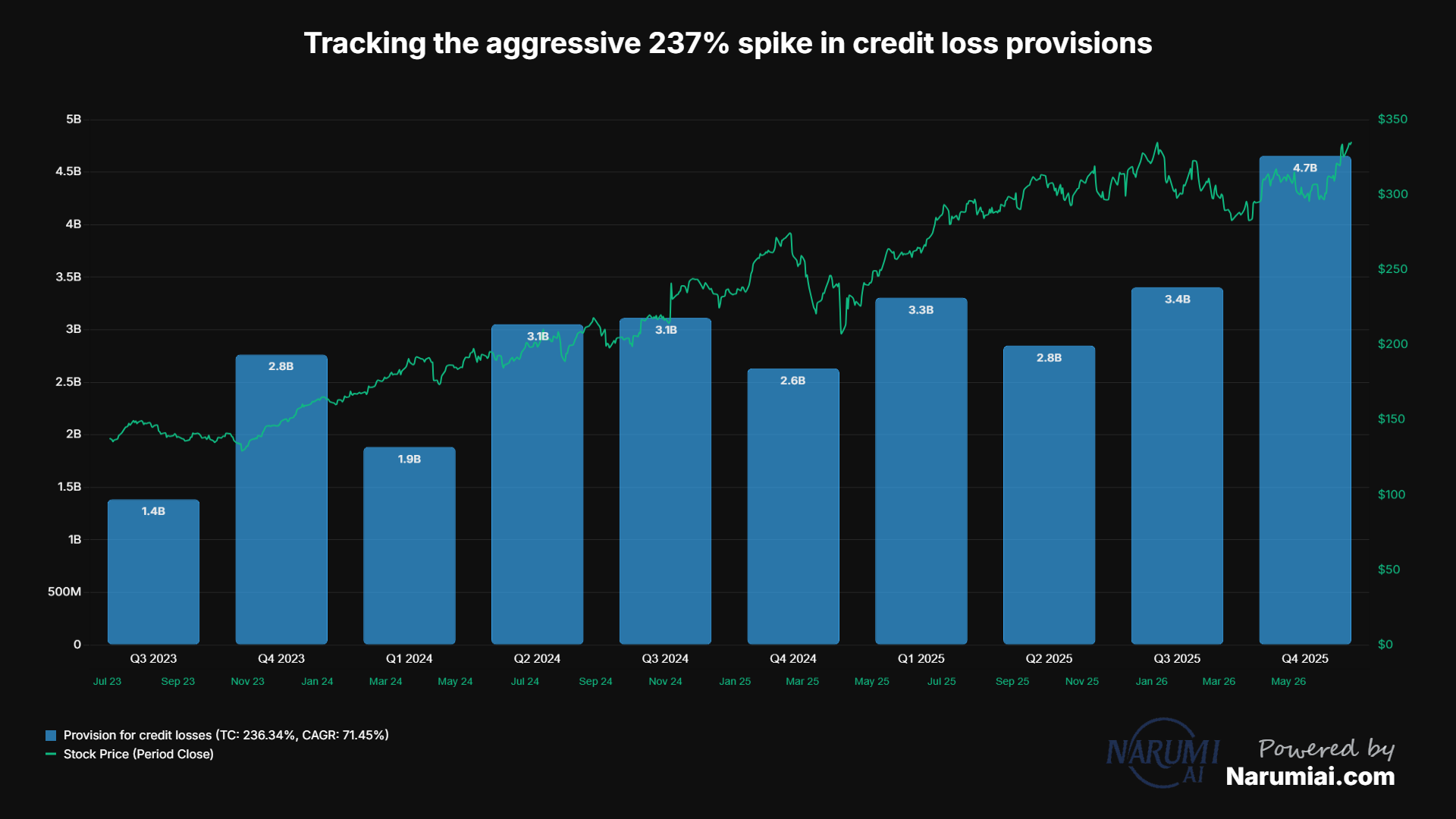
Indeed, the most alarming figure in the Q4 2025 data isn't the executive bonuses—it’s the 'Provision for Credit Losses.' In late 2023, the bank set aside $1.38 billion for rainy days. By the end of 2025, that figure exploded to $4.65 billion. This 237% increase suggests that while the boardroom is focused on who will sit in the big chair, the risk department is bracing for a significant credit event. The bank is essentially paying its leaders more to manage a business that is becoming riskier by the quarter.
The Marianne Lake Wildcard
The departure of Marianne Lake is the 'Black Swan' event of this reshuffle. By passing over Lake for the co-presidency, JPMorgan has inadvertently gifted its rivals a battle-tested CEO-in-waiting. Sources close to the matter suggest that Wells Fargo’s Charlie Scharf—himself a Dimon protégé—might be eyeing Lake to eventually take over the reins in San Francisco. Unlike Citigroup’s Jane Fraser, who is currently mired in a multi-year restructuring, Lake would arrive at a competitor with the 'JPMorgan Playbook' memorized.
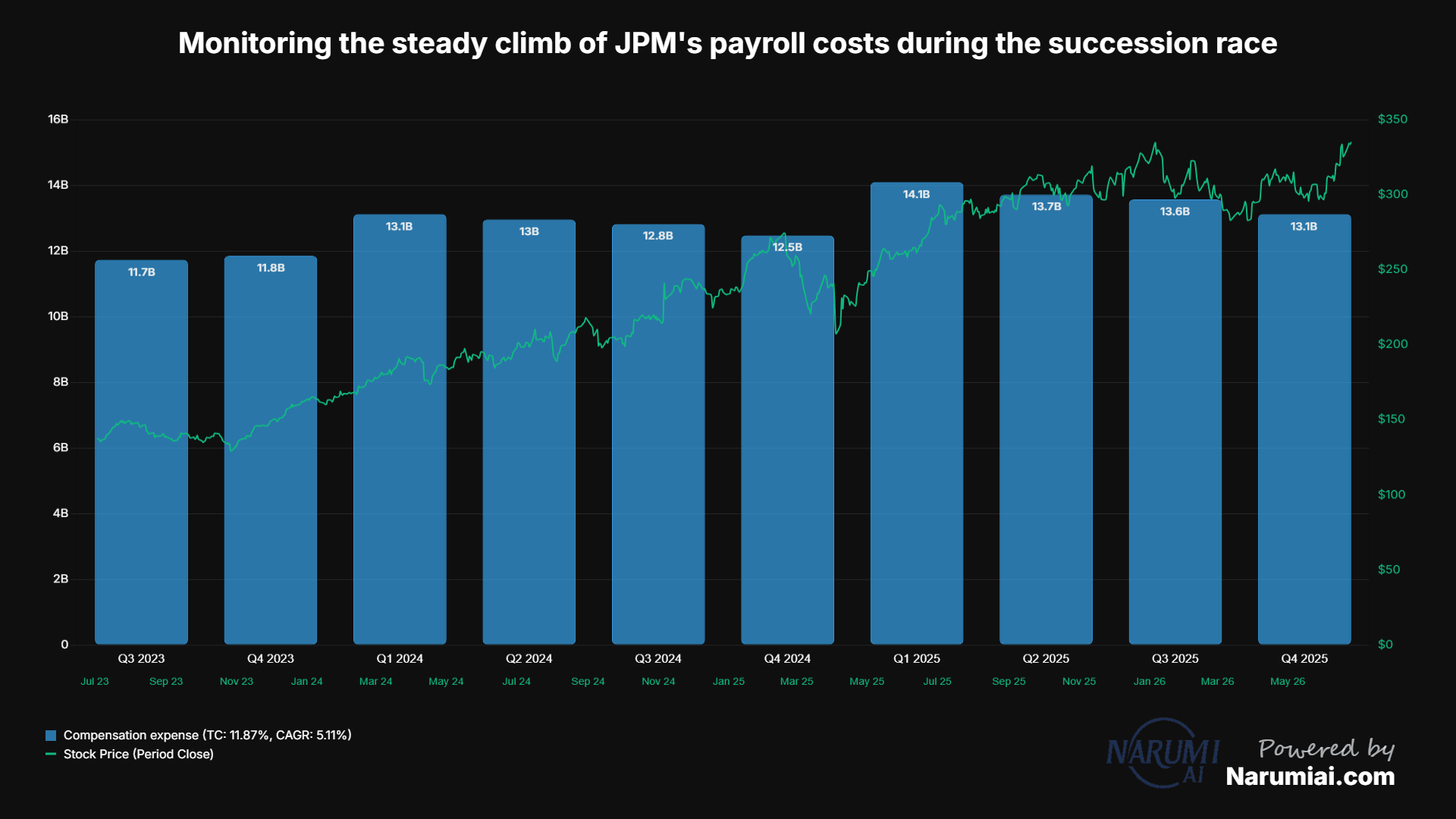
Her exit also highlights a cultural shift. By rewarding the 'trading and advisory' side of the house (Rohrbaugh and Petno) over the consumer and operations side (Lake), Dimon is signaling that JPMorgan’s future remains tethered to Wall Street's volatility rather than Main Street's stability. This is reflected in the 'Noninterest Expense' lines, where 'Compensation Expense' has ballooned from $11.7 billion to $13.1 billion over the same period. The bank is essentially an expensive talent agency that happens to have a balance sheet.
Trading Places: The Cross-Pollination Gamble
The strategy behind the co-presidency is a classic Dimon 'crucible.' Troy Rohrbaugh, a career markets and trading specialist, is being sent to lead the Consumer and Community Banking (CCB) division. It is a move designed to test whether a man who speaks the language of derivatives can understand the needs of 87 million credit card holders. Conversely, Doug Petno takes sole command of the Commercial & Investment Bank (CIB), where he must prove he can manage the high-octane trading desks that were previously Rohrbaugh’s domain.
This 'cross-pollination' is a double-edged sword. While it creates a more rounded CEO candidate, it also introduces operational risk at a time when 'Net Interest Income'—the bank's bread and butter—is showing signs of plateauing. JPM’s Net Interest Income grew from $22.7 billion in Q3 2023 to $24.9 billion in Q4 2025, but the rate of growth is slowing as deposit costs catch up with the bank’s 'fortress' pricing. If Rohrbaugh fumbles the consumer tech integration or Petno misreads a market swing, the $30 million retention awards will look like a very expensive mistake.
The Verdict: A King-Sized Premium
JPMorgan remains the world’s most formidable lender, but the Q4 2025 data shows a bank that is increasingly reliant on its scale to mask rising costs and credit risks. The $100 million total retention package for the top tier of management is a clear signal: the board believes the 'Dimon Premium' is worth protecting at any cost. However, with the P/E ratio drifting toward 15.5x—a high-water mark for a bank of this size—investors are no longer just buying a bank; they are buying the hope that the new co-presidents can maintain the Dimon magic without the magician.
Check out our Interactive Charting Tool.