Tesla’s AI Hail Mary: The $1.4 Trillion Software Gamble
The Ghost in the Machine
In the high-stakes theater of Palo Alto, the narrative has shifted. For years, the bears focused on panel gaps and production hell; today, they are staring at lines of code. It is June 30, 2026, and Tesla is no longer presenting itself as a mere manufacturer of sleek electric sedans. With the rollout of Full Self-Driving (FSD) v14 Lite, Elon Musk is attempting to execute the most audacious software update in industrial history: turning four million 'legacy' vehicles into high-margin AI nodes. The market has responded with a $1.4 trillion valuation, but beneath the surface of the recent delivery acceleration, a complex financial struggle is unfolding.
The 413,000-Unit Mirage
Morgan Stanley’s upward revision of Q2 deliveries to 413,000 units has sent the stock into a frenzy, but a veteran eye on the SEC filings reveals a more nuanced conflict. While deliveries are rebounding from the slumps of 2024 and 2025, the cost of this growth has been steep. When we look at the long-term trajectory, the 'silent bleed' becomes apparent. In Q3 2023, Tesla generated $1.85 billion in net income on $23.35 billion in revenue. Fast forward to Q4 2025, and while total revenues held steady at $24.90 billion, net income plummeted to just $856 million—a staggering 53% erosion in profitability despite a larger operational footprint.
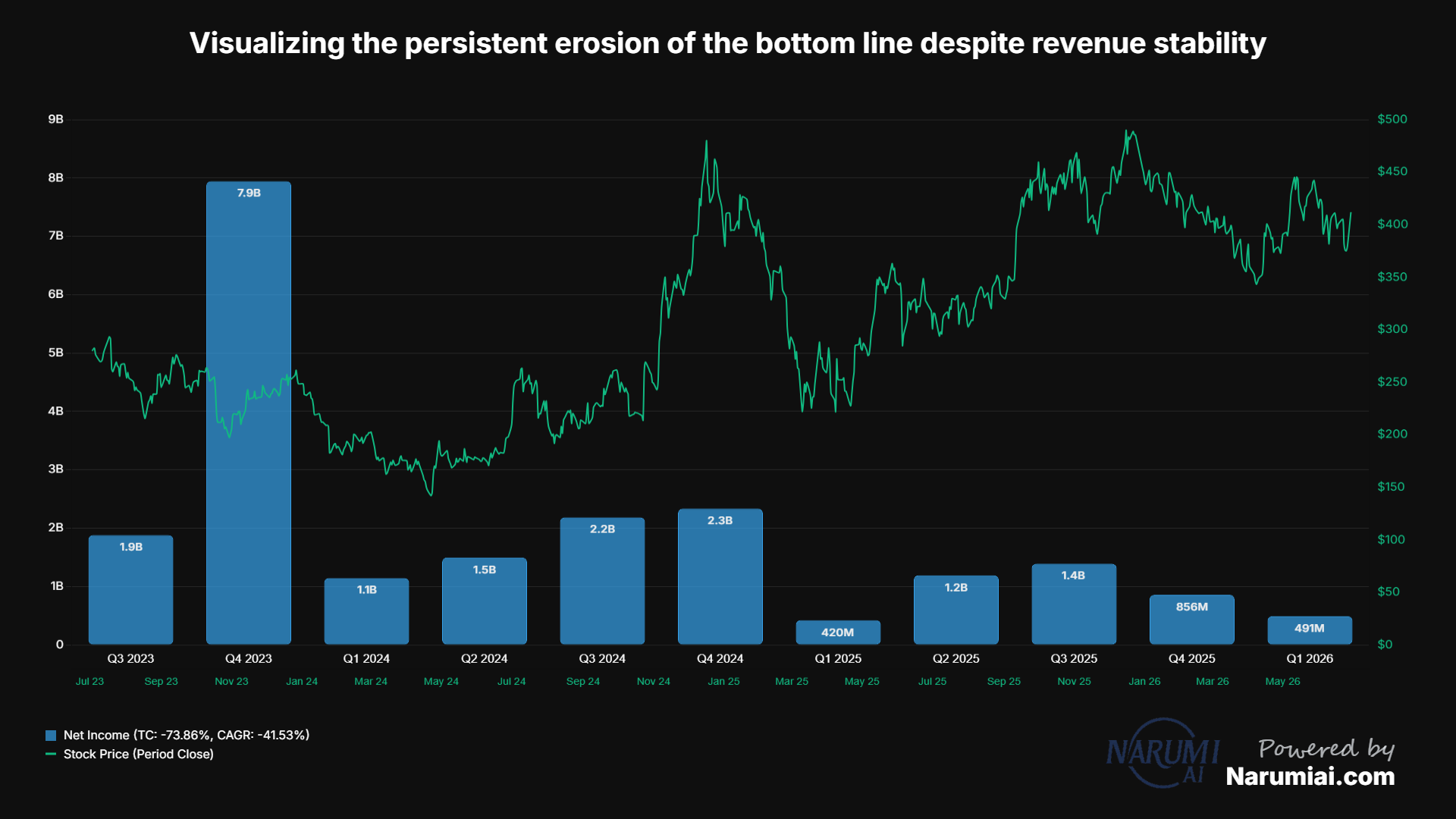
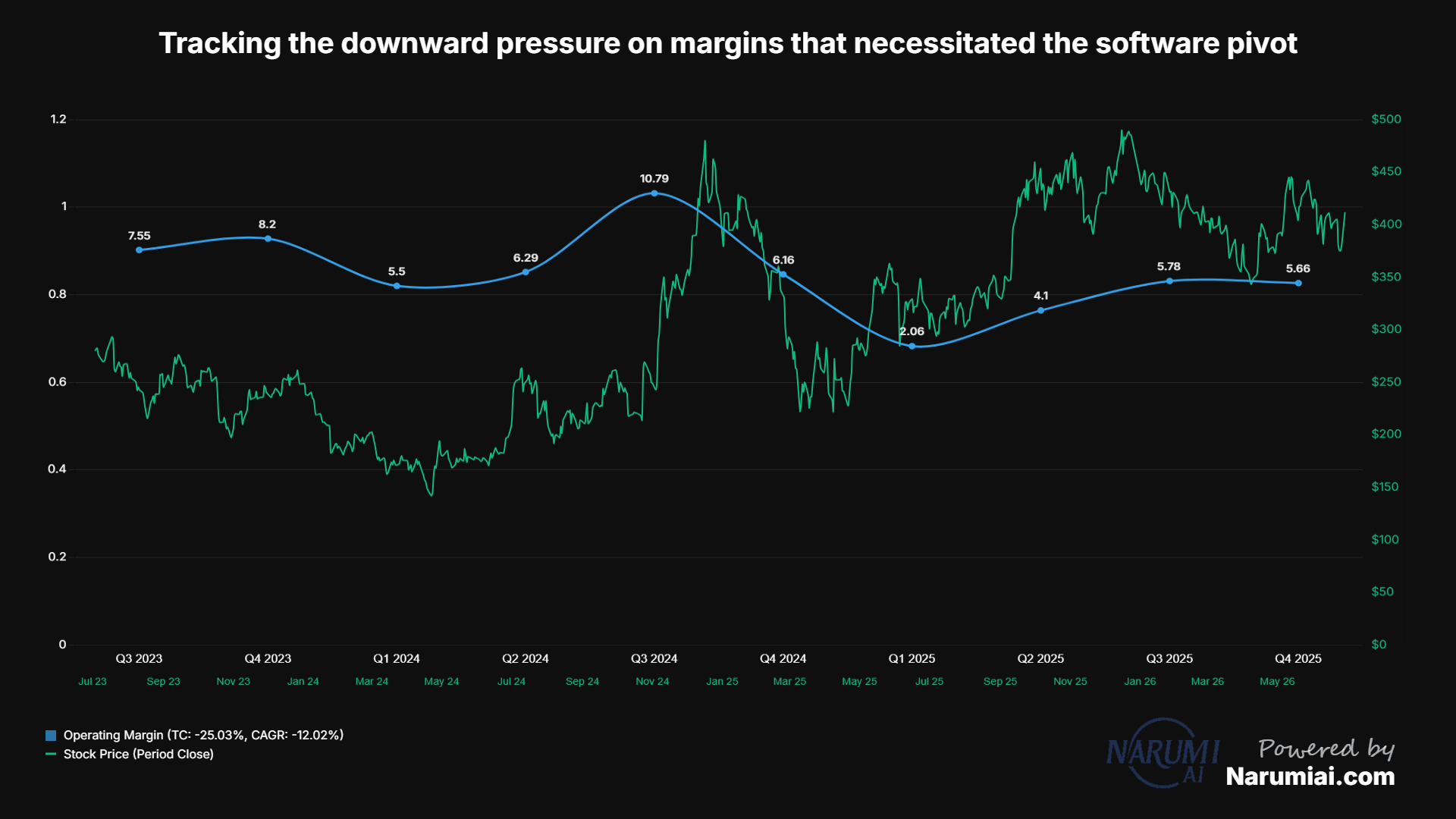
This disconnect is driven by the 'Efficiency Ratio'—or in Tesla's case, the lack thereof in the automotive segment. Operating margins, which stood at a respectable 7.55% in late 2023, have been squeezed down to 5.66% as of the latest filings. The company is selling more cars, but it is making significantly less on each one. This is the 'Why' behind the FSD v14 Lite rollout. Musk needs the $99-per-month subscription revenue to fix a broken automotive margin profile.
Distilling the Future into Legacy Silicon
The strategic genius—or perhaps desperation—of v14 Lite lies in its target: the Hardware 3 (HW3) fleet. By 'distilling' complex AI behaviors designed for newer AI4 chips into the more limited compute capacity of older cars, Tesla is attempting to unlock a recurring revenue stream from owners who have already paid for their vehicles. This is a direct attack on the depreciation curve. If an older Model 3 can suddenly drive itself as well as a 2026 Model S, the resale value stabilizes, and the owner is more likely to enter the high-margin subscription funnel.
However, the R&D costs to maintain this technical wizardry are ballooning. Research and Development expenses have climbed from $1.16 billion in Q3 2023 to $1.78 billion in Q4 2025. Tesla is spending billions to ensure its older hardware doesn't become obsolete, a capital-intensive race against its own engineering history.
The Vultures at the Gates
While Tesla chases the Robotaxi dragon, its competitors are picking up the discarded 'utility' crown. Hyundai and Kia have moved aggressively into the U.S. market, using competitive leasing to bypass tax credit restrictions and capture the pragmatic buyer. Meanwhile, in China, BYD’s vertical integration allows it to thrive in the price war that is currently gutting Tesla’s automotive sales revenue, which fell from a peak of $20.6 billion in Q4 2023 to $16.7 billion in Q4 2025.
The Regulatory Wall
The momentum faces a formidable foe: the NHTSA. The upgrade of federal probes into a formal 'Engineering Analysis' targets the very core of 'Tesla Vision.' If regulators conclude that a camera-only system cannot safely handle low-visibility conditions—sun glare or fog—Tesla could be forced into a massive physical recall or, worse, a software neutering that would render the FSD v14 Lite rollout a moot point. In Europe, the situation is a bureaucratic patchwork. While the Dutch authority has granted provisional approval, France and Spain remain holdouts, waiting for a unified EU decision that could drag into 2027.
The Verdict: Betting on the Multiple
Tesla’s current valuation is a defiance of traditional physics. Trading at a P/E ratio that has surged toward 416x in recent quarters, the market is no longer pricing a car company. It is pricing a miracle. The 'Fundamental Disconnect' is total: the business performance (declining net income, thinning margins) does not justify a $1.4 trillion cap. Only the successful, global, and regulatory-cleared monetization of FSD can bridge that gap.
As we move into the second half of 2026, the question isn't how many cars Tesla can build, but how many subscribers it can keep. The 413,000 units delivered this quarter are just the hardware nodes; the real quarterly report will be written in the subscription data of v14 Lite. If the software fails to convert, the $1.4 trillion dream may finally meet the reality of the balance sheet.
Check out our Interactive Charting Tool.