NVIDIA’s $1 Trillion Flex: The AI War Just Got Personal

Jensen’s World, We’re Just Paying for the Tokens
If you thought the AI hype cycle was nearing its expiration date, Jensen Huang just threw a trillion-dollar bucket of cold water on that thesis. As of late May 2026, NVIDIA ($NVDA) isn't just leading the semiconductor industry; it is effectively absorbing it. With the dual-engine rollout of the Blackwell Ultra and the newly unveiled Vera Rubin architectures, NVIDIA has laid out a roadmap that projects a staggering $1 trillion+ revenue framework over the next few years.
But the battlefield has shifted. The 'Training Era'—where companies threw billions at chips just to see what would happen—is being replaced by the 'Inference Era.' Now, the winners are measured by Return on Investment (ROI) and cost-per-token. While NVIDIA builds the 'AI Factories' of the future, AMD and Intel are launching a guerrilla war on the Green Giant’s margins, attacking the structural bottlenecks of packaging and power.
The Blackwell Behemoth and the Rubin Reveal
To understand NVIDIA’s current dominance, you have to look at the sheer velocity of its financial flywheel. In Q3 2023, NVIDIA was pulling in a respectable (but now seemingly quaint) $18.12 billion in quarterly revenue. Fast forward to Q4 2025, and that number has exploded to $68.13 billion—a 276% increase in just over two years.
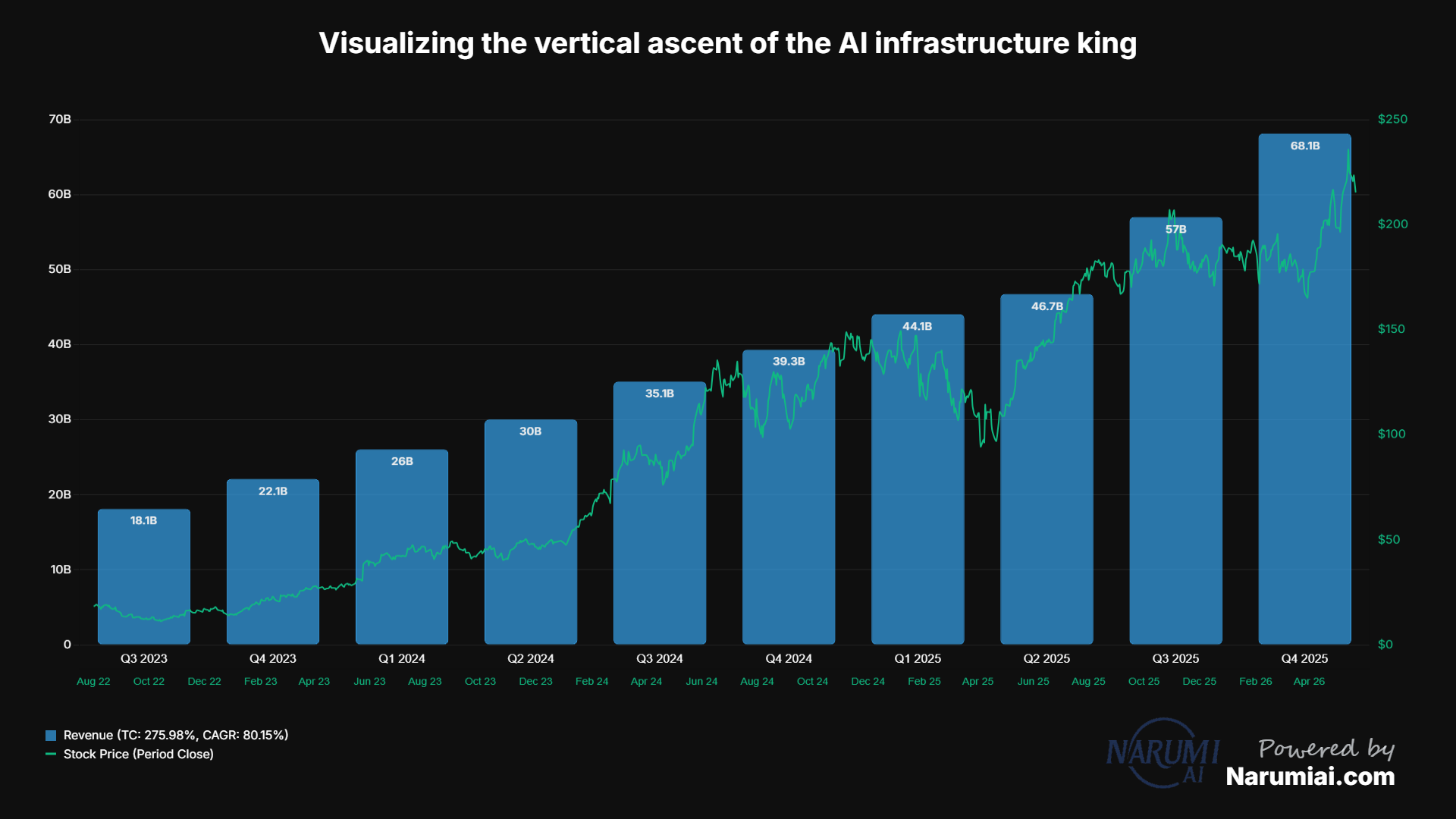
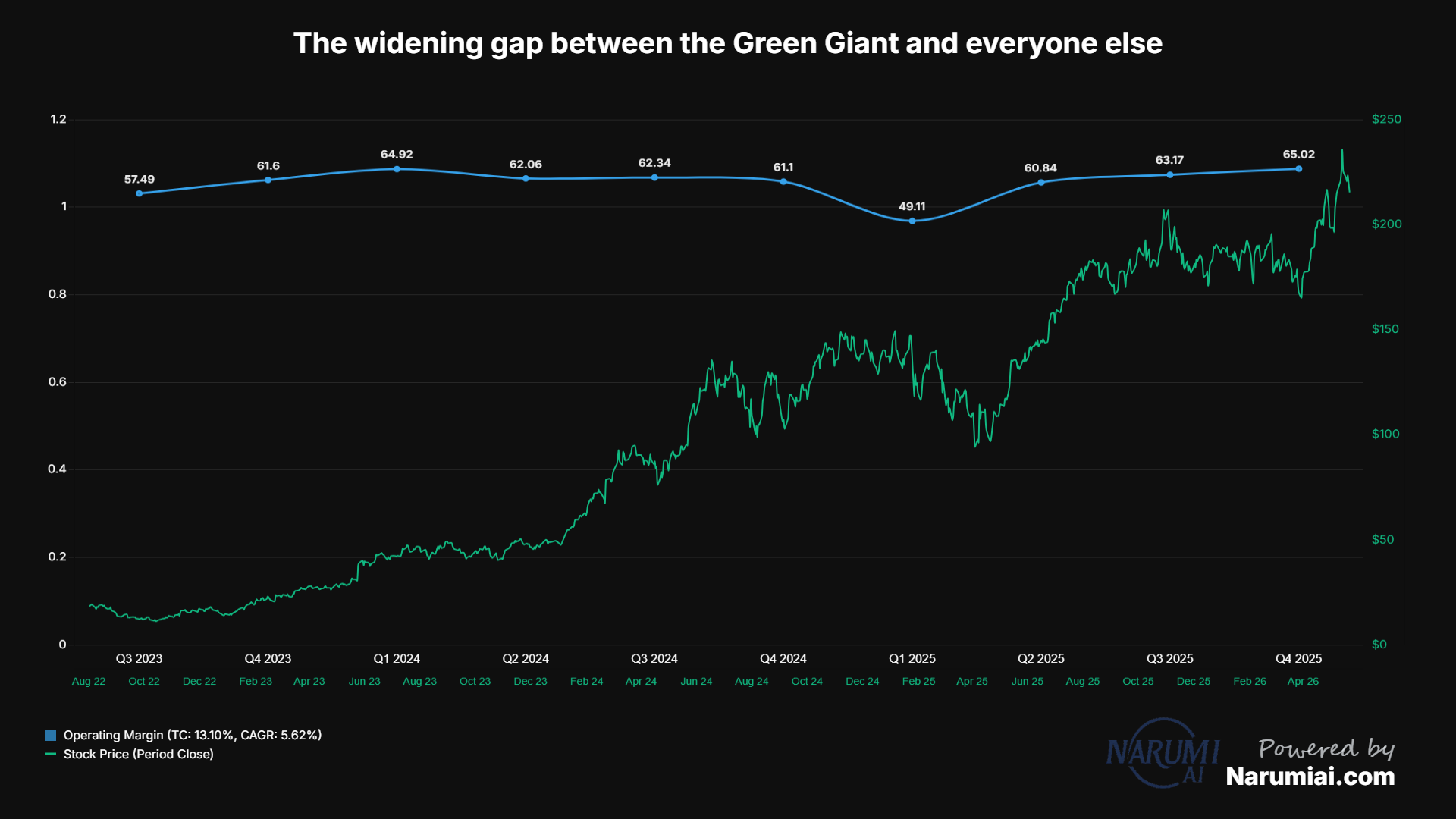
What’s even more terrifying for competitors is NVIDIA’s efficiency. Usually, when a company scales this fast, margins take a hit. Not here. NVIDIA’s Operating Margin climbed from 57.49% in late 2023 to a jaw-dropping 65.02% in the most recent quarter. This is the definition of a 'monopoly tax' on the AI revolution. Every dollar spent on R&D is being squeezed for maximum juice, with R&D as a percentage of revenue actually dropping from 12.6% to 8.09% over the same period, despite absolute spending doubling.
AMD’s $10 Billion Taiwan Sledgehammer
While NVIDIA is building the chips, AMD is trying to fix the plumbing. The biggest bottleneck in AI isn't just design; it’s advanced packaging (think of it as the high-tech gift wrapping that lets multiple chip components talk to each other at light speed). AMD’s $10 billion investment in Taiwan is a direct attempt to break NVIDIA’s stranglehold on the TSMC supply chain.
By industrializing its own Elevated Fanout Bridge (EFB) technology, AMD is positioning its MI355X GPUs as the 'Value King' for inference. AMD’s strategy is simple: give the people more memory. The MI355X features 288GB of HBM3E memory, allowing enterprises to run massive models on fewer chips. For a tier-2 cloud provider, that’s the difference between a profitable AI service and a money pit. AMD’s revenue has grown from $5.8B in Q3 2023 to $10.27B in Q4 2025, proving that there is plenty of room for a high-volume alternative.
Intel’s Agentic AI Hail Mary
Intel ($INTC), meanwhile, has stopped trying to out-muscle NVIDIA in raw training power. Instead, CEO Lip-Bu Tan has pivoted the company toward Agentic AI—the multi-step reasoning loops that represent the next phase of AI applications. Unlike massive LLMs that need parallel GPU clusters, 'agents' depend heavily on CPU multi-threading and task planning.
Intel is leveraging its massive x86 footprint to argue that inference should happen on the servers you already own. By embedding Advanced Matrix Extensions (AMX) into its Xeon processors, Intel is betting that mainstream businesses will choose 'good enough' local inference over 'expensive' cloud GPU clusters. However, the financial reality remains a struggle: Intel’s revenue has actually dipped slightly from $14.16B in Q3 2023 to $13.67B in Q4 2025, highlighting the urgency of its 18A foundry pivot.
The Geopolitical Elephant in the Room
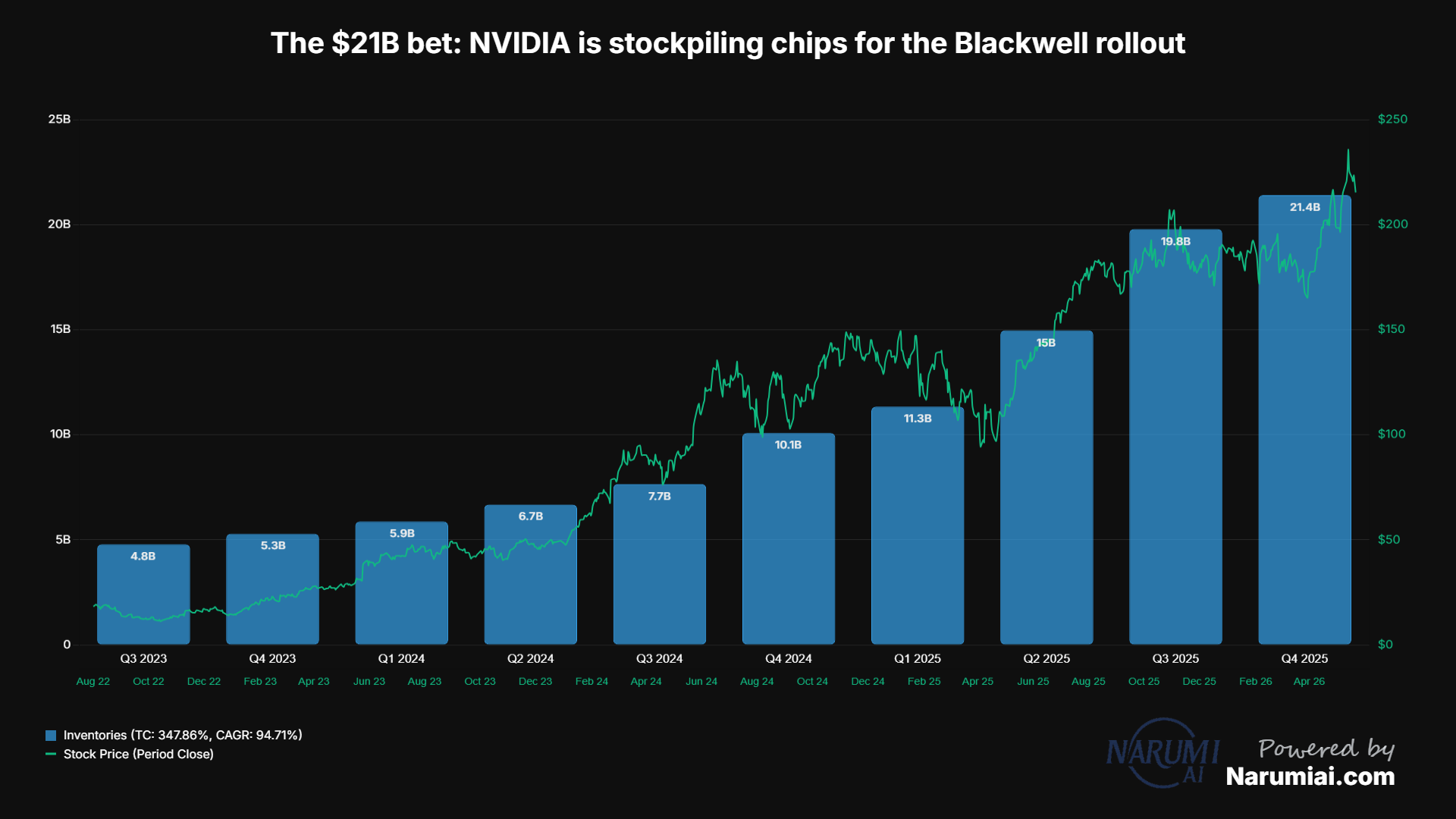
Despite the 'Up and to the Right' charts, the 'AI Chip War' faces two massive risks: China and Hyperscaler Hangovers. China was once a massive revenue pillar for NVIDIA, but current guidance assumes virtually zero compute revenue from the region due to export bans. NVIDIA had to write down $4.5 billion in inventory last year just to deal with the H20 chip fallout.
Furthermore, JPMorgan and other analysts are watching for a 'CapEx cooling cycle.' The massive cloud players (Microsoft, Meta, Google) are spending at a 70% growth rate, but if they don't see a clear path to monetizing these 'thinking tokens,' the $119 billion in supply commitments NVIDIA currently holds could become a liability.
The Verdict: Buying the Future or the Peak?
NVIDIA’s $5.41 trillion market cap is a bet that the 'Reasoning' era of AI is just beginning. With $10.6 billion in cash and a Shareholder Yield that keeps institutional investors happy, NVIDIA is the undisputed heavyweight champion. But for investors, the real question is about duration.
Can NVIDIA maintain a 65% operating margin when AMD is undercutting them on hardware costs and Intel is trying to move the goalposts to the CPU? For now, the 'Green Giant' is running a 24.5x P/E ratio that, surprisingly, looks almost reasonable given its 276% revenue growth. As long as the world keeps demanding more 'thinking tokens,' Jensen Huang’s $1 trillion framework might actually be conservative.
Check out our Interactive Charting Tool.