Nike’s $986 Million Legal Win Can't Hide the Bleeding

The Phantom of the Supreme Court
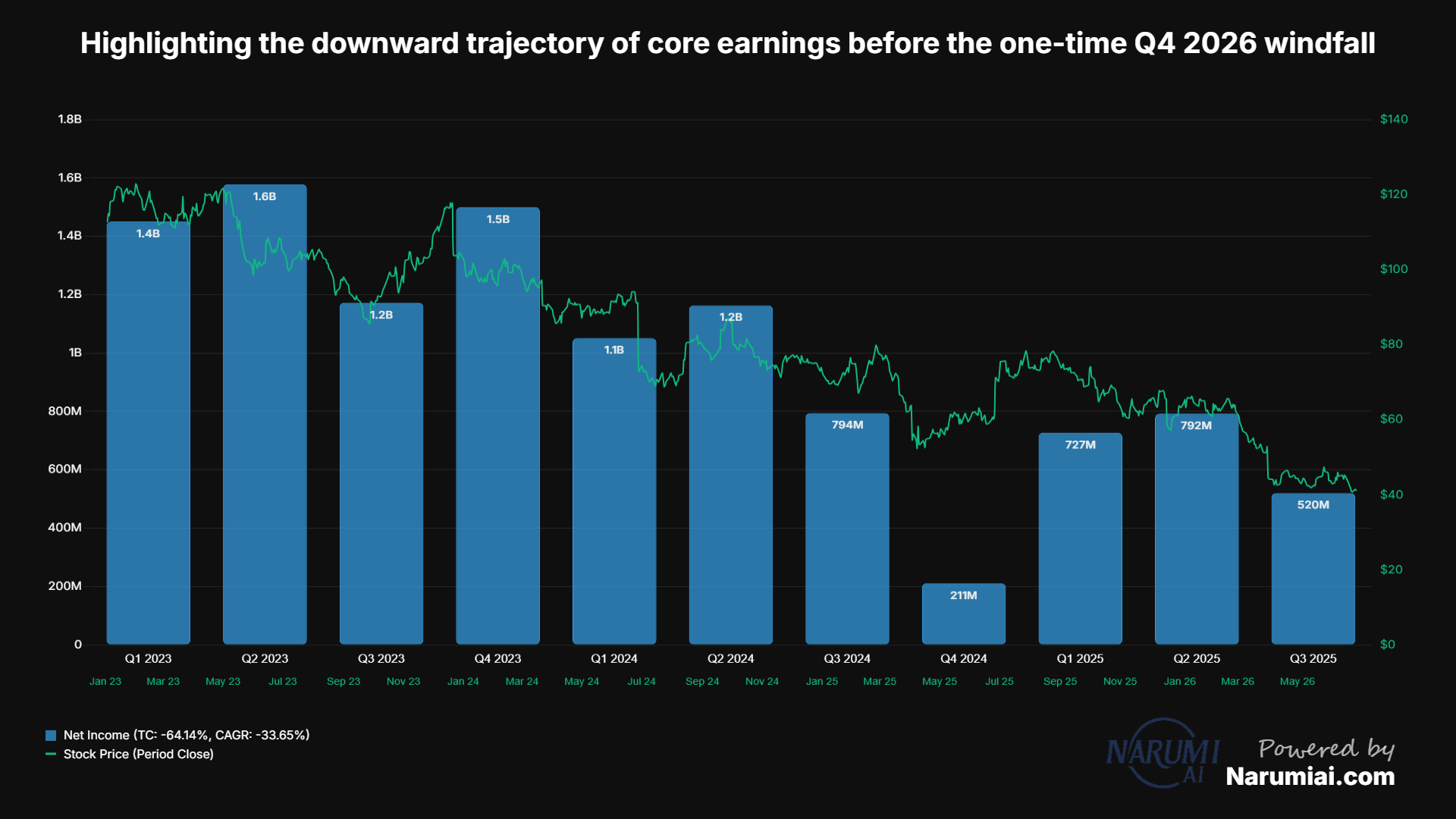
On the surface, the numbers released by Nike ($NKE) for its fiscal fourth quarter of 2026 looked like a masterclass in resilience. The headlines sang of a beat on both top and bottom lines, sending the usual shivers of relief through the retail desks at the major banks. But for those of us who spend our nights dissecting the fine print of SEC filings, the 'beat' felt less like a victory lap and more like a well-timed accounting miracle. The catalyst for this sudden profitability wasn't a breakthrough in sneaker technology or a resurgence in brand heat; it was a gavel. A Supreme Court ruling striking down global duties handed Nike a staggering $986 million tariff refund, a one-time windfall that added 52 cents to the earnings per share.
Without this legal gift, Nike’s adjusted earnings would have been a mere 20 cents per share. While that still technically edged out the 13 cents analysts expected, it highlights a grim reality: the core engine of the world’s most famous sportswear brand is sputtering. The 'Swoosh' is currently navigating a treacherous transition, and the terrain is getting steeper. CEO Elliott Hill, in a moment of refreshing if sober honesty, admitted that the turnaround is 'not linear.' In the language of Wall Street, that is code for 'expect more pain.'
The Great Wall of Rejection
The most alarming signal in the report wasn't the earnings—it was the 12% collapse in Greater China sales. On a constant-currency basis, that decline widened to 17%. For decades, China was Nike’s ATM, a high-growth, high-margin buffer that could offset any seasonal weakness in North America. That era is over. The rise of 'Guochao'—a movement of cultural pride and nationalism among Chinese consumers—has fundamentally shifted the power balance. Domestic heavyweights like Anta Sports and Li-Ning are no longer just 'budget alternatives'; they are the preferred choice for a generation that increasingly views Western brands as stagnant and overpriced.
Nike’s struggle in the East is a toxic cocktail of macroeconomic cooling and strategic missteps. While Nike was busy cutting ties with wholesale partners to force a Direct-to-Consumer (DTC) pivot, Anta and Li-Ning were building vast, agile retail networks in China’s Tier-3 and Tier-4 cities. These domestic rivals can spot a fitness trend and have a product on the shelf in weeks, while Nike’s 18-month design cycle feels like a relic of a slower century.
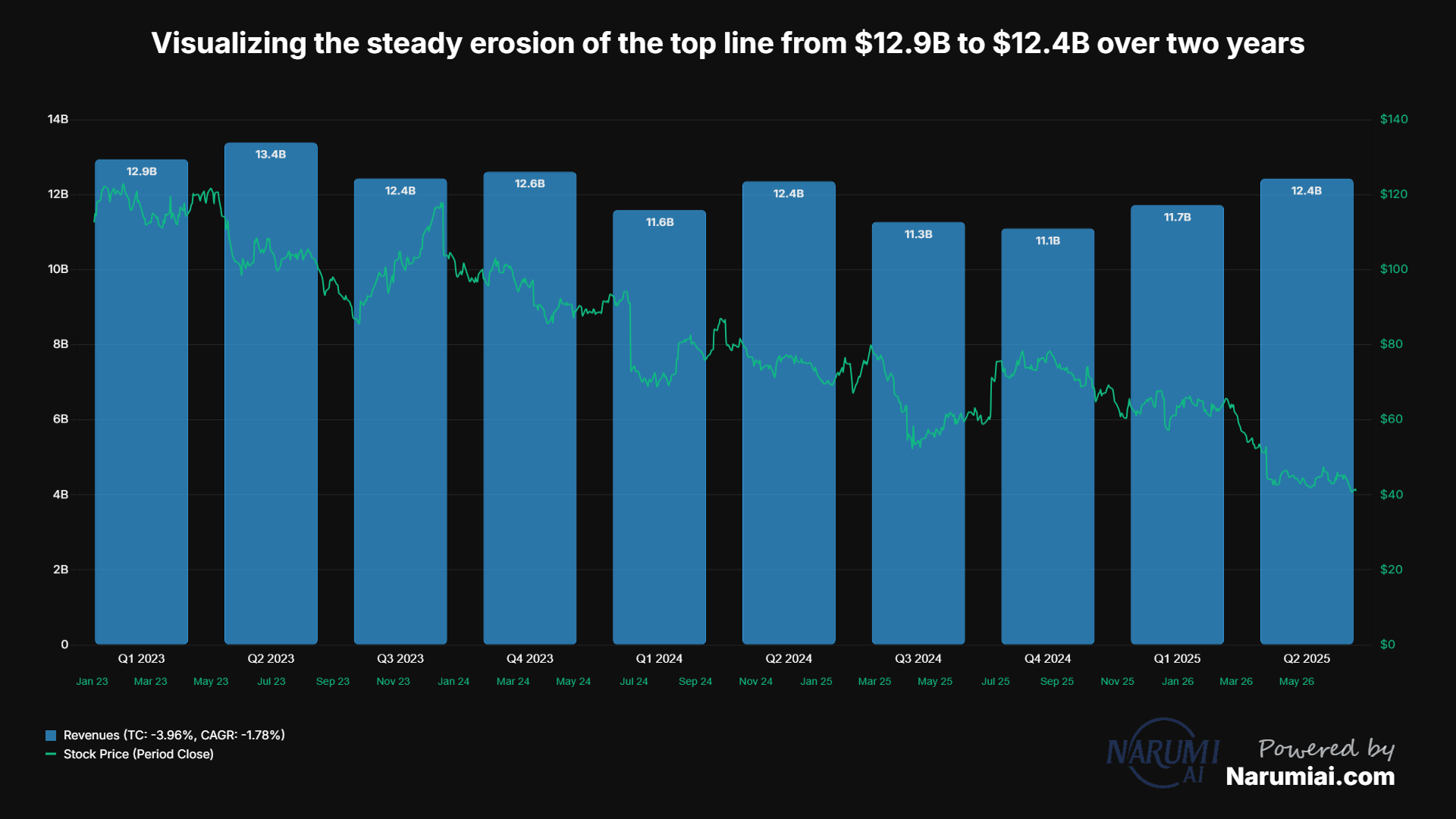
The Innovation Drought and the Rival Sprint
While Nike attempts to 'clean the marketplace' by pulling back on over-saturated legacy franchises like the Dunk and Air Force 1, its competitors are running a different race. Adidas, under the leadership of Bjørn Gulden, has successfully monopolized 'Terrace Culture' with the Samba and Gazelle, capturing the lifestyle market that Nike once owned. Meanwhile, boutique performance brands like Hoka (Deckers Outdoor Corp) are executing a massive land grab in the running space. Hoka crossed the $2.5 billion mark in 2026, guiding for double-digit growth in 2027—the exact period Nike expects to be 'flattish.'
The financial data reveals the silent bleed. If we look at the relationship between revenue and operating efficiency, the trend is clear. In Q2 2023, Nike generated an operating margin of approximately 13.6% (calculated as Gross Profit minus SG&A over total Revenue). Fast forward to Q2 2025, and that margin has compressed to roughly 8.1%. This isn't just a dip; it's a structural erosion of pricing power and operational leverage.
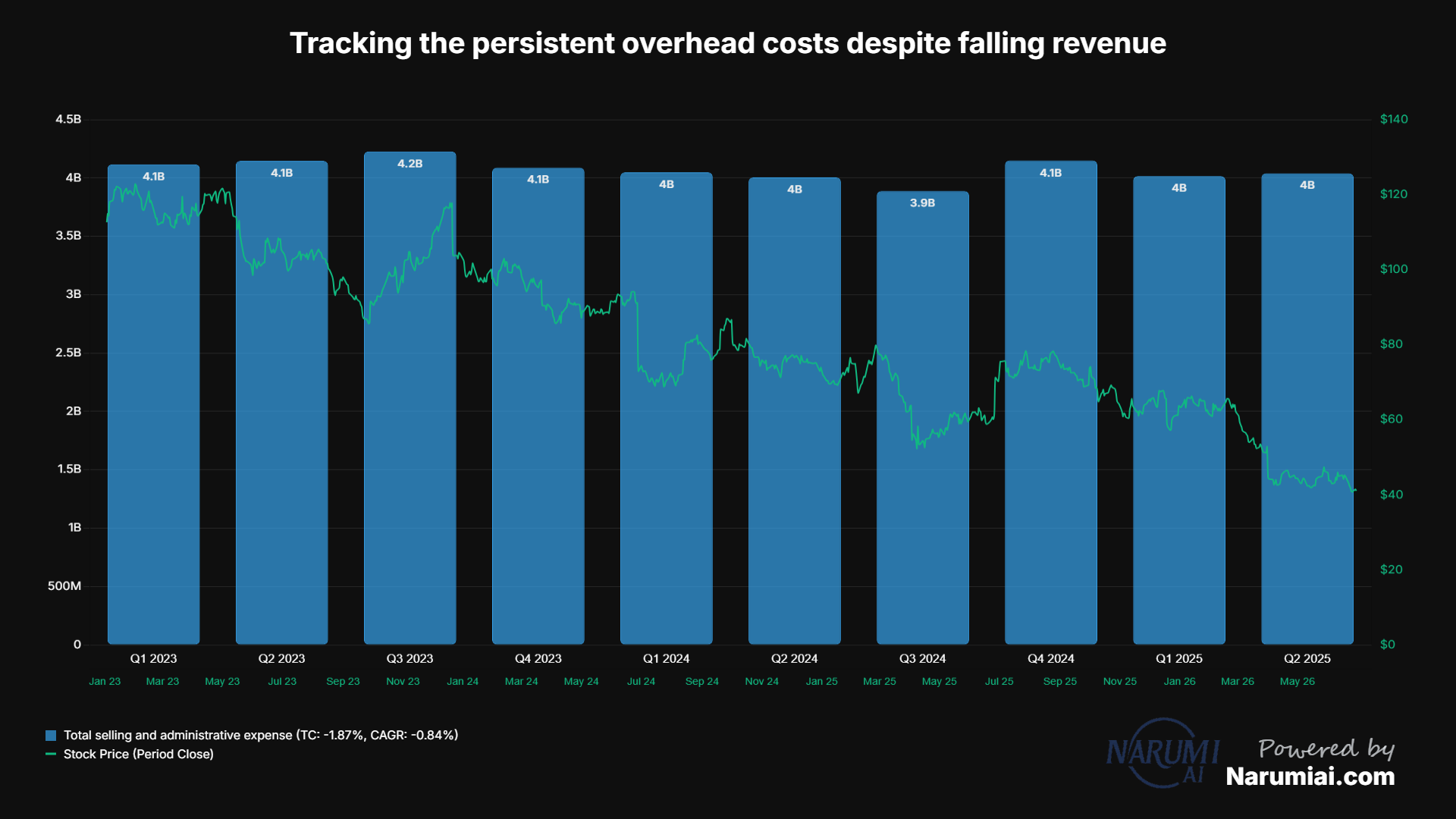
The High Cost of Direct Ambition
The hyper-focus on DTC—the brainchild of the previous leadership—has left Nike uniquely exposed. By cutting out the 'middleman,' Nike also cut out its financial shock absorbers. In a traditional wholesale model, retailers like Foot Locker or Dick’s Sporting Goods share the risk of holding inventory. In the DTC model, Nike owns 100% of the risk. When Chinese consumers pulled back in April, Nike was left holding the bag—literally. The result was a glut of inventory that required heavy, brand-eroding promotions to clear.
Furthermore, the cost of acquiring a customer digitally has skyrocketed. Inflation has driven up the costs of warehouse labor, logistics, and digital advertising. Bypassing wholesale was supposed to expand margins, but the reality has been the opposite: Nike is spending more to sell less. The current strategy of re-engaging wholesale partners is a necessary retreat, but it is one that will take years to bear fruit.
The Verdict: A Long Road to 2028
The $986 million tariff refund provided a convenient cushion for the fiscal year, but it cannot fix a broken product pipeline. Nike’s 'Sport Offense' realignment—which includes cutting 1,400 roles to move design teams closer to manufacturing—is the right move, but it is a move made in desperation. The company’s own guidance suggests that meaningful 'newness' won't arrive at scale until the latter half of fiscal 2027.
For investors, the question is no longer whether Nike is a 'growth' stock—it clearly isn't. The question is whether it can survive as a 'turnaround' story without losing its soul. With a Cash Flow to Debt ratio that has plummeted from 0.31 in early 2023 to a precarious 0.16 by Q2 2025, the financial flexibility to buy back its way into relevance is narrowing. The Swoosh is at a crossroads, and for the first time in decades, it isn't the one setting the pace.
Check out our Interactive Charting Tool.