GM’s Great Skills Swap: Why Detroit is Trading Coders for AI

The Great Skills Swap of 2026
General Motors isn’t just building trucks anymore; it’s building a brain. This week, the automotive giant confirmed it is laying off between 500 and 600 salaried IT workers across Texas and Michigan. In the old world of Detroit, a layoff meant the balance sheet was bleeding. In 2026, it means something entirely different: a 'skills swap.' GM is clearing out legacy IT roles to make room for AI architects, autonomous vehicle (AV) specialists, and data engineers. It’s a brutal, high-speed heart transplant designed to turn a 118-year-old manufacturer into a software-first powerhouse.
The move comes as GM attempts to rebuild its technical backbone from the ground up. According to internal reports, a staggering 90% of GM’s autonomous driving code is now written by AI, not humans. This shift fundamentally changes the job description. The company no longer needs thousands of manual coders; it needs high-level system architects who can oversee the machines doing the heavy lifting. As one Industry Insider put it:
The $3.6 Billion Red Flag
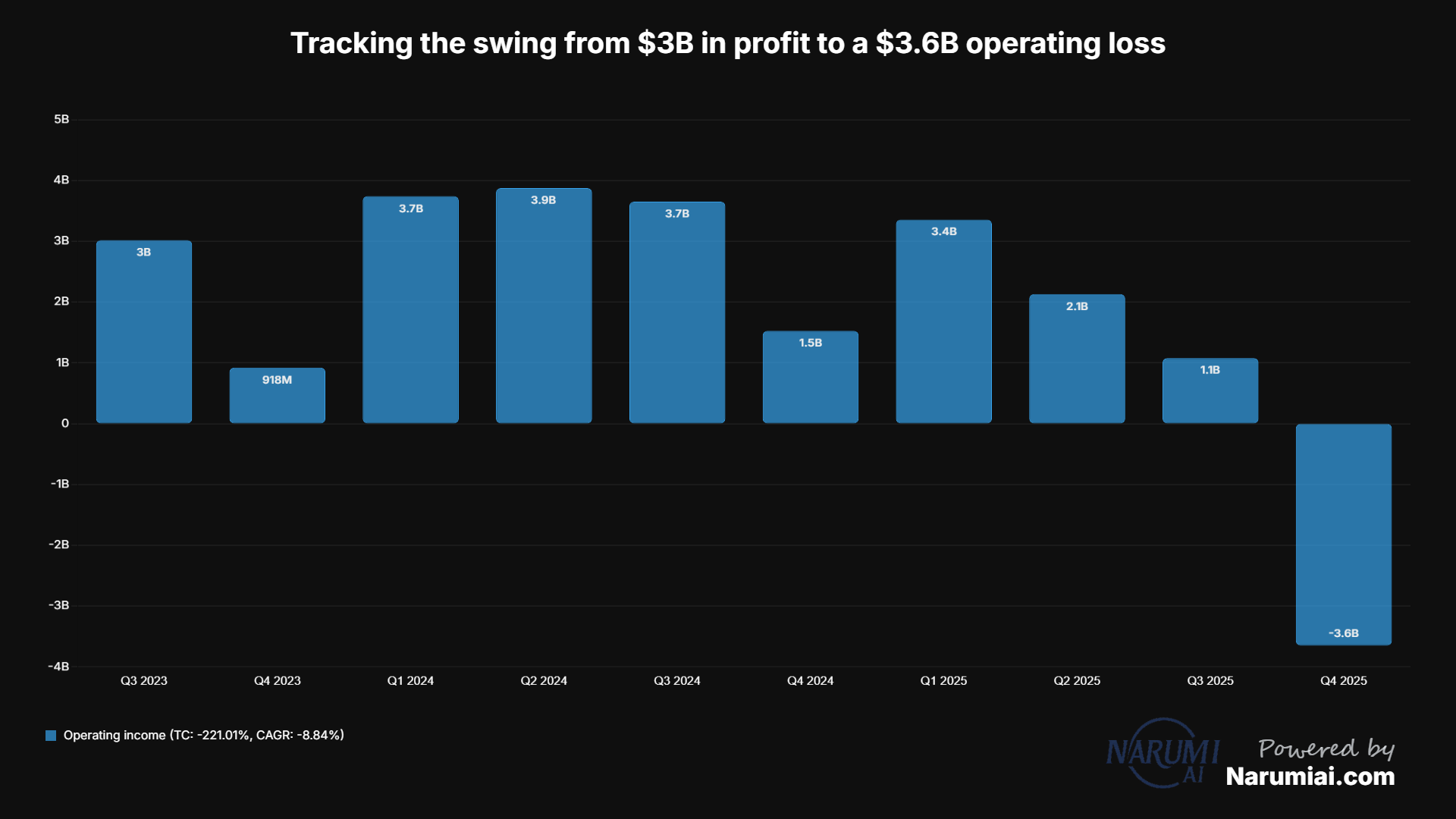
While the 'skills swap' sounds visionary, the financial data suggests GM is under immense pressure to find efficiency. When we look at the trajectory from Q3 2023 to Q4 2025, the numbers tell a story of rising complexity and thinning patience. In Q3 2023, GM was a profit machine, churning out nearly $3 billion in net income. Fast forward to Q4 2025, and the company reported a staggering Operating Loss of $3.64 billion.
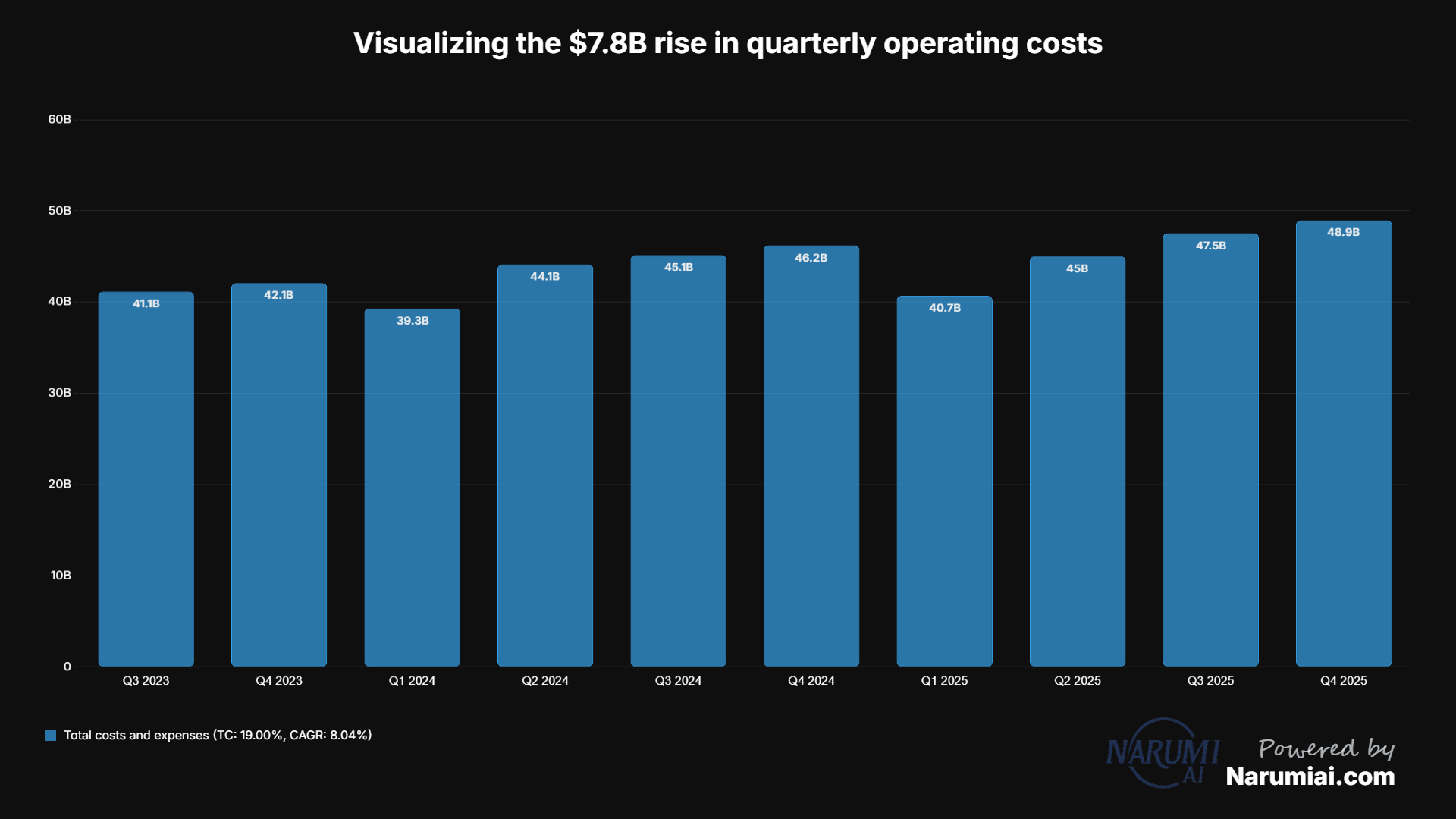
Despite total revenue holding steady—climbing slightly from $44.1 billion in Q3 2023 to $45.2 billion in Q4 2025—the cost of doing business has exploded. Total costs and expenses surged from $41.1 billion to $48.9 billion in that same window. This created a negative Operating Margin of -8.05% in the most recent quarter. For investors, these layoffs aren't just about 'innovation'; they are a necessary response to a business model where expenses are currently outrunning sales.
When 90% of Your Code Writes Itself
GM’s pivot isn’t happening in a vacuum. The company is aggressively consolidating its tech divisions, moving talent from traditional IT into its Autonomous Vehicle (AV) and Cruise sectors. The goal? To solve the technical hurdles that have historically plagued the Cruise division. By hiring heavy hitters like Sterling Anderson and Rashed Haq, GM is signaling that it wants to own the full AI stack rather than relying on external partnerships like rival Stellantis ($STLA), which leans on Amazon and Leapmotor.
This 'AI-native' strategy puts GM on a collision course with Ford ($F). While Ford is focused on 'democratizing autonomy' by making Level 2+ systems like BlueCruise affordable for the masses, GM is swinging for the fences with full Level 4 autonomy. It’s a high-risk, high-reward bet that the future of the car isn't just a vehicle that helps you drive, but a 'mobile office' that handles the urban navigation challenge entirely on its own.
The Pit Crew is the New R&D Lab
One of the most fascinating pillars of GM’s reallocation is its renewed focus on motorsports. This isn't about trophies; it’s about rapid prototyping. GM is using racing as a high-stress lab to test AI-driven strategies and real-time image analysis. In the racing world, design cycles are measured in weeks, not years. By feeding racing data directly into its consumer AI models, GM hopes to create a high-speed feedback loop that gives its electric trucks and SUVs a technical edge. If an AI can optimize thermal management for a race car at Le Mans, it can certainly squeeze an extra 20 miles of range out of a Chevy Silverado EV.
Navigating the Algorithmic Minefield
However, replacing humans with AI—and using AI to decide which humans to replace—is a regulatory nightmare. In the European Union, GM’s use of AI for workforce management now falls under the 'High-Risk' category of the EU AI Act. This means mandatory audits and the threat of fines reaching 7% of global turnover if their algorithms show bias.
Even at home, the 'Reasonable Care' standard in US employment law means GM could be liable for 'algorithmic discrimination' if their AI-driven layoff process disproportionately impacted protected groups. As one Market Analyst noted:
The Investor Verdict: Cautious Optimism
Institutional investors are currently playing a game of wait-and-see. On one hand, Wall Street loves the $23 billion GM has returned to shareholders via buybacks and dividends since 2023. On the other hand, the 4.45% drop in stock price following the layoff announcement suggests anxiety. Investors are worried that GM might be 'hollowing out' its traditional IT backbone before the new AI talent is fully onboarded.
The real test will be the 2027 launch of the Chevrolet Bolt, which is expected to be the first 'affordable' mass-market car featuring GM’s next-gen AI autonomy. If GM can prove that its 'AI-native' workforce can deliver software that customers will pay for monthly, the stock could finally decouple from the 'legacy automaker' label and start trading like a tech giant. Until then, Mary Barra is walking a tightrope between a legacy cash cow and a silicon moonshot.
Check out our Interactive Charting Tool.