Ford’s $2 Billion Bet on the AI Grid

The Industrial Real Option
In the theater of global macroeconomics, the most successful actors are those who can transform a sunk cost into a strategic pivot. Ford Motor Company’s ($F) recent announcement of a $2 billion battery-storage subsidiary, Ford Energy, is not merely a diversification play; it is a profound exercise in capital reclamation. By repurposing its massive Glendale, Kentucky manufacturing footprint to produce 5.45 MWh containerized 'DC Blocks,' Ford is effectively salvaging multi-billion-dollar investments originally intended for a consumer EV market that has cooled significantly. This is what we call an 'Industrial Real Option'—the ability to shift production from a volatile consumer product to a high-demand infrastructure asset without abandoning the underlying technology stack.
The Margin of Safety in Utility Scale
While the automotive sector is notoriously cyclical, utility-scale infrastructure operates on a different temporal plane. The demand for grid reliability and data center power is structural, not seasonal. Ford’s latest financial data reflects a company in the midst of this transition. In Q3 2025, total revenues hit $50.53 billion, up nearly 9.4% from $46.20 billion in the same period of 2024. More impressively, net income attributable to Ford jumped from $892 million to a staggering $2.45 billion over that same timeframe.
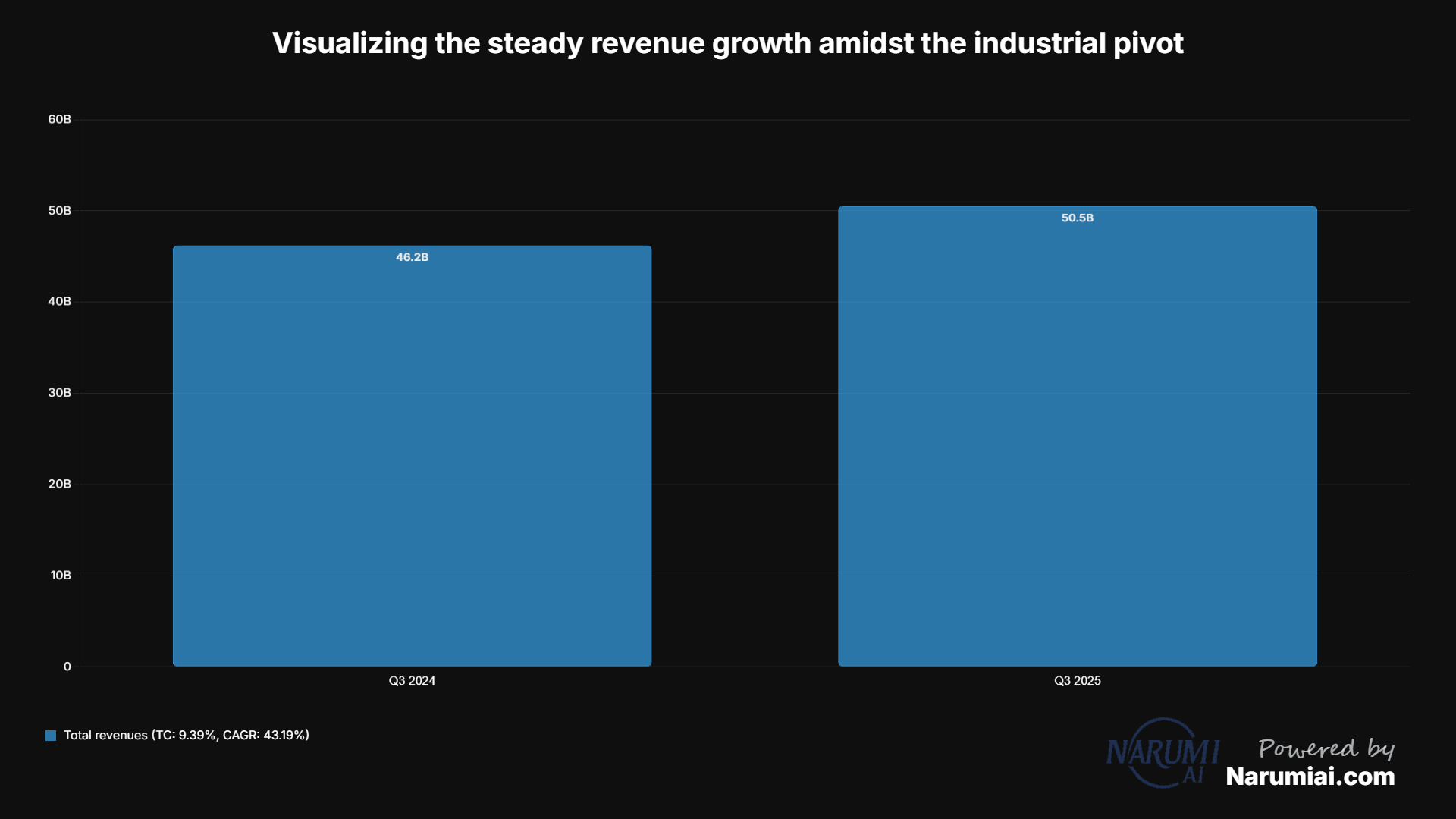
However, the real story lies in the efficiency of this capital allocation. By calculating the operating margin—Operating Income divided by Total Revenue—we see an improvement from roughly 1.9% in Q3 2024 to 3.08% in Q3 2025. While these margins remain slim by software standards, they represent a significant strengthening of the core business as it begins to integrate higher-margin industrial energy contracts, such as its 20 GWh framework agreement with EDF Power Solutions.
A Century of Bankability
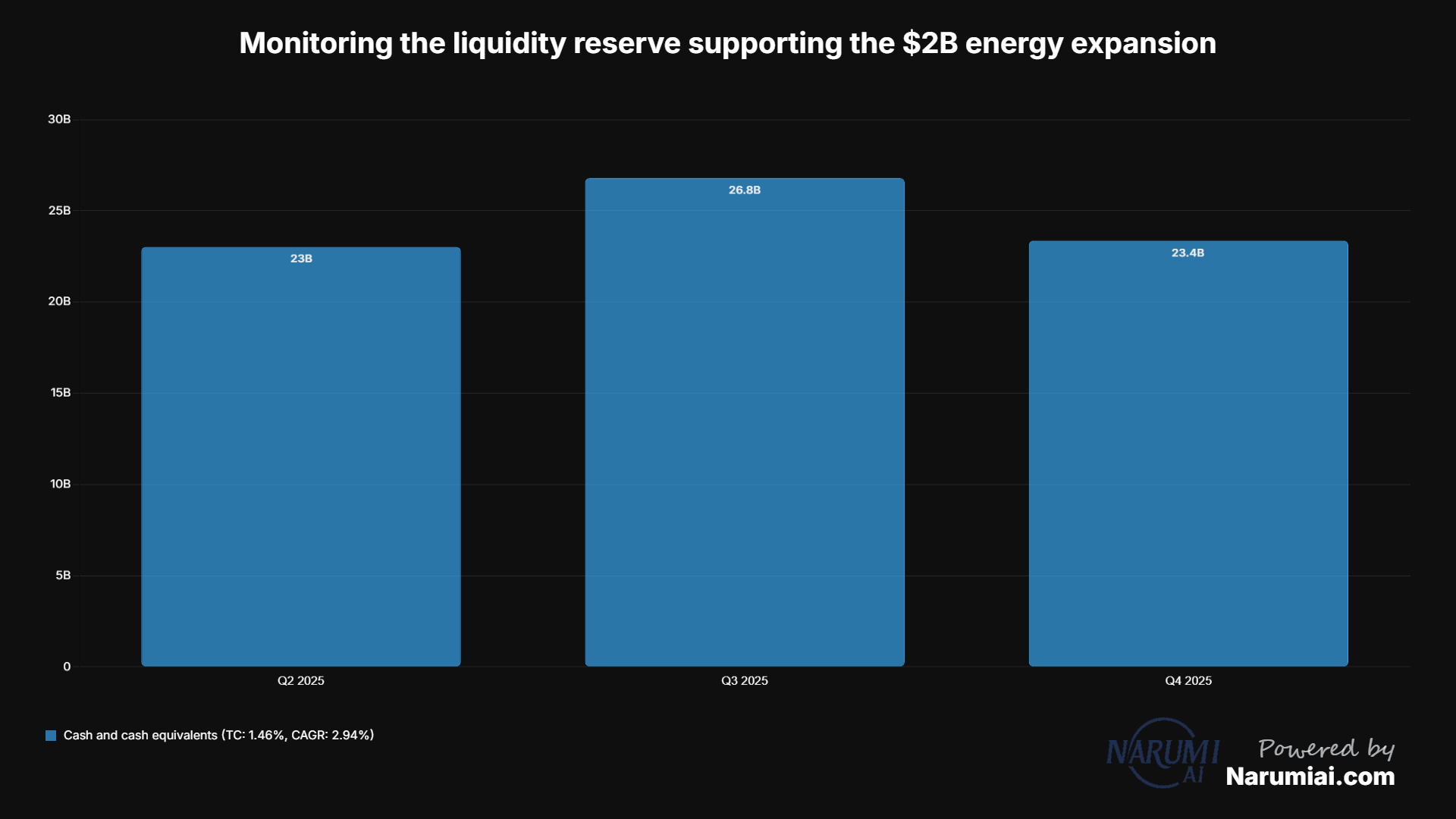
In the world of utility-scale energy, the most valuable currency is not innovation, but 'bankability.' When a utility or a hyperscale data center operator signs a 20-year contract, they are betting on the counterparty's survival. This is where Ford’s 122-year legacy becomes a formidable economic moat. While renewable energy startups struggle with high interest rates and unproven balance sheets, Ford sits on $23.36 billion in cash and cash equivalents as of Q4 2025. This liquidity allows Ford to honor long-term warranties and navigate the complex regulatory environments that stymie smaller competitors.
Furthermore, Ford's use of Lithium Iron Phosphate (LFP) technology, licensed through CATL, provides a cost-effective and durable solution for stationary storage. The scale of manufacturing these cells for the grid will inevitably drive down the per-unit cost for Ford’s automotive line, creating a virtuous cycle of cost-reduction that traditional energy firms cannot replicate.
The Geopolitical Relief Valve
No macro analysis is complete without accounting for the friction of global trade. The reported 60-day ceasefire extension between the U.S. and Iran offers a critical 'relief valve' for Ford’s logistics. The Strait of Hormuz handles 20% of the world’s seaborne petroleum; its stabilization directly lowers the input costs for energy-intensive materials like steel and aluminum. For an automaker with $43.41 billion in quarterly cost of sales, even a minor reduction in global freight premiums and petrochemical costs can lead to massive bottom-line expansions.
The Next Decade: From Cars to Kilowatts
Ford is no longer just competing with General Motors or Tesla; it is positioning itself against energy infrastructure titans like Fluence and Wärtsilä. The pivot to battery storage allows Ford to bypass the 'interconnection queue' bottleneck by co-locating storage with renewable projects like Vesper Energy’s 201MW solar plant in Texas. This strategy transforms Ford from a seller of depreciating assets (cars) into a provider of appreciating utility (energy security).
As we look toward the next decade, the successful execution of Ford Energy will likely be the primary driver of the company's valuation multiple. If Ford can prove that it is a 'bankable' backbone of the AI-driven grid, the market will eventually stop valuing it as a cyclical manufacturer and start valuing it as a diversified industrial energy titan. The $2 billion investment is not just a budget line item; it is the foundation of Ford’s second century.
Check out our Interactive Charting Tool.