Comcast's Great Divorce: The $100 Billion Gamble on Purity
The Final Act of the Conglomerate Myth
In the wood-paneled boardrooms of Philadelphia, the dream of the 'one-stop shop' has finally been laid to rest. On June 30, 2026, Comcast ($CMCSA) officially announced the structural amputation of its media limb, spinning off NBCUniversal and Sky into a standalone entity. For years, Brian Roberts championed the synergy of 'pipes and pictures,' but the cold reality of the 2020s—defined by the streaming wars' bottomless pits and the relentless capital demands of fiber optics—has forced a strategic retreat. This isn't just a corporate reshuffle; it is a tactical admission that the era of the media-telecom conglomerate is dead. Comcast is betting its future on becoming a high-margin utility, leaving the volatile world of film slates and theme parks to a new, independent player.
A War of Attrition in the Last Mile
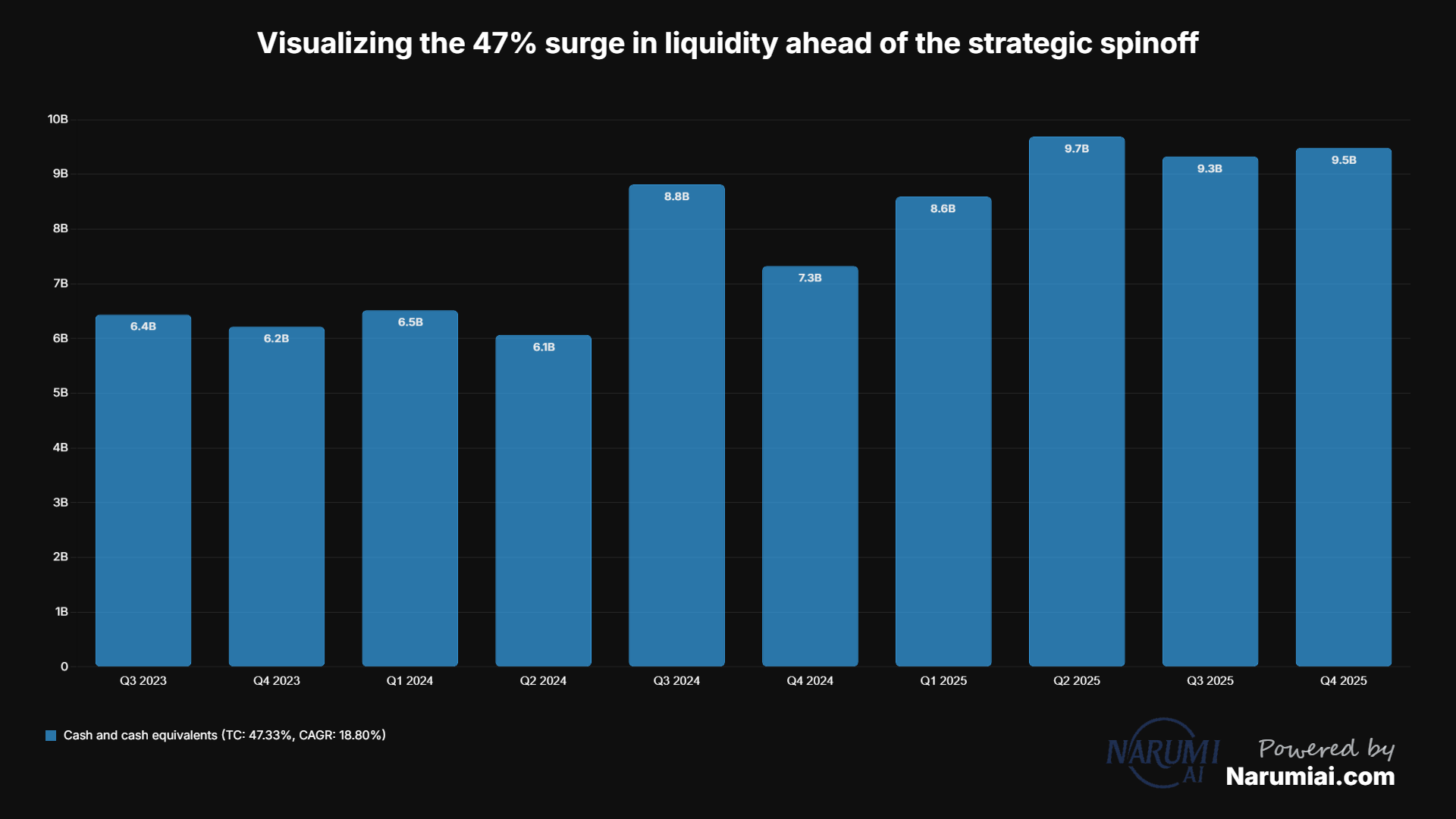
By stripping away the content-creation assets, 'New Comcast' emerges as a focused connectivity machine. The financial data reveals a company that has been quietly hoarding ammunition for this transition. Between Q3 2023 and Q4 2025, Comcast's cash and cash equivalents surged from $6.43 billion to $9.48 billion, a 47% increase that signals a readiness to pivot. The conflict here is clear: while the media side required multi-billion dollar content budgets just to keep Peacock relevant, the core broadband business was facing a silent bleed from fixed-wireless competitors like Verizon ($VZ) and fiber overbuilders like AT&T ($T).
The strategic rationale is simple: defend the home turf. Comcast is no longer distracted by the need to outbid Netflix for sports rights. Instead, every dollar of its $3.75 billion quarterly capital expenditure (as of Q4 2025) can now be funneled into DOCSIS 4.0 and Fiber-to-the-Home (FTTH) upgrades.
The Geometry of the New Debt
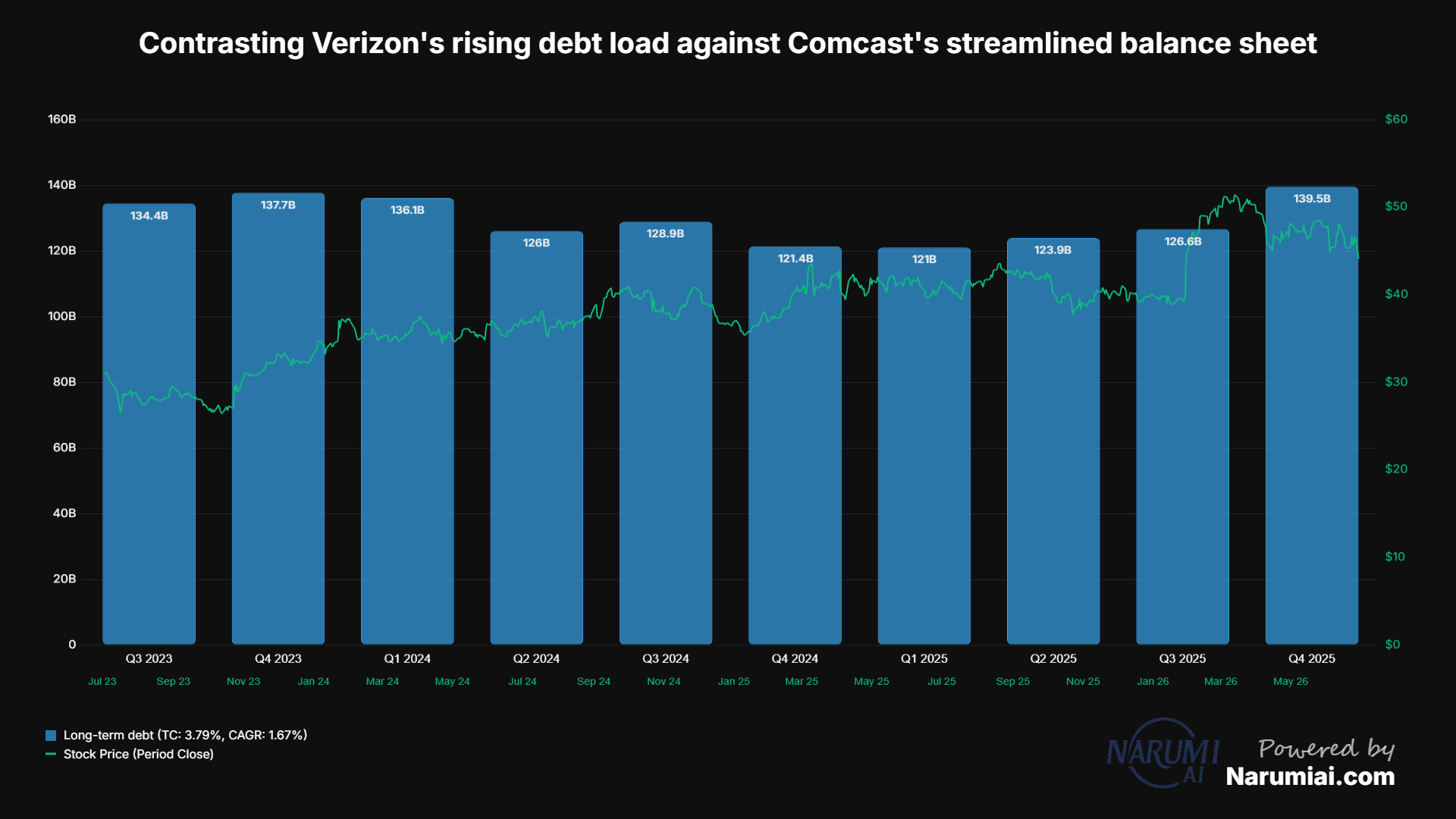
The spinoff forces a radical re-evaluation of Comcast’s balance sheet. As of the end of 2025, Comcast carried $92.98 billion in noncurrent debt. While this is a formidable figure, it is a lean profile compared to the debt-heavy legacy of its rivals. Verizon, for instance, saw its long-term debt balloon to $139.53 billion in Q4 2025. By shedding the capital-intensive Media SpinCo, New Comcast aims for a 'cleaner' valuation multiple, positioning itself as a pure-play infrastructure utility.
However, the transition is not without its risks. S&P Global Ratings has already signaled a skeptical eye, placing the 'RemainCo' on CreditWatch with negative implications. The loss of diversification means that if broadband growth stalls, there is no blockbuster movie or theme park surge to soften the blow. This puts immense pressure on management to maintain an impeccable Efficiency Ratio—the measure of how much it costs to generate a dollar of revenue.
The MVNO Trojan Horse
Perhaps the most provocative element of Comcast’s new strategy is its parasitic—and highly profitable—relationship with Verizon. Comcast’s Xfinity Mobile operates as an MVNO (Mobile Virtual Network Operator), meaning it sells wireless service using Verizon’s own towers. This is a capital-light masterstroke. While Verizon must shoulder the massive costs of maintaining macro cell towers and spectrum licenses, Comcast simply pays a wholesale fee and poaches Verizon’s retail customers.
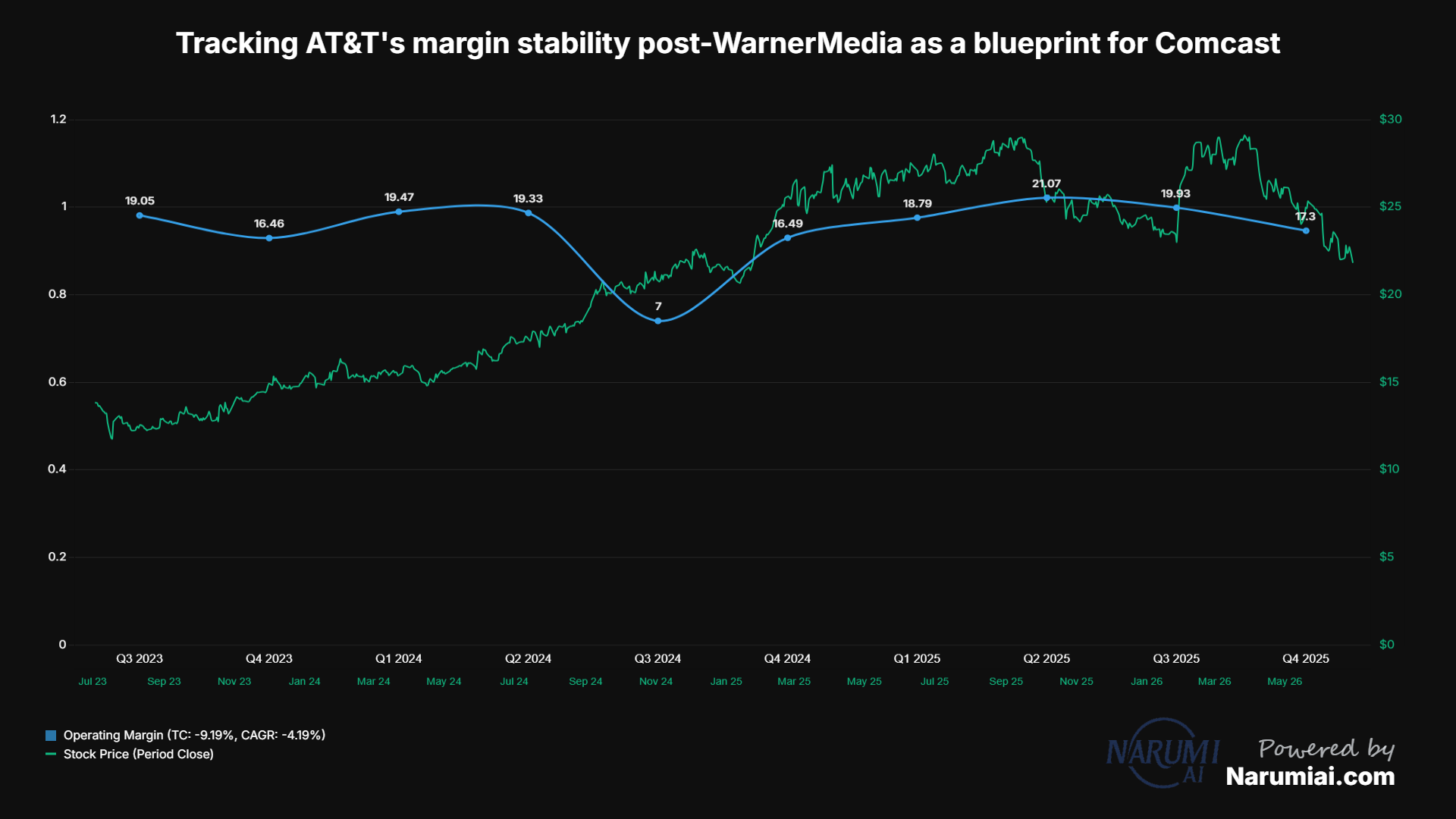
The data from the competitors tells a story of margin erosion that Comcast is desperate to avoid. Verizon’s operating margin, which stood at a healthy 22.42% in Q3 2023, has plummeted to a startling 13.75% by Q4 2025. This 'margin bleed' is the ghost that haunts the halls of pure-play telecom. Comcast’s gamble is that by focusing 100% on connectivity, it can use its wireless bundle to keep its broadband customers locked in, effectively weaponizing Verizon's infrastructure against Verizon itself.
The Post-Conglomerate Reality
Institutional investors are already recalibrating. The 'conglomerate discount' that has plagued Comcast for a decade is expected to evaporate, replaced by a premium multiple reserved for pure-play utilities. New Comcast is essentially a massive cash-cow with a 19.9% monetization stake in the spun-off media entity—a 'safety valve' it can use to pay down debt or fund aggressive share buybacks.
The battlefield is now symmetrical. AT&T learned the hard way with its disastrous WarnerMedia experiment, and now Comcast has followed suit. The giants are no longer fighting for the 'eyeballs' of the consumer; they are fighting for the 'pipes' that reach their doorstep. In this new world, the winner won't be the one with the best movies, but the one with the most efficient capital allocation and the cleanest balance sheet. For Comcast, the divorce from Hollywood was expensive, but in the war for the American home, it may have been the only way to survive.
Check out our Interactive Charting Tool.