Buffett’s $10 Billion AI Pivot: Berkshire Hathaway Joins the Silicon Gold Rush

The Oracle’s New Digital Railroad
For decades, Warren Buffett and the team at Berkshire Hathaway ($BRK) have been the ultimate 'brick and mortar' enthusiasts. They liked things you could touch: railroads, insurance policies, and bottles of cherry coke. But on June 2, 2026, the narrative shifted. In a move that signaled a massive evolution under CEO Greg Abel, Berkshire participated in Alphabet’s $80 billion equity raise with a cool $10 billion private placement. This isn't just a tech trade; it’s Berkshire buying the 'digital tracks' of the 21st century.
Alphabet is using that $80 billion to fund an aggressive AI computing infrastructure buildout. For Berkshire, this investment functions less like a speculative software bet and more like its favorite asset class: regulated utilities. By anchoring the buildout of global data centers, Berkshire is essentially investing in the plumbing of the AI age. It’s a productive deployment of their legendary cash hoard, which has hovered near $400 billion, waiting for a 'fat pitch' of this exact magnitude.
HPE and the 29% Victory Lap
While Berkshire is laying the tracks, Hewlett Packard Enterprise ($HPE) is building the locomotives. HPE shares surged a staggering 29% as the company pulled forward its financial targets by two full years. Why? Because the enterprise world has a desperate, unquenchable thirst for AI servers. HPE’s networking division, bolstered by the Juniper Networks integration, is solving the industry's biggest headache: data routing latency.
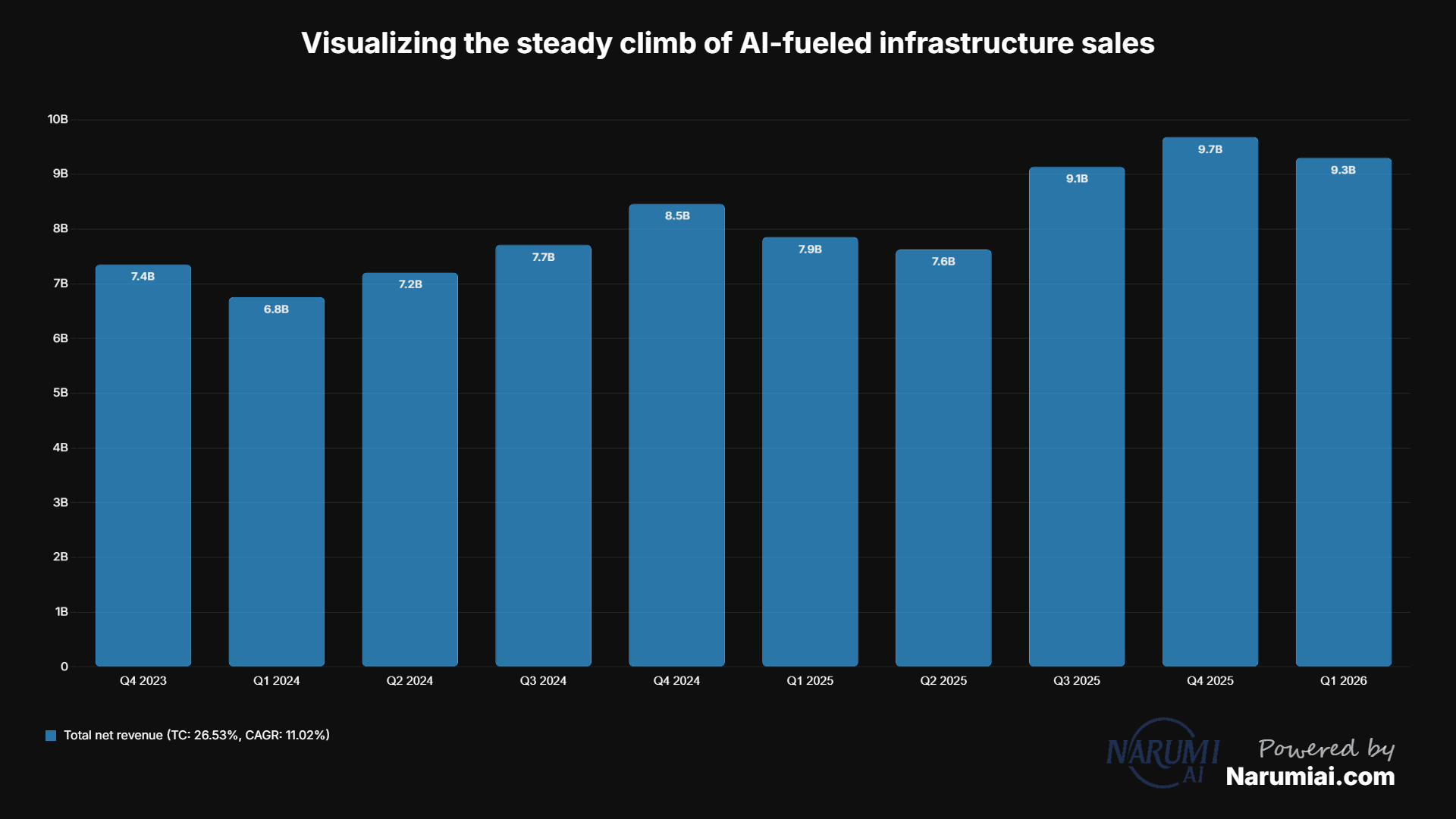
The numbers back up the hype. Looking at the direct relationship between product demand and top-line growth, HPE has seen a significant transformation. In Q4 2023, HPE reported total net revenue of $7.35 billion. By Q4 2025, that figure climbed to $9.68 billion—a 31% increase in just two years. More importantly, their 'Services' revenue, which often carries higher margins, jumped from $2.68 billion to $3.31 billion in the same period.
HPE’s secret weapon is liquid cooling. As AI chips get hotter (literally), traditional fans can’t keep up. HPE’s heritage in high-performance computing allows them to ship turnkey, liquid-cooled racks that rivals like Dell are still racing to optimize. This engineering moat is why HPE is currently the darling of the enterprise data center.
AMD’s 2-Nanometer Sledgehammer
If HPE is the locomotive, Advanced Micro Devices ($AMD) is the high-octane fuel. AMD has officially ramped up production of its 'Venice' EPYC processors. These aren't just any chips; they are the first high-performance computing products to utilize advanced 2nm technology. This move is designed to put a permanent gap between AMD and Intel’s server roadmap.
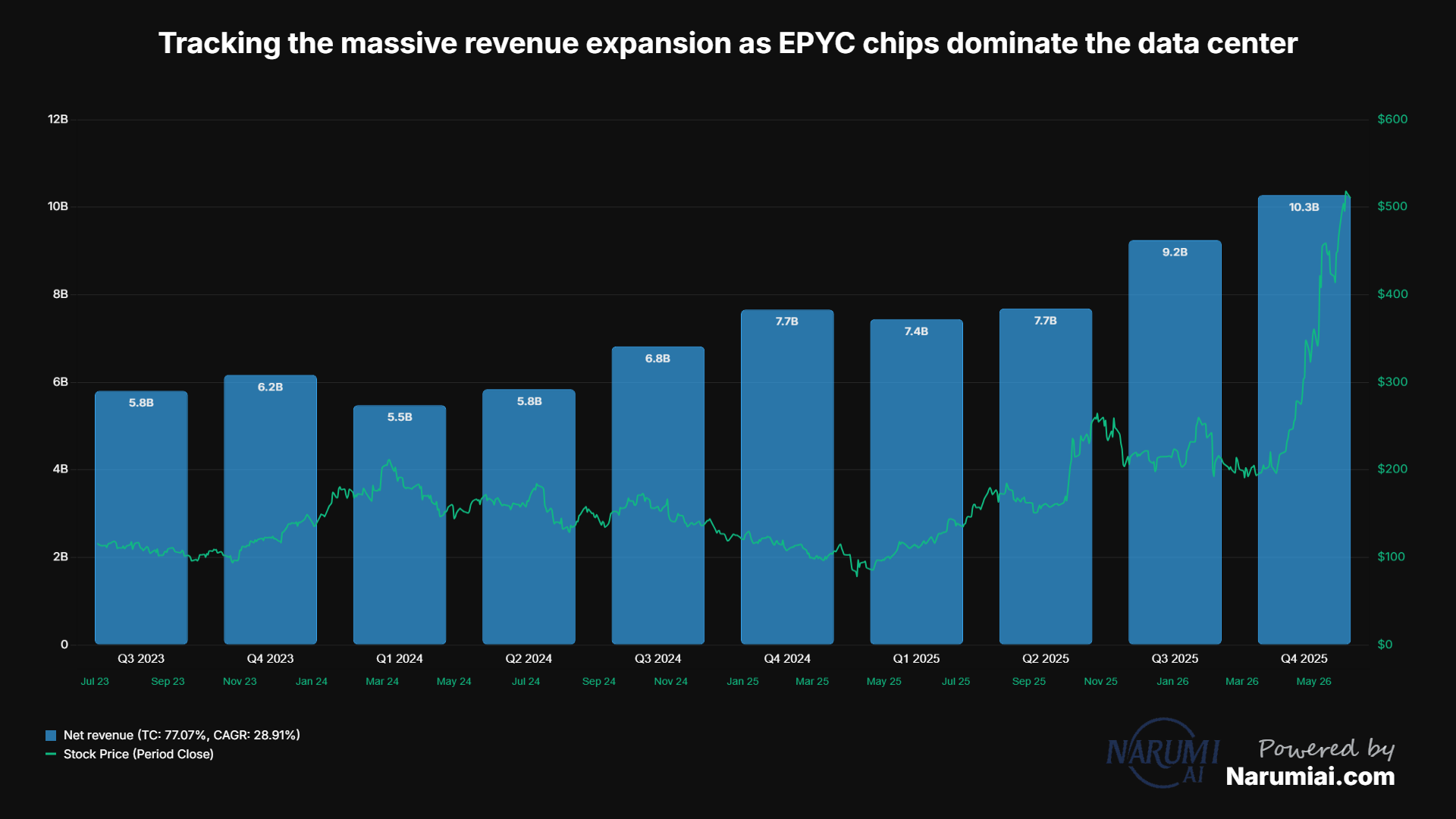
The growth at AMD is nothing short of explosive. In Q3 2023, AMD’s net revenue sat at $5.8 billion. Fast forward to Q4 2025, and they are raking in $10.27 billion. That is a 77% revenue expansion in roughly two years. This growth is driven by the 'control plane' of the AI data center—the CPUs that orchestrate the massive data flows between GPU clusters.
However, the 2nm transition isn't without risk. Moving to Gate-All-Around (GAA) transistors is a multi-billion dollar hurdle. A single 2nm wafer can cost north of $30,000. For AMD, the challenge is maintaining its Operating Margin—which we calculate at approximately 17% for Q4 2025 (Operating Income of $1.75B on $10.27B Revenue)—while absorbing these astronomical manufacturing costs.
The Portfolio Ripple Effect
The beauty of Berkshire’s $10 billion Alphabet bet lies in the synergies across its wholly-owned subsidiaries. As Alphabet builds out data centers, they need power—massive, continuous base-load power. Enter Berkshire Hathaway Energy (BHE). As a major utility provider, BHE stands to benefit from the surge in grid demand required to keep these AI clusters humming.
Even Geico, Berkshire's insurance jewel, wins here. Insurance is a data game. By aligning with the Alphabet/Google Cloud ecosystem, Geico can leverage advanced AI modeling to modernize its tech stack, potentially matching or exceeding the data-driven pricing advantages held by competitors like Progressive. This is the 'Buffett Moat' being reinforced with silicon and code.
The Verdict for Investors
The semiconductor industry is currently facing a 'structural constraint'—specifically in memory. Micron ($MU) is seeing an undersupplied market through 2027. This means the infrastructure boom has legs. Institutional investors are no longer just buying 'AI'; they are buying the bottlenecks. Whether it's the memory shortage at Micron, the 2nm dominance of AMD, or the networking integration at HPE, the play is now about execution and supply chain resilience.
For Berkshire Hathaway, the 'Fundamental Disconnect' is over. Critics who claimed Buffett was too old to understand the new economy are being silenced by a $10 billion check. Berkshire is no longer just a bet on the American consumer; it is a bet on the global compute engine.
Check out our Interactive Charting Tool.