Benioff’s New Religion: Can Autonomous Agents Save Salesforce?

The Ghost in the Machine: Marc Benioff’s $11 Billion Pivot
In the mahogany-rowed offices of San Francisco’s Salesforce Tower, the air is thick with a new kind of evangelism. Marc Benioff, the man who once convinced the world that software belonged in the cloud, has found a new god: the Autonomous Agent. As of May 2026, the company’s pivot toward 'Agentforce' and its multi-vendor control plane, Agent Fabric, isn't just a product update; it’s a desperate architectural shift to stay relevant in a world where the traditional 'seat' is becoming a relic of the past.
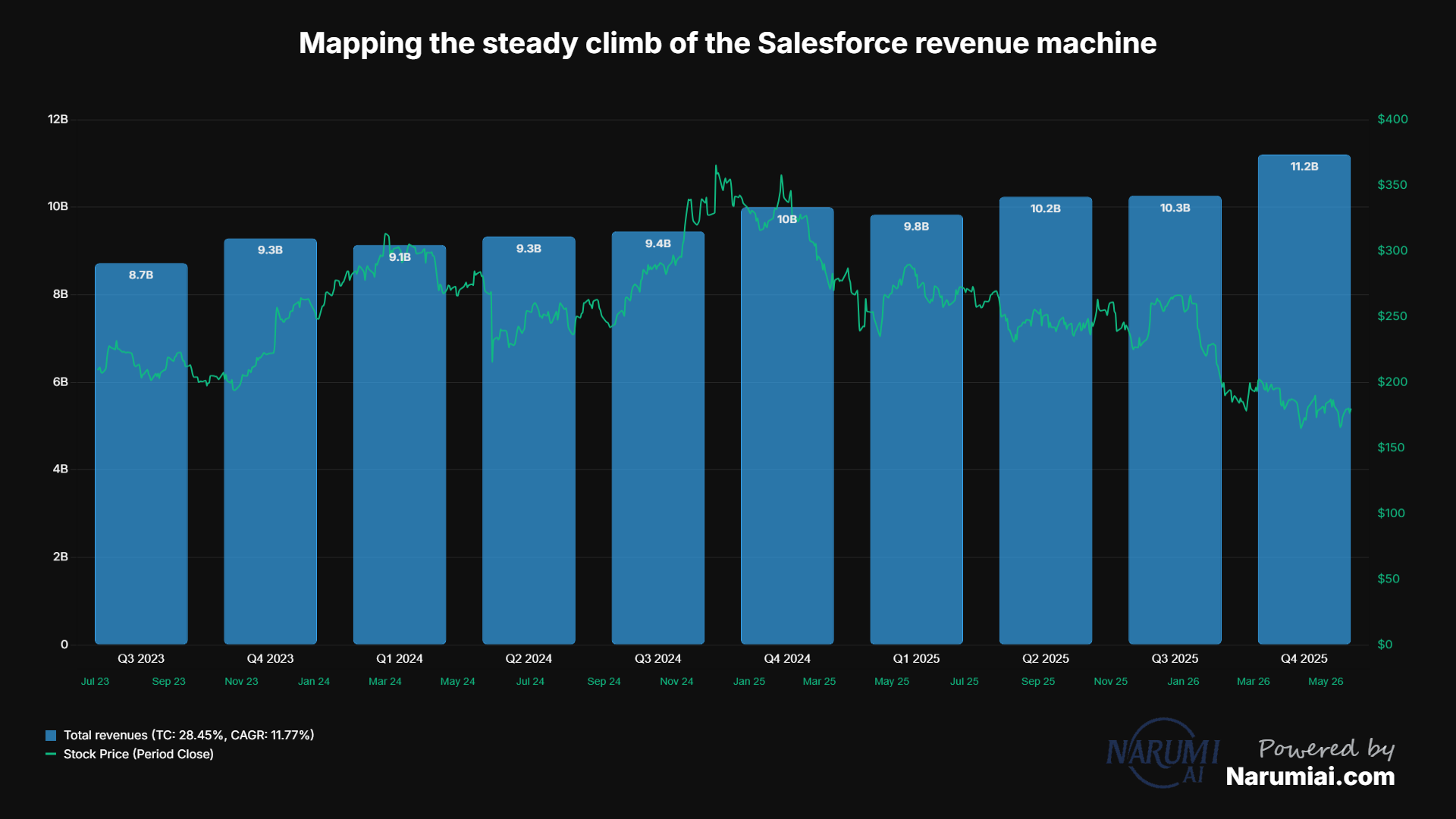
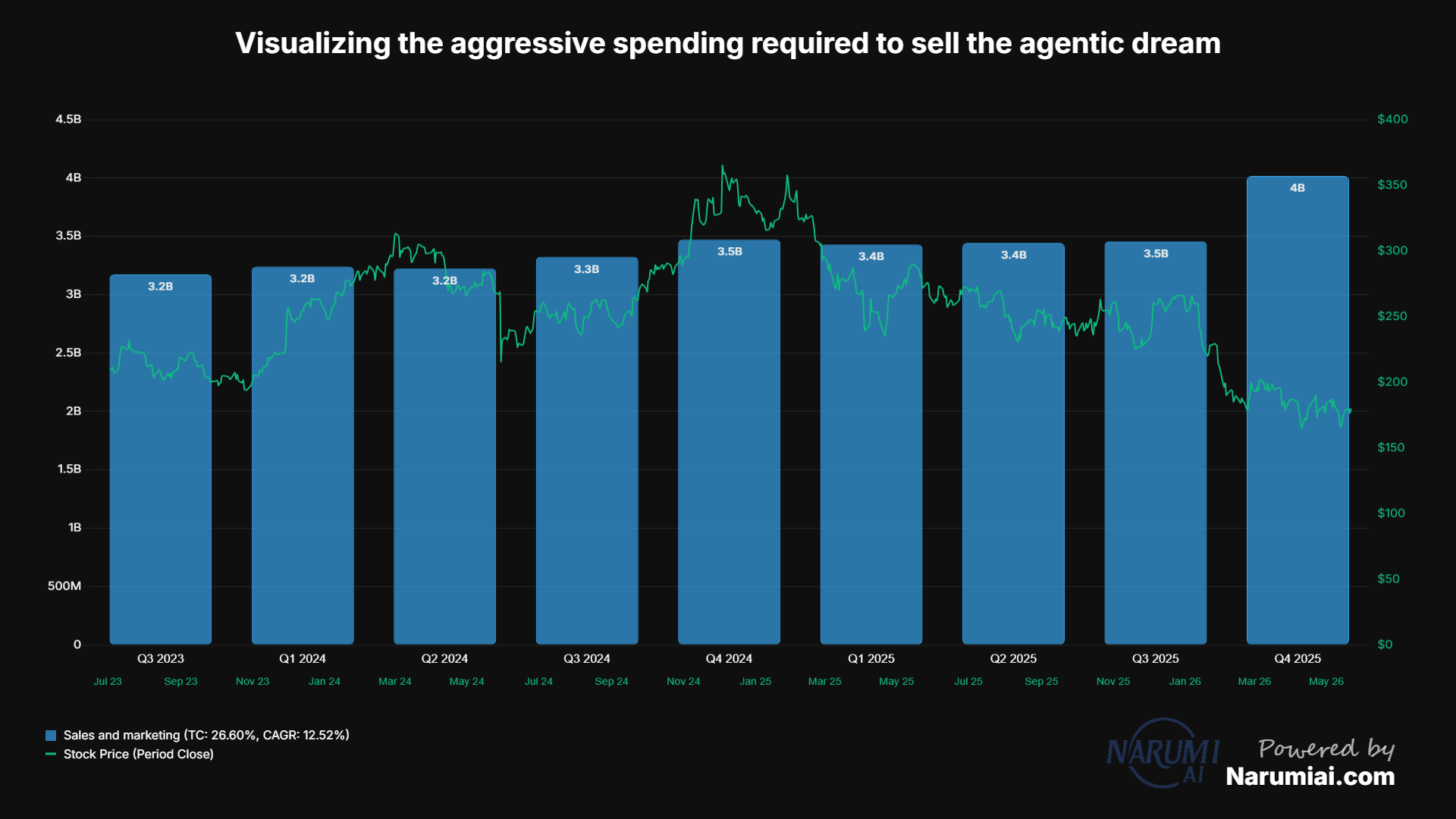
The headline numbers look spectacular at first glance. Salesforce reported a massive Q4 2025 revenue of $11.2 billion—a healthy 28.4% leap from the $8.7 billion recorded in Q3 2023. But for the investigative eye, the narrative lies in the cost of buying that growth. To sell the vision of a digital workforce, Salesforce has had to open the spigots on spending. Sales and Marketing (S&M) expenses ballooned from $3.17 billion in Q3 2023 to over $4.01 billion by the end of 2025. This is the 'AI Tax' in action: a relentless need to re-educate a skeptical enterprise market that is increasingly weary of AI hype.
The Invisible Bleed: A Manual Look at the Margins
While the top-line growth is undeniable, the efficiency of the Salesforce machine is showing signs of friction. A manual calculation of the operating margin—derived from dividing operating profit by total revenue—reveals a subtle but significant compression. In Q3 2023, the bankable operating margin stood at a respectable 17.21%. Fast forward to the latest Q4 2025 data, and despite the multi-billion dollar revenue surge, the margin has eroded to 16.68%.
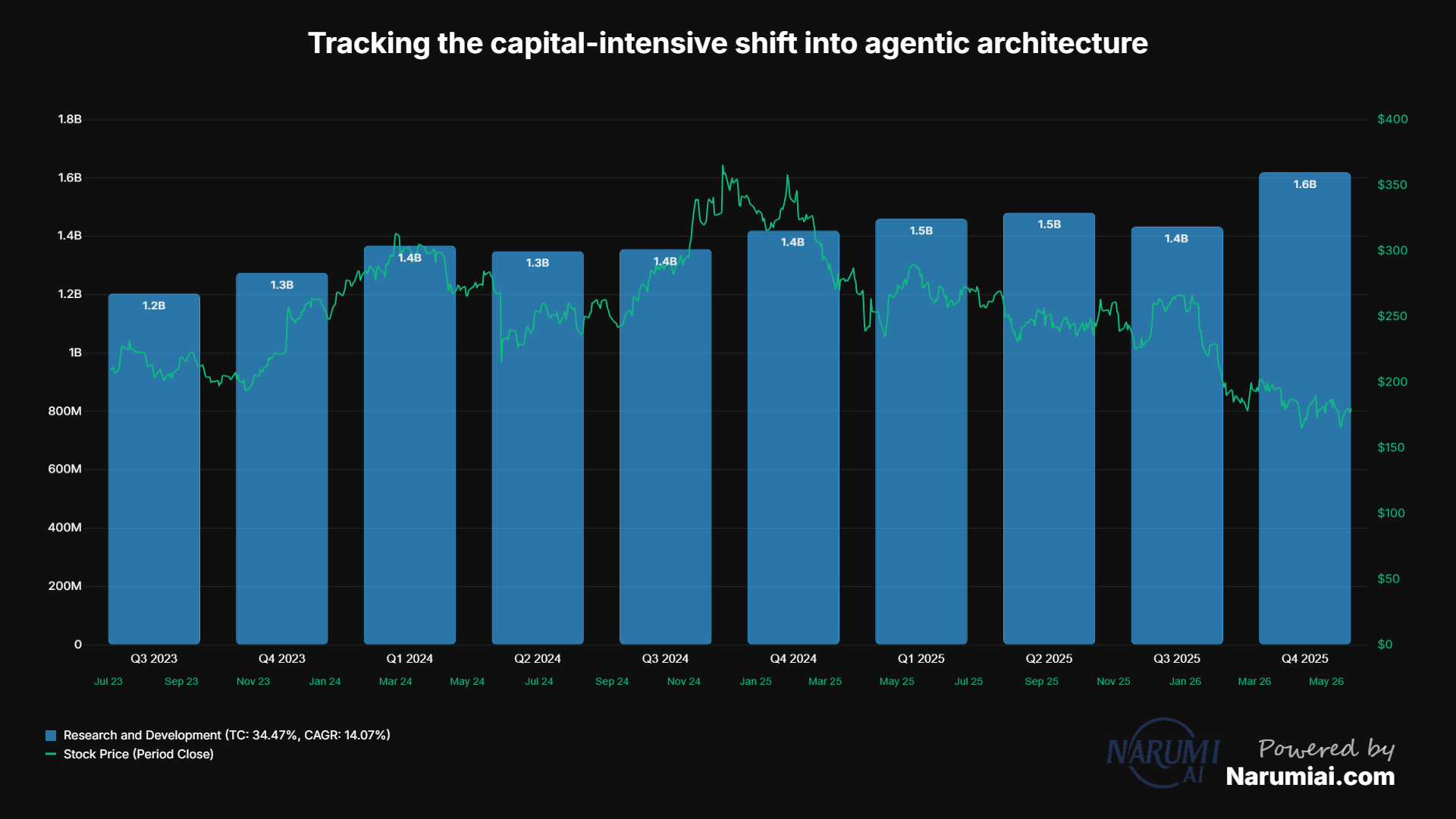
Indeed, Research and Development (R&D) spending has surged by over 34% in the same period, climbing to $1.61 billion. Benioff is building a 'System of Agency,' but the foundational costs of these LLM-driven architectures are eating the very efficiencies the technology promises to deliver.
The Consumption Trap and the Competitor Foil
The industry is shifting from 'seat-based' to 'consumption-oriented' models, a move that Salesforce is embracing with its $2-per-conversation pricing for Agentforce. However, this is a double-edged sword. While it allows for a lower entry point, it risks cannibalizing the stable, recurring revenue of the golden goose: the per-user license.
Contrast this with Workday (WDAY). While Salesforce is fighting for the front-office agent, Workday is entrenching itself in the back-office with 'Illuminate,' its own agentic framework. Workday’s strategy is a direct attack on Salesforce’s weakness; by leveraging its unmatched HR and financial dataset—processing over a trillion transactions annually—Workday is positioning itself as the 'System of Record' that doesn't just talk to customers, but actually reconciles the books. Workday has managed to expand its non-GAAP operating margins to north of 31%, leaving Salesforce’s mid-teens performance looking pedestrian in comparison.
Meanwhile, Adobe (ADBE) is moving the goalposts entirely. As AI discovery replaces traditional search, Adobe is pivoting toward 'Generative Engine Optimization' (GEO). They aren't just selling tools to create content; they are selling the infrastructure to ensure that content is discovered by other AI agents. If Salesforce is the 'nervous system' of the enterprise, Adobe is aiming to be its 'voice' in the agentic web.
Cannibalizing the Golden Goose
The existential risk for CRM is the 'Bypass Vector.' As autonomous agents become more capable, enterprises will inevitably scale down their human workforces. If an AI agent does the work of five customer service reps, those five seat licenses evaporate. Salesforce must hope that the consumption revenue from that one agent exceeds the lost revenue from those five humans. It is a mathematically delicate challenge that few CFOs have solved.
The Governance Moat in a Commodity World
If foundational AI models become a commodity—where anyone can build an agent using cheap open-source code—what is the 'moat' for a $270 billion giant like Salesforce? The answer lies in the 'Agentforce Trust Layer.' Enterprises are terrified of rogue agents leaking salary data or hallucinating legal contracts. Salesforce’s pivot is less about 'smarter' AI and more about 'safer' AI. By hardcoding audit trails and data masking into the Agent Fabric, they are betting that corporate legal departments will choose the expensive, safe incumbent over the cheap, unvetted startup.
However, the balance sheet suggests the market is starting to price in the risk. Cash and cash equivalents have dwindled to $7.3 billion in Q4 2025, down from nearly $9 billion a year prior. The company is using massive buybacks—$3.9 billion in the latest quarter alone—to prop up the share price as the fundamental disconnect between AI hype and margin reality grows. For now, the 'Agentic' story is keeping the bulls at bay, but the silent bleed in the margins suggests that even for Marc Benioff, the transition to the future will be anything but free.
Check out our Interactive Charting Tool.