ASML’s $45 Billion Gamble: The AI Arms Race Hits a $400 Million Wall
Veldhoven’s Golden Cage
In the quiet, meticulously sterilized corridors of Veldhoven, the machines that dictate the future of the global economy are being assembled. ASML ($ASML), the sole gatekeeper of Extreme Ultraviolet (EUV) lithography, just signaled to the world that the AI fever is far from breaking. Reporting a robust Q2 2026 with €9.3 billion in net sales and €2.9 billion in net income, the company didn't just meet expectations—it shattered its own ceiling. Management raised full-year 2026 revenue guidance to a staggering range of €43 billion to €45 billion, a massive leap from the previous €40 billion ceiling.
But beneath this veneer of explosive growth lies a sophisticated game of geopolitical chess and corporate brinkmanship. While NVIDIA ($NVDA) prints money at a rate that defies historical precedent, the machines required to build its next generation of chips are becoming so expensive that even the world’s largest foundry, TSMC, is beginning to flinch. The conflict is no longer about whether the world needs more chips; it’s about who will blink first in the face of a $400 million price tag per machine.
The Efficiency Trap: TSMC’s High-Stakes Thrift
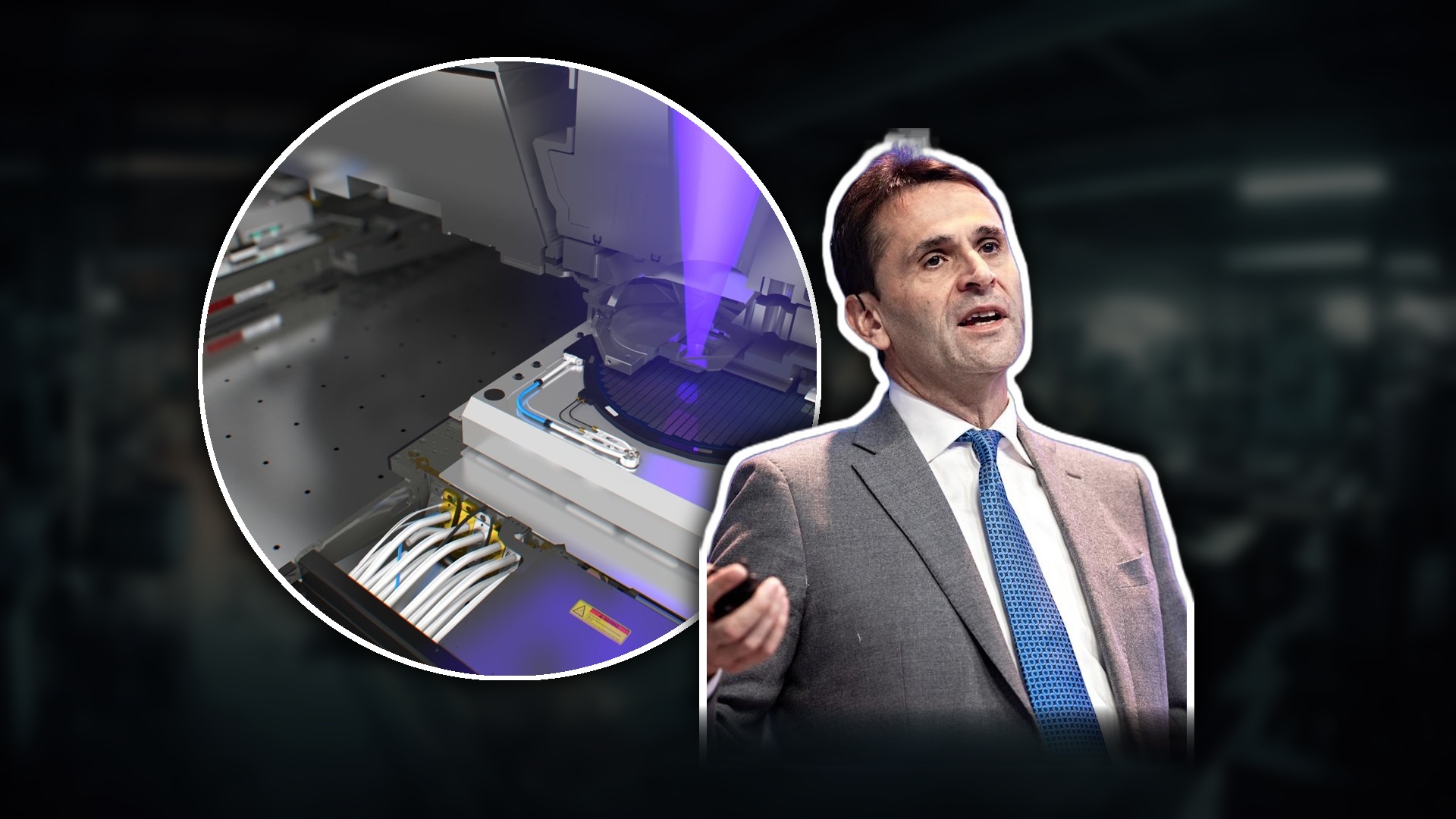
The primary tension in ASML’s narrative is the adoption of High-NA EUV (0.55 NA). While Intel has sprinted ahead to embrace these behemoths, TSMC has adopted a stance of pragmatic delay. For the upcoming 2nm (N2) and A16 nodes—the very silicon destined to power NVIDIA’s 2027 accelerators—TSMC is betting it can squeeze more life out of 'old' 0.33 NA systems. By using advanced multi-patterning techniques, TSMC is effectively trying to avoid the capital expenditure shock of the High-NA era.
This creates a fascinating divergence. ASML is guiding for gross margins of 54%-56% by 2026, a target that assumes they can successfully pass on the costs of these next-gen systems. If TSMC continues to hold out, ASML’s backlog could shift from a symbol of strength to a logistical bottleneck.
NVIDIA’s Insatiable Appetite vs. The Lithography Bottleneck
To understand why ASML is so confident, one only needs to look at the vertical ascent of its ultimate end-user: NVIDIA. The financial data from the GPU giant provides the 'why' behind ASML’s raised guidance. NVIDIA’s revenue has climbed from $18.1 billion in Q3 2023 to a jaw-dropping $68.1 billion in Q4 2025. This isn't just growth; it's a structural re-architecting of global compute.
NVIDIA’s net margin, which hit a staggering 63% in late 2025, represents the pool of capital that is eventually recycled back into ASML’s order book. However, ASML is the 'arms dealer' in a world where the borders are closing. The company is currently absorbing the impact of U.S. export restrictions to China, once its most voracious market for mid-tier DUV (Deep Ultraviolet) systems. The fact that ASML can raise guidance while being partially locked out of the Chinese ecosystem speaks to the sheer volume of the Western AI build-out, but it also highlights a 'silent bleed'—the loss of high-margin, low-complexity legacy sales that used to pad the bottom line.
The Fundamental Disconnect: Pricing the Future
ASML’s strategy to maintain its 54%-56% gross margin involves a ruthless focus on service revenue and software upgrades for its installed base. By making the existing 0.33 NA machines more productive, they can keep TSMC happy while waiting for the High-NA transition to become mandatory. It is a delicate balancing act: ASML must innovate fast enough to stay ahead of Chinese domestic competitors like SMEE, yet slow enough that its primary customers don't go bankrupt buying the equipment.
As we look toward 2027, the risk isn't a lack of demand, but a 'valuation indigestion.' If TSMC’s pragmatic delay works, ASML may find itself with a fleet of $400 million machines sitting in Veldhoven with no place to go. For now, the AI tailwind is strong enough to mask these structural cracks, but in the semiconductor world, today’s record guidance is often tomorrow’s overcapacity warning. ASML has the world over a barrel, but the barrel is getting increasingly expensive to build.
Check out our Interactive Charting Tool.