ASML’s $400 Million Gamble: Intel’s High NA Moonshot
The Oregon Monoliths
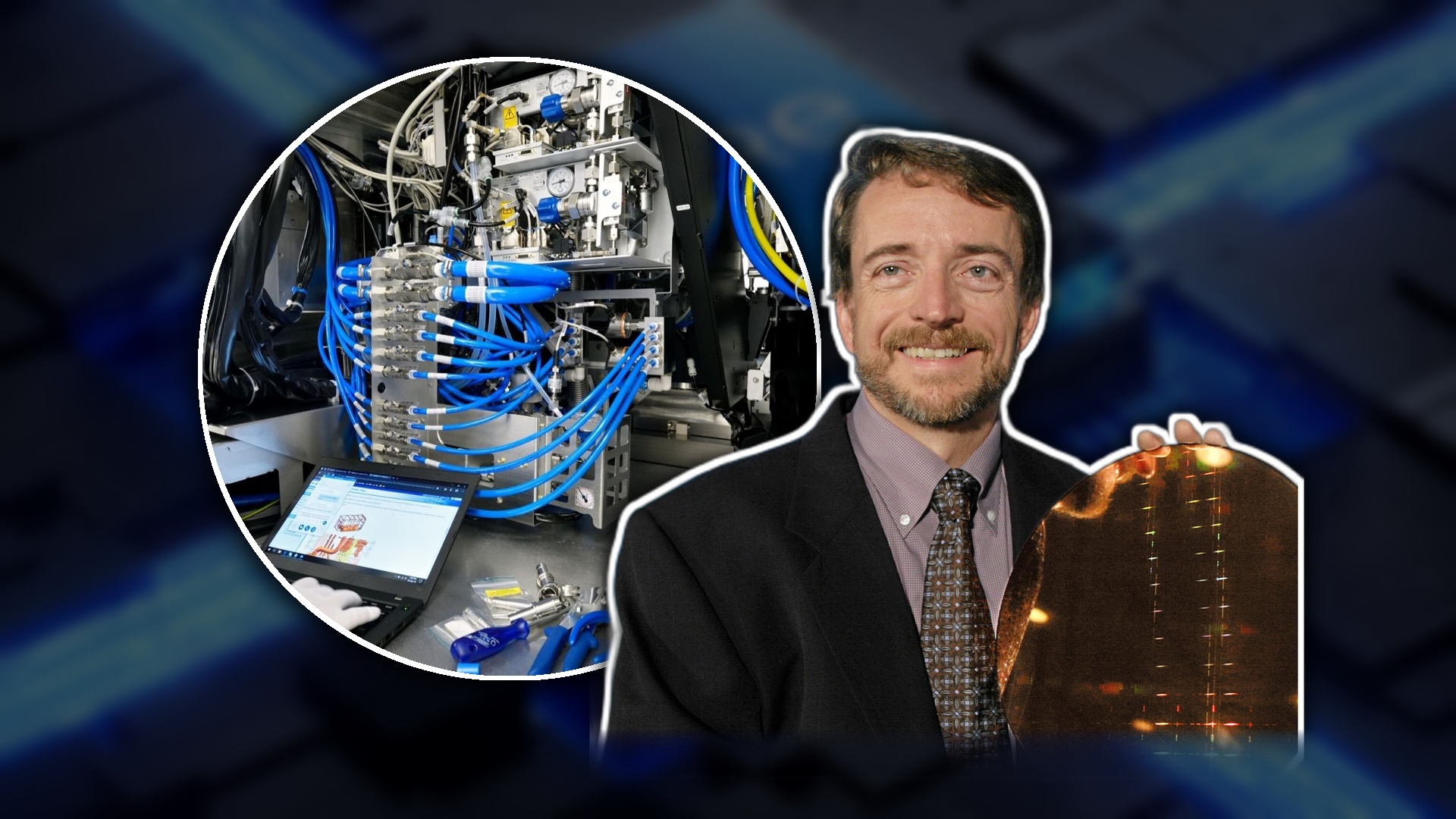
In the sterile, vibration-dampened halls of Intel’s D1X fab in Hillsboro, Oregon, a new kind of deity has arrived. It is the ASML Twinscan EXE:5000, a machine the size of a double-decker bus with a price tag—roughly $400 million—that would make even a sovereign wealth fund blink. As of July 15, 2026, the industry has reached its most critical inflection point: Intel Foundry has officially entered high-volume manufacturing (HVM) for its Panther Lake chips using this advanced High Numerical Aperture (High NA) EUV lithography. It is a cinematic moment for a company that has spent the last half-decade in the wilderness, but behind the flashing lights of the PR machine lies a brutal financial reality.
For ASML, the Dutch gatekeeper of the semiconductor world, this isn't just a sale; it’s a co-dependency. By tethering its near-term financial guidance to Intel’s ability to yield transistors at the 18A node, ASML has essentially bet its reputation on Pat Gelsinger’s turnaround. If Intel’s engineers can’t make the physics work, ASML’s €39 billion backlog becomes a list of expensive paperweights.
The Front-Loaded Financial Bleed
Intel’s decision to be the industry’s 'guinea pig' for High NA EUV is a high-stakes divergence from the cautious paths taken by TSMC and Samsung. This 'pioneer tax' is visible in the raw data. Looking at Intel’s performance, the strain of maintaining a 'foundry-within-a-company' model while simultaneously mastering cutting-edge lithography is evident. In Q4 2025, Intel reported an Operating Margin of approximately 4.24%, a staggering erosion from the 16.78% margin recorded in Q4 2023. This is the sound of a company spending its way toward a future that isn't yet guaranteed.
The cost of sales has remained stubbornly high, hitting $8.73 billion in the most recent quarter, while Research and Development (R&D) expenses continue to swallow a massive chunk of the top line. In Q4 2025, Intel’s R&D to Revenue ratio stood at 23.54%. While this is a slight reduction from the 25.88% peak in late 2023, it represents a relentless commitment to out-innovating the competition, even as net income slipped back into the red at -$333 million in the final quarter of 2025.
TSMC’s Multi-Patterning Trap
While Intel bleeds, TSMC is playing a different game. The Taiwanese giant has famously opted to delay High NA adoption, choosing instead to squeeze every drop of ROI from its existing fleet of standard 'Low NA' EUV machines. TSMC’s strategy relies on 'multi-patterning'—passing a wafer through a machine multiple times to achieve the same density that High NA does in one.
In the short term, TSMC looks like the genius. Their CapEx is optimized, and their margins remain the envy of the world. However, multi-patterning is an operational nightmare. It increases process steps, raises the risk of defects, and lengthens cycle times. Intel is betting that by the time TSMC is forced to adopt High NA in 2027 or 2028, Intel will have already mastered the learning curve, leaving TSMC to face a massive 'CapEx shock' just as Intel’s yields stabilize.
Revenue at the Mercy of the Yield
The risk for ASML investors is more subtle but no less dangerous. Under current accounting standards, ASML cannot recognize the $400 million revenue for a High NA tool until it passes on-site acceptance testing. If Intel hits a yield wall with Panther Lake, or if fab construction in Ireland or Oregon slows down, those machines sit in limbo. A delay in accepting just four machines could shave $1.6 billion off ASML’s recognized revenue in a single year, causing the kind of quarterly whiplash that sends institutional investors reaching for the 'sell' button.
Intel’s liquidity remains a bright spot, with cash and short-term investments surging to over $37 billion by the end of 2025. This provides the 'war chest' necessary to survive the depreciation of these massive machines. But the 'foundry-within-a-company' model is a double-edged sword. To justify the High NA investment, Intel doesn't just need to make its own chips; it needs to convince rivals to trust their designs to Intel’s fabs.
The Verdict: A Structural Advantage or a Value Trap?
The milestone of high-volume manufacturing for Panther Lake is a psychological victory, but the financial war is just beginning. Intel’s Return on Equity (ROE) remains deep in the negative at -0.23% for Q4 2025, compared to a brief flash of 1.60% in late 2023. The 'Fundamental Disconnect' here is palpable: Intel is valued as a turnaround play, but its balance sheet is that of a company in a high-intensity capital war.
If Intel successfully uses its High NA head-start to deliver superior transistor density and faster cycle times on the upcoming 14A node, they will have achieved a structural cost advantage that TSMC cannot easily replicate. But for now, the 'pioneer tax' is a heavy burden. ASML and Intel are locked in a high-speed chase; the only question is whether they reach the finish line before the capital runs out.
Check out our Interactive Charting Tool.