AMD’s $50 Billion GPU Breakout: The End of the Nvidia Monopoly?
The hum in Meta’s Menlo Park data centers isn't just the sound of cooling fans; it’s the sound of a monopoly cracking. For three years, the AI gold rush had a single gatekeeper: Nvidia. But as of June 2026, the architectural drawings of the world’s largest hyperscalers are being redrawn. The catalyst isn't just a product launch, but a structural re-rating of Advanced Micro Devices ($AMD) that suggests the market has fundamentally misunderstood where the power lies in the silicon wars.
The Six-Gigawatt Handshake
When Citi analyst Atif Malik upgraded AMD to a Buy with a $575 price target this week, he wasn't just chasing momentum. He was quantifying a tectonic shift in the Meta-AMD relationship. The deal is staggering: a four-year, six-gigawatt infrastructure partnership built around custom AMD Instinct MI450 chips. To put that in perspective, each gigawatt of capacity translates to roughly $15 billion in revenue for AMD. We are looking at a $90 billion framework that effectively transitions AMD from a 'secondary source' to a primary pillar of the global AI backbone.
This isn't merely about selling chips; it's about 'Nvidia fatigue.' Hyperscalers like Meta and Microsoft are desperate for a hedge against Nvidia’s pricing power. By co-developing custom MI450 variants, Meta isn't just buying off-the-shelf parts; they are building a bespoke fortress that lowers their Total Cost of Ownership (TCO) and bypasses the software friction that once made Nvidia’s CUDA ecosystem an impenetrable moat.
The Operating Margin Resurrection
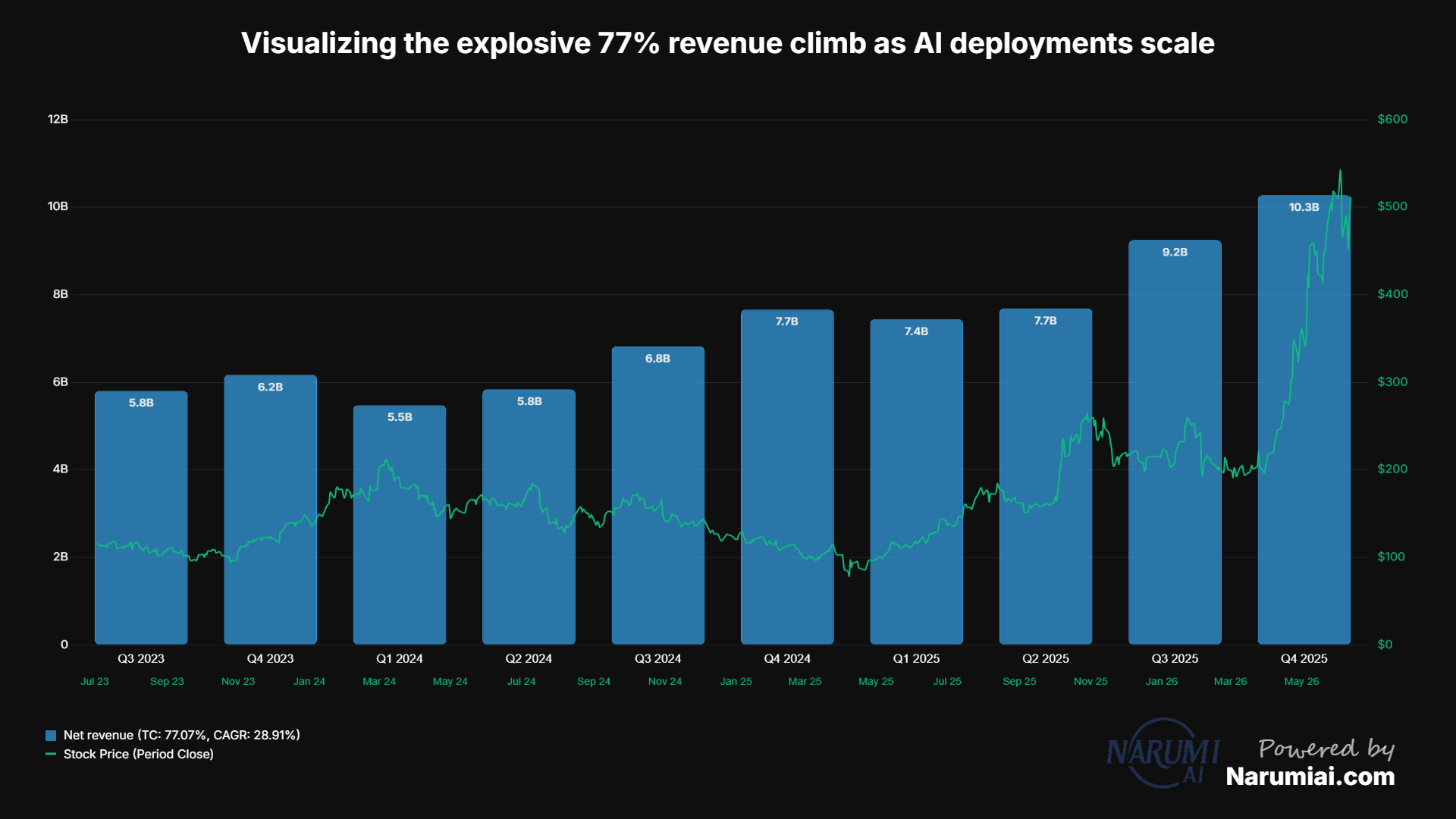
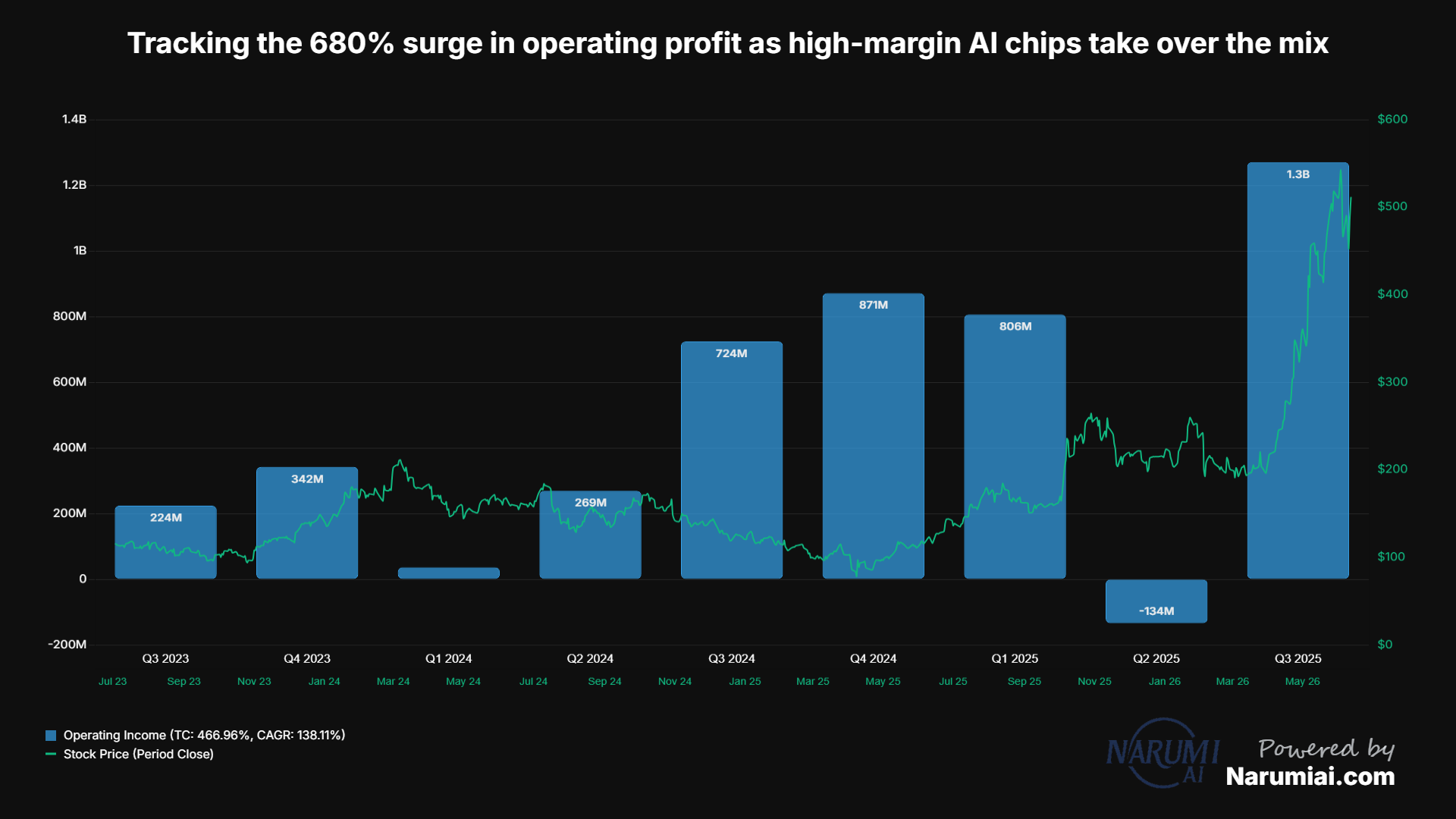
Under the hood, AMD’s financials are beginning to reflect this high-stakes pivot. In Q3 2023, AMD was scraping by with an operating income of $224 million on $5.8 billion in revenue—a meager 3.8% operating margin. Fast forward to Q4 2025, and the picture has transformed. The company reported a massive $1.752 billion in operating income on $10.27 billion in revenue. That is an operating margin of roughly 17%, a four-fold expansion that proves AMD is finally capturing the premium 'AI tax' previously reserved for its green-tinted rival.
While the GPU story dominates the headlines, the 'Agentic AI' pivot is the silent engine. Autonomous AI agents require a heavy mix of sequential logic and parallel math. This plays directly into AMD’s unique hand: the synergy between its EPYC server CPUs and Instinct GPUs. While Intel ($INTC) struggles to find its footing in the premium hyperscale cluster market, AMD has effectively boxed them out, capturing a record 46% share of the x86 server CPU market in early 2026.
The Infrastructure Land Grab: HPE and Modine
The AI trade is no longer just about the silicon; it is about the physical constraints of reality. Hewlett Packard Enterprise ($HPE) recently reported a 40% revenue jump, driven by a $6.3 billion backlog of AI-integrated server and networking infrastructure. HPE isn't just selling boxes; with its Juniper Networks integration, it is selling complete 'AI factories.' This end-to-end networking moat is a direct attack on Dell’s volume-heavy strategy, positioning HPE as the sophisticated choice for sovereign AI clouds.
But chips and servers are useless if they melt. That is where Modine Manufacturing ($MOD) enters the drama. Modine recently secured a $4 billion long-term capacity deal with a major hyperscaler. The terms are unheard of: the customer paid $165 million upfront just to reserve factory space. This 'pre-funded capacity' model mimics the desperate semiconductor allocations of 2021. Cooling has officially joined land and power as a primary strategic bottleneck.
The Valuation Disconnect
Despite the run-up, a skeptical eye on the P/E ratio reveals a surprising normalization. In Q3 2023, AMD traded at a dizzying 1285x earnings as investors priced in a future that hadn't arrived. By Q3 2025, that ratio had compressed to 79.7x. While still premium, it suggests that the earnings growth is finally catching up to the hype. Citi’s 'sum-of-the-parts' model values the GPU business alone at $281 per share—more than the entire stock was worth just months ago.
The risk remains customer concentration. If Meta pivots to its own in-house ASICs, the $50 billion GPU dream could evaporate. However, with the first gigawatt of the Meta deal only beginning to ramp in the second half of 2026, the momentum is firmly with Lisa Su. AMD has successfully executed the most difficult maneuver in tech: turning a monopoly into a duopoly.
The Narumi Verdict
The AI infrastructure trade has matured. We are moving from the 'speculative pilot' phase to the 'massive deployment' phase. AMD is no longer the 'budget alternative' to Nvidia; it is a strategic necessity for the world’s largest tech companies. As long as hyperscalers are willing to pay upfront for cooling and networking, the silicon providers with the best TCO will win. AMD’s $575 target isn't a ceiling; it’s a reflection of a new world order where Nvidia finally has to look over its shoulder.
Check out our Interactive Charting Tool.